173 results for: Manufacturing
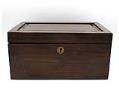
Box made from wood from Yesler's Mill, ca. 1909
Henry Yesler built the first steam-powered sawmill in Seattle in 1852. It was instrumental in developing this small white settler town into a thriving city. The mill burned down in the Great Seattle Fire of 1889, but wood from the mill was found during the excavation of the public comfort station at Pioneer Place in 1909. This box was made…
ID Number:1963.3093.1
Date:Circa 1909
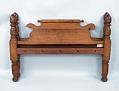
Bedstead made by Henry Van Asselt, 1857
Henry Van Asselt settled in the Seattle area in 1851, intending to make his living through agriculture. When his first homestead was burned in the Battle of Seattle of 1856, he left the area for the Willamette Valley of Oregon, where he polished his cabinet-making skills. He opened up a cabinet shop upon his return to Seattle, and his furniture…
ID Number:1964.3230.1
Date:1857
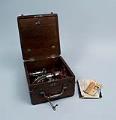
Roberson Thompson indicator, 1899
The Roberson Thompson indicator was designed and built by John Roberson of south Seattle. It was used to measure steam consumption of steam engines.
ID Number:1964.3433.1
Date:Circa 1899

Yellow hat designed by John Eaton, 1960s
This hat has a dramatic flourish of yellow tulle. Cornish School of Arts graduate John Eaton (1914-1991) was a successful milliner, designer, and teacher whose individually-styled hats became known all over the country. Eaton and partner James Neher opened their first store in 1950, and eventually opened “John Eaton Of Course!” at 509 Pine Street, across the street from Frederick…
ID Number:1965.3785.M423
Date:1960-1969
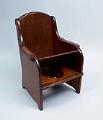
Child's potty chair and duty seat made by Julius Christenson, ca. 1893
Julius Christison made this chair for his son, Frank, in 1893. Christison was an early Seattle white settler and woodworker.
ID Number:1966.3878.48
Date:Circa 1893
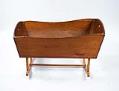
Wooden baby cradle made by Julius Christison, 1893
Julius Christison came from Denmark to Seattle in 1887. He worked as a cabinetmaker in one of Seattle's earliest furniture factories, the Hall & Paulson Furniture Company (established 1874). He was later employed as a carpenter by the Pacific Manufacturing Company. By 1899 he had adapted to modern mechanization sufficiently to work as a a "machine hand" at Rolfs and…
ID Number:1966.3878.49
Date:1893
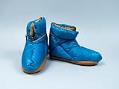
Goose down lounging booties, 1967
Eddie Bauer advertised its Mt. Everest insulated slippers as "ideal for keeping feet warm in tent or cabin." Eddie Bauer supplied all of the down equipment for the 1963 American Mount Everest expeditions and used the name in its product line.
ID Number:1967.4134.1
Date:1967
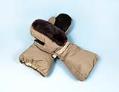
Eddie Bauer brand insulated mittens, ca. 1963
Seattle outdoorsman and entrepreneur Eddie Bauer helped bring high-quality outdoor gear to a greater population. His efforts dismissed the notion that adventure-type recreation was only for backwoods eccentrics or world-class athletes. Eddie Bauer based the design of this type of mitten on ones custom made for Jim Whittaker’s Mt. Everest expedition in 1963. In that historic expedition, the local climber…
ID Number:1967.4134.2
Date:Circa 1963
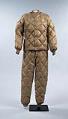
Eddie Bauer goose-down insulated jacket and pants, 1940s-1960s
Seattle outdoorsman and entrepreneur Eddie Bauer helped bring high-quality outdoor gear to a greater population. His company was established in 1920, and in 1940 Bauer patented the first quilted down jacket. His efforts dismissed the notion that adventure-type recreation was only for backwoods eccentrics or world-class athletes.
ID Number:1967.4134.3
Date:Circa 1940-1960
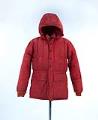
Man's goose down parka from Eddie Bauer, 1953
In 1953, a group of mountain climbers ascended Mt Godwin Austen (aka K2), the highest peak in Asia's Karakoram Range. The group spent over a month at 20,000 feet at temps as low as negative 70. All wore red windproof and water repellant parkas designed by Eddie Bauer for the ascent. The so-called "K2 Parka" later became a bestseller for…
ID Number:1967.4134.7C1289
Date:1953