22 results for: Indigenous People
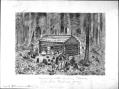
Watercolor drawing, "Bargaining with Indian Traders (at Alki Point in 1851)," by Emily Inez Denny, ca. 1870-1915
The daughter of one of Seattle’s founding families, Emily Inez Denny (1853 – 1918) was both a painter and writer. Greatly influenced by seeing the drawings of Sarah Willoughby as a student at the Washington Territorial University, she took on painting as a life-long pursuit. This scene was created by the artist based on stories told to her by her…
ID Number:1984.74.1
Date:Circa 1870-1915
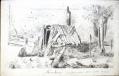
Pencil drawing, "Forsaken (Camp on West Shore of Lake Union)," by Emily Inez Denny, 1876
The daughter of one of Seattle’s founding families, Emily Inez Denny (1853 – 1918) was both an artist and writer. Greatly influenced by seeing the drawings of Sarah Willoughby as a student at the Washington Territorial University, she took on painting and drawing as a life-long pursuit. A woman who thrived on the creation of art, Emily constantly traveled with…
ID Number:1984.74.3
Date:1876
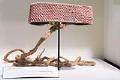
Tumpline, Salish, from the Clara Young collection, ca. 1890
When local Native people had to carry heavy loads like a canoe or bundle of wood, they’d use a tumpline strap to redistribute the weight. The strings tie around the load, and the band goes across the forehead or chest. This tumpline was collected by Clara Young (1890-1983). Young was a schoolteacher in the early part of the 20th century…
ID Number:1985.40.46
Date:Circa 1890
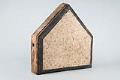
Home plate from Sick's Stadium in Seattle, ca. 1960s-1970s
Businessman Emil Sick bought the Seattle Indians baseball team in 1937. The appropriation of Indigenous names for professional sports teams has been popular since the 19th century and is one common example of discrimination and marginalization faced by Native peoples in the United States. Sick renamed the team the Seattle Rainiers and started work on a new steel and concrete…
ID Number:2001.22.32
Date:Circa 1960-1970
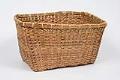
Duwamish carrying basket, attributed to Kikisoblu (Princess Angeline), ca. 1885
This basket was possibly made by Kikisoblu (Princess Angeline) to deliver clams and other materials to Seattle customers. Kikisoblu (ca. 1820-1896) was the daughter of Chief Si'ahl (Chief Seattle). The 1855 Treaty of Point Elliott required all Duwamish people leave Seattle to live on reservations, but Kikisoblu remained in a cabin on the waterfront. She earned a living doing laundry…
ID Number:2003.62.1
Date:1884-1896
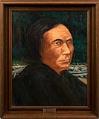
Portrait of Chief Leschi painted 1950-1960, artist unknown
Leschi was born to Nisqually and Yakama parents and grew up among the Nisqually people. When he was 25 years old, the Hudson Bay Company (HBC) built a fort at the mouth of the Nisqually River, and soon the HBC was farming throughout the plain. Leschi was working for the HBC in 1848 when Oregon Territory was created. Two years…
ID Number:2005.16.1
Date:1950-1960
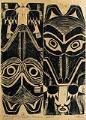
Woodcut, "Tlingit Inside House Post" by Helmi Juvonen, ca. 1930-1950
It is thought that this print features two lodge poles that were on display at the Burke Museum of Natural History & Culture in Seattle for many years. The poles depict the story of Kaats' and they were stolen from the Gaash Village in Cape Fox, Alaska, as part of the Harriman Alaska Expedition in 1899. In 2001, these two…
ID Number:2006.38.324
Date:1930-1950
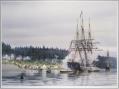
Print, "The Battle of Seattle, January 26, 1856" and featuring the USS Decatur, by Mark Myers, 1987
This colored print features the USS Decatur which was an armed vessel anchored in Elliott Bay during the "Battle of Seattle" that took place on January 26, 1856. On this day, the native peoples in the area attacked the newly arrived white settlers who took refuge in the blockhouse or on the Decatur which proceeded to fire shells toward land.…
ID Number:2006.60.1
Date:1987
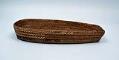
Salish cradle basket made from cedar root and cedar slats, probably Interior Salish, ca. 1900-1930
The Salish people have been living in the Pacific Northwest since before European contact.
ID Number:2009.1.198
Date:Circa 1900-1930
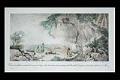
Color print of illustration of Spanish explorers meeting with Salish people in the Strait of Juan de Fuca (now the Strait of Georgia), ca. 1792
This illustration is derived from a visit of Spanish explorers Alacala Galiano and Dionysio Valdes to what are now the Canadian Gulf Islands in the summer of 1792. The caption on the print states, "Vista de una Galeria natural de cien pies de largo y die de ancho, en la immediacion del Puerto del Descanso, en el Estrecho de Juan…
ID Number:2011.115.1
Date:Circa 1792