22 results for: Indigenous People
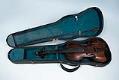
Violin, case, and bow made in Germany, ca. 1800-1830
This violin was played by Jake Harding, who came to Seattle in the 1850s. He played at early Seattle dances that included a mix of European settlers and native people.
ID Number:1950.30.1
Date:Circa 1800-1830
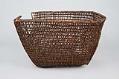
Puget Sound clam basket
The Coast Salish people of the Pacific Northwest designed baskets like this for gathering clams. When a clam is put into the basket, the basket structure holds the clam, but the open structure allows water and sand to fall out. This particular basket has been damaged over time and is not fully intact.
ID Number:1952.237.M.1
Date:19th Century
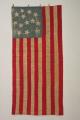
Battle of Seattle "Petticoat Flag," 1856
On the morning of January 26, 1856, the "Battle of Seattle" began when Native Americans raided the white settlement in what is now known as Seattle. Previously warned of the attack, most settlers had barricaded themselves in a blockhouse. Settlers say the women who sought shelter in the blockhouse used strips from their petticoats to sew this flag during the…
ID Number:1955.921.1
Date:1856
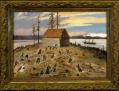
Oil painting, "Battle of Seattle, Jan. 26, 1856," by Emily Inez Denny, ca. 1890
On the morning of January 26, 1856, the "Battle of Seattle" began when Native Americans raided the white settlement in what is now known as Seattle. Previously warned of the attack, most settlers had barricaded themselves in a blockhouse. The attackers were driven off by artillery fire. The battle was the penultimate event in a series of armed conflicts, known…
ID Number:1955.921.2
Date:Circa 1890
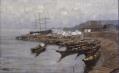
Oil painting of canoes at Ballast Island by John Fery, 1925-1935
Artist John Fery (1859-1934) was born in Austria and immigrated to the United States where he eventually settle in Seattle. During his career, Fery painted many scenes under contract for the Great Northern Railway. He based this waterfront scene on a historical photograph. Ballast Island, as the name implies, was where ships coming into the bay would dump their ballast.…
ID Number:1957.1282.7
Date:1925-1935
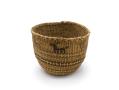
Coast Salish twined basket, ca. 1900-1940
This basket with its dog or wolf design is thought to be made by the Twana people who lived in the region around Hood Canal in the south Puget Sound.
ID Number:1964.3334.13
Date:Circa 1900-1940
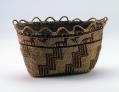
Skokomish twined basket, ca. 1900
The Skokomish Tribe was originally primarily composed of Twana Indians, a Salishan people from the Hood Canal drainage basin in western Washington State. The Twana subsisted on hunting, fishing and gathering activities, moving around in warmer weather and settling on more permanent sites during colder climes. Twana descendants live on the Skokomish Reservation, and all have become known as the…
ID Number:1965.3775.8
Date:Circa 1900

Igorot spear from the Alaska-Yukon-Pacific Exposition (AYPE) replica village, 1909
The Igorot (meaning "people of the mountains") are indigenous, Austronesian-speaking ethnic groups that live in the Cordillera Mountains of Northern Luzon, Philippines. A group of Igorot people lived in a village on the Pay Streak at the Alaska-Yukon-Pacific Exposition (AYPE), held in Seattle in 1909. During the 1899 Philippine-American War, the Igorot were allied first with the independence fighters and…
ID Number:1974.5919.118
Date:1909
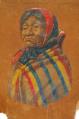
Hide painting of Kikisoblu (Princess Angeline) by Carrie Monroe (C.M.) Gilbert, ca. 1900-1915
Kikisoblu (Princess Angeline), also known in Lushootseed as Kikisoblu, Kick-is-om-lo, or Wewick, was the eldest daughter of Chief Si'ahl (Chief Seattle). She was born around 1820 and lived until she was in her mid-seventies. This portrait is reproduced from a photograph. The artist, Carrie Monroe Gilbert (1871-1956), lived in Oregon and was known for her portraits of Indigenous people of…
ID Number:1980.6980.1
Date:Circa 1900-1915
Igorot spear from the Alaska-Yukon-Pacific Exposition (AYPE) replica village, 1909
The Igorot (meaning "people of the mountains") are indigenous, Austronesian-speaking ethnic groups that live in the Cordillera Mountains of Northern Luzon, Philippines. A group of Igorot people lived in a village on the Pay Streak at the Alaska-Yukon-Pacific Exposition (AYPE), held in Seattle in 1909. During the 1899 Philippine-American War, the Igorot were allied first with the independence fighters and…
ID Number:1983.47.1
Date:1909