After the Soweto Uprising in South Africa in 1976, Seattle’s activists came together to oppose the oppressive conditions of apartheid. Their efforts expanded throughout the 1980s, with regular demonstrations outside the South African Consul’s residence and calls for government and businesses to divest from companies profiting from apartheid in South Africa. This pressure benefited from the work of longstanding activists in Seattle’s Black community and support from concerned citizens who showed up for the protests.
/ August 6, 2025
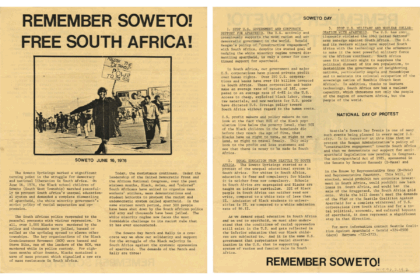
Remember Soweto! Free South Africa! flier, 1988
MOHAI, Maris Kundzins Video and Ephemera Collection, 2019.96.2.19.2
The Seattle Coalition Against Apartheid (SCAA) was active for much of the 1980s. Led by activists like Maryamu Eltayeb Givens, Gerald Lenoir, Selma Waldmen, and Cecilia Beckwith, the SCAA organized demonstrations and forums, petitioned local government leaders, and hosting dignitaries and representatives from the African National Congress. This flier was created by SCAA to promote a national day of protest on June 16, 1988—the 12th anniversary of the killing of hundreds of peaceful Black South African school children by police.
The flier outlines three demands of the protest: an end to US government and corporate support for South Africa, equal educational opportunities for all both in South Africa and in the US, and for the US to stop supplying military equipment to the South African state.
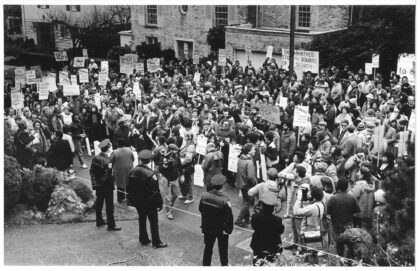
Anti-apartheid demonstrators protesting at South African consulate, Seattle, January 23, 1985
MOHAI, Seattle Post-Intelligencer Collection, 2000.107.047.33.02, photo by Grant Haller
In October 1984, SCAA and other demonstrators began protesting outside the home of the honorary South African Council James Swing’s residence in Madison Park. These regularly scheduled protests were designed to create a “wall of noise,” and were held every Sunday for several years. These demonstrations drew international attention, with noted leaders including Archbishop Desmond Tutu and Jesse Jackson joining the effort. In this photo from a protest in January of 1985, the crowd of demonstrators are shown before several police officers. Despite the peaceful protest, 58 of approximately 1000 protestors were arrested for criminal trespass.
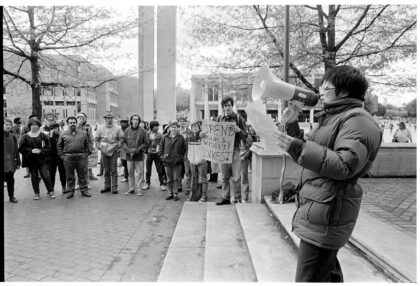
Student anti-apartheid protest in Red Square, Seattle, April 25, 1986
MOHAI, Seattle Post-Intelligencer Collection, 2000.107.19860425.1.3
Other activists would lead efforts against local governments and institutions, calling for them to cut ties with South African businesses. In 1989 Eddie Rye Jr., who also worked with Lynne Wilson to force the Seattle Pension Board to divest from businesses working in South Africa, publicized that Metro had purchased South African granite for the new bus tunnel downtown – forcing the resignation of Metro’s director and the decision not to use the granite in the tunnel.
At the University of Washington and Seattle University, Students Against Apartheid protested and demanded that their schools’ leaders divest from companies doing business in South Africa. In this photo, around 50 students demonstrate in Red Square, chanting and holding signs in favor of divestment, while the University of Washington Board of Regens met nearby.
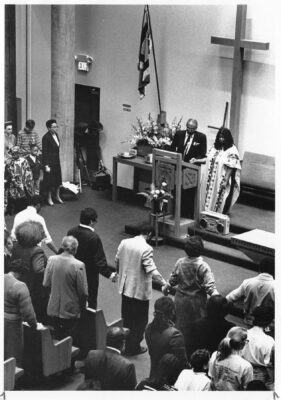
Pastor Samuel McKinney and Maryamu Eltayeb leading prayer at Mount Zion Baptist Church, Seattle, February 11, 1990
MOHAI, Seattle Post-Intelligencer Collection, 2000.107.169.17.02, photo by John Herndon
Groups in Seattle would continue these protests and public support for the Anti-Apartheid movement until the policy of apartheid ceased in the early 1990s. On February 11, 1990, Nelson Mandela, leader of the movement to end South African apartheid, was released from a South African prison after 27 years of incarceration. The Mount Zion Baptist Church in Seattle held a celebration of his release that afternoon, and Mayor Norm Rice named the day Nelson Mandela Day in Seattle. In this image Rev. Dr. Samuel Berry McKinney (1926-2018), long-time activist for Civil Rights and social justice in Seattle, stands at the podium of Mount Zion Baptist church with SCAA co-chair Maryamu Eltayeb Givens.