The MOHAI collections team has had a full and fascinating year! Every year, staff carefully review hundreds of potential donations, evaluating which objects will best strengthen MOHAI’s permanent collection.

Adding a new artifact is never a simple “yes” or “no.” Each decision requires a thoughtful look at what’s already represented in the collection—and what stories are still missing.

Recent decades are often less represented than earlier eras, with items from the past 40 years offered far less frequently than those from 50 or more years ago. Similarly, the stories and histories of People of Color, Indigenous people, LGBTQ+ communities, immigrants from outside Europe, refugees, people with disabilities, minority religious groups, and working class and low-income individuals remain underrepresented in MOHAI’s collections. These are central priorities for future collecting.

Together, the artifacts MOHAI acquires help illuminate the many ways people have shaped life in Seattle and the greater Puget Sound region since the mid-19th century. Below is a look at just a few of the pieces added to the collection in 2025.
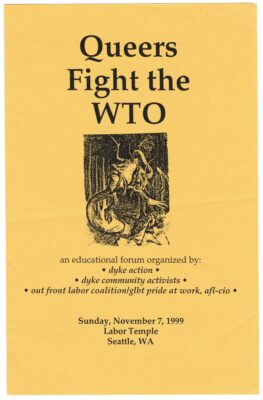
Queers Fight the WTO flier, November 1999

Yellow flier titled "Queers Fight the WTO," advertising a November 7, 1999 educational forum at Seattle's Labor Temple organized by Dyke Action, Dyke Community Activists, and the Out Front Labor Coalition/GLBT Pride at Work, AFL-CIO.

MOHAI, Heather Day WTO Ephemera Collection, 2025.19.16

Earlier this year, after MOHAI’s exhibit Teamsters, Turtles, and Beyond: The Legacy of the Seattle WTO Protests closed, the collections team worked with lenders to the exhibit to transfer materials permanently to MOHAI’s collections.

One of these donations came from activist Heather Day, who went on to co-founded Community Alliance Global Justice (CAGJ) with others who helped organize the 1999 WTO protests. Day donated this flier promoting an educational forum sponsored by Dyke Action, Dyke Community Activists, Out Front Labor Coalition/GLBT Pride at work, and AFL-CIO.

Held at the Seattle Labor Temple a few weeks prior to the opening of the WTO Ministerial Conference in November 1999, the forum introduced the WTO and explained how it impacts a wide variety of issues, including women’s rights, access to AIDS drugs in African countries, and domestic partnership laws.

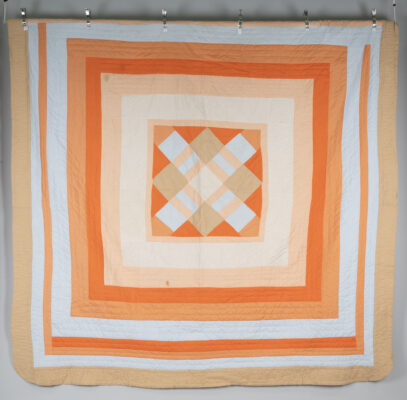
Quilt made by Odessa Davis, 1965

Handmade quilt with striped borders of dark orange, light orange, and white fabric and an offset checkered pattern in the middle.

MOHAI, 2025.17.1

This quilt was hand stitched by Seattleite Odessa Davis and gifted to Dr. Lora-Ellen McKinney (who was a child at the time). McKinney is the daughter of Rev. Dr. Samuel Berry McKinney, longtime pastor of Mount Zion and a civil rights leader in Seattle.

Davis was born in Texas and came to Seattle sometime before 1950. She and her husband Ernest attended Mount Zion Baptist Church, which was near their home on 25th Ave East. The quilt also came with a matching pillow.

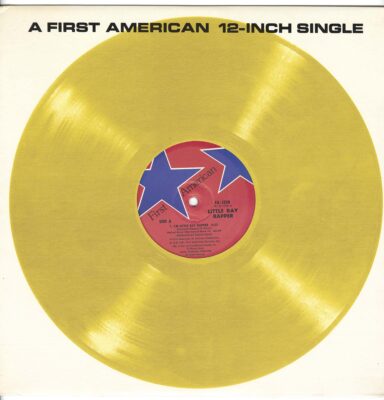
"I'm Little Ray Rapper" recording on 12-inch vinyl disk, 1981

A-side of a 12-inch vinyl record in golden yellow.

MOHAI, 2025.28.1

This fall, MOHAI received a donation of materials from Ben Camp, also known as Novocaine132, that represent Seattle’s early rap and hip-hop history. The donation included this single recorded by musician David Perry, who went by Little Ray Rapper, and published by Seattle’s First American Records.

Featuring Perry on vocals and guitar along with Moyes Lucas on drums and Steve Allen on bass, the A-side featured the song “I’m Little Ray Rapper,” on which Perry rapped slowly and then sped up on playback for a chipmunk-like effect. The song “Get That Future Punk” is on the B-side.

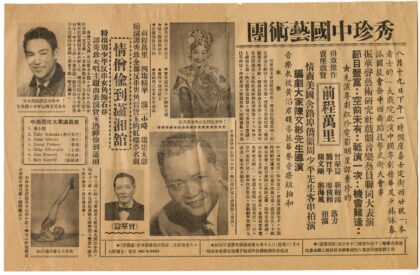
Poster advertising performance by Seattle Chinese arts group in Vancouver, 1962

1962 Chinese-language poster promoting a Vancouver, BC performance by Seattle's Xiu Zhen Chinese Arts Group, featuring Cantonese opera artists and a young Bruce Lee billed as the "male Cha Cha champion of Hong Kong."

MOHAI, Betty Lau Ephemera Collection, 2025.10.24

This Chinese-language poster advertises an upcoming performance at the Majestic Theater in Vancouver BC by the Seattle-based Xiu Zhen Chinese Arts Group on August 19, 1962. It is part of a donation of materials from activist and Chinatown/International District advocate Betty Lau.

The poster includes mentions of Cantonese opera excerpts performed by Ping Chow (center bottom), a leader in Seattle’s Chinese American community and the husband of Ruby Chow; the Cantonese opera movie star, Tan Xiu Zhen; 13-year-old acrobat Jung Mei-lien, bottom left; and Bruce Lee (top left), billed here as the “male Cha Cha champion of Hong Kong,” who demonstrated the Cha Cha with Lin Yen-ni, 18, the female champion. Bruce Lee also demonstrated the martial art of Shaolin Wing Chun Kung Fu as part of the “variety show” portion of the performance.

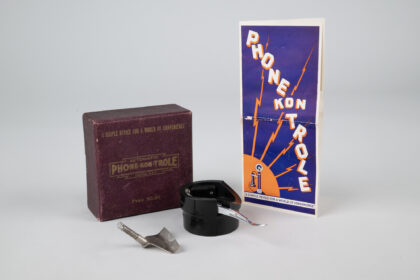
Phone-Kon-Trole device invented by Morton Clark and Carroll Priestley, ca. 1925

Early 1920s Phone-Kon-Trole telephone accessory invented in Seattle, shown with its original box, metal components, and illustrated instruction pamphlet reading "A Simple Device for a World of Convenience."

MOHAI, 2025.15.1

The Phone-Kon-Trole, invented by Morton Clark, Sr. in the early 1920s, was used with early 20th century rotary phones. These telephones had a lightweight base with a rotary dial, small neck, and cradle for the handset. It took one hand to hold the phone steady and the other hand to dial, leaving users with no way to hold the handset.

The Phone-Kon-Trole collar allowed the caller to lift the handset off the cradle to activate the dial tone and freed up a hand to dial the number. The practical invention was short-lived: Western Electric soon came out with heavy, big based, no-neck telephones which stayed put when dialing a number.

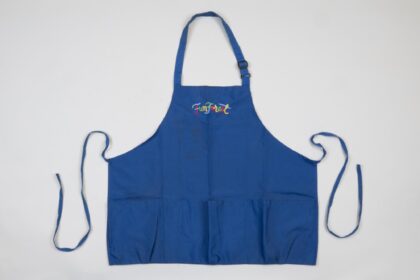
Fun Forest apron, ca. 2010

Blue apron with the words "Fun Forest" in multi-colored lettering stitched on the chest.

MOHAI, 2025.30.1

This Fun Forest apron was worn by a Fun Forest employee near the end of the amusement park’s run at the Seattle Center. The Fun Forest began as “The Gayway,” a 20-ride amusement zone at the 1962 World’s Fair near the Monorail and Space Needle. From 1962 to 2011, it delighted generations of Seattleites and visitors with rides, games, and concessions.

The Fun Forest area is now home to the Museum of Pop Culture (on the site of the long-running “Flight To Mars” ride) and the Chihuly Garden and Glass.

Categories:
Art, Global, History, Immigration, Technology

Related Blog Posts

Photograph of several kinds of cassette and VHS tapes stored in the MOHAI collection.
March 19, 2026

Inside MOHAI’s Archives: Preserving Seattle’s Historic Digital and Audiovisual Collections

At MOHAI, our library and archives are full of millions of stories. As a proud Smithsonian Affiliate, we were excited…
Read More
Round wall clock that once hung in the window of Ding Ho Laundry and Cleaners, a Seattle business founded by Chinese immigrants York and Arlene Luke in 1956.
March 4, 2026

Spring Forward with Seattle History: Timeless Clocks from the MOHAI Collection

It’s almost time to spring forward! Celebrate the season with a look at four historic clocks from the MOHAI collection,…
Read More