Late Summer through early fall is the season for harvesting hops in the Pacific Northwest. Hop farming was an important activity in the Puget Sound region between the 1860s and the 1890s in the valleys of Puyallup, White River, and Snoqualmie. In the 20th century most of the growing moved to Eastern Washington, while beer brewing continued throughout the state.

Explore a brief history of hop harvesting in the Puget Sound region below.
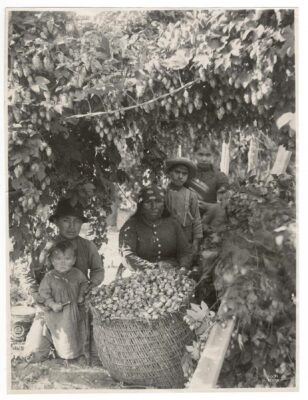
Indigenous family working in a hop field in western Washington, circa 1900

Black and white photograph of an Indigenous family in hop fields.

MOHAI, George and Louisa Frye Family Papers, 1990.45.11

In the late 19th century, Indigenous workers came from throughout the Pacific Northwest, Canada, and Alaska (but especially from regional tribes like the Puyallup, Snoqualmie, Muckleshoot, Duwamish, Sammamish, Lummi, and Nisqually) as a seasonal labor force to harvest hops. Often, whole families would work together and on occasion entire villages were emptied as people left for the hops harvest. Workers would use downtime to socialize with each other, weave baskets to sell, or fish for salmon.

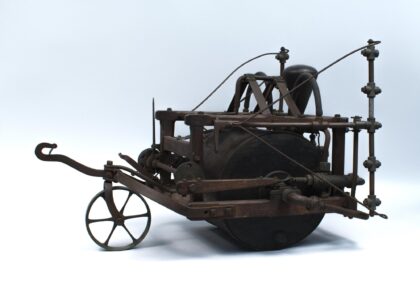
Product model of Puyallup rolling hops sprayer, ca. 1895

Large metal hop spraying machine.

MOHAI, 2009.12.1

In the 1890s, the hop industry faced a serious threat: hop lice (aphids). In 1895, Albert Povine patented the Puyallup rolling hops sprayer. This rolling hops sprayer had increased efficiency over earlier insecticide sprayers, and its swinging spray arms that allowed them to remain in position even while tilted on a hillside. Unfortunately, the infestation was too powerful even for this new innovation. The Western Washington hop industry went into decline, and most of the production moved to the Yakima Valley. Many of the hop farms west of the Cascades transitioned to growing various food crops.

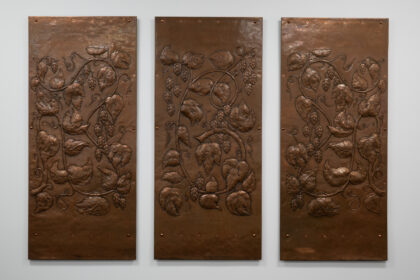
Three copper repoussé panels from a fireplace at the Rainier Brewing Company, ca. 1948

Three large copper panels with designs of hops hammered into them.

MOHAI, 1999.64.2, Gift of John Stroh III

These copper panels from the Rainier Beer Brewery fireplace on Airport Way show a leafy and flowering hop plant, ready to harvest. These copper repoussé panels (a technique of hammering a copper sheet into a desired design) were originally made by the Dirk Van Erp Studio of Oakland California. Van Erp immigrated to the United States from the Netherlands in 1886 and worked in Bay Area shipyards as a coppersmith. He founded his own studio in Oakland in 1908 and exhibited at the 1909 Alaska-Yukon-Pacific Exposition in Seattle along with local metalsmith, Albert Berry.

In 1929 the studio was passed on to his son William. Most of the works designed and manufactured by the studio were copper and brass lighting and ecclesiastical objects for San Francisco churches. Commissioned studio work like these panels are much more rare.

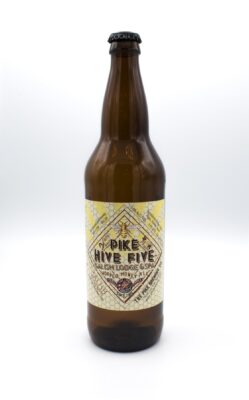
Beer bottle, "Pike Hive Five Salish Lodge & Spa Hopped Honey Ale", from the Pike Brewing Co., Seattle, WA, 2016

Single "Pike High Five" beer bottle from Pike Place Brewing Co.

MOHAI, 2014.28.21

There are still many locally brewed beers that use hops from Washington, even if now they come from east of the Cascades. The Pike Brewing Co. was started in 1989, and this beer features ingredients from Western and Eastern Washington. It is brewed with hops from Yakima, and honey from the apiary at Salish Lodge & Spa (near Snoqualmie).

Categories:
Business, Indigenous

Related Blog Posts

Round wall clock that once hung in the window of Ding Ho Laundry and Cleaners, a Seattle business founded by Chinese immigrants York and Arlene Luke in 1956.
March 4, 2026

Spring Forward with Seattle History: Timeless Clocks from the MOHAI Collection

It’s almost time to spring forward! Celebrate the season with a look at four historic clocks from the MOHAI collection,…
Read More
A group of Indigenous women cooking salmon over a fire on the Muckleshoot Reservation.
September 17, 2025

The Story of Salmon Homecoming: Honoring Salmon in the Pacific Northwest

Salmon return to the rivers and streams of the Pacific Northwest each fall; this cycle has played a pivotal role…
Read More