Salmon return to the rivers and streams of the Pacific Northwest each fall; this cycle has played a pivotal role in the ecosystem of the region since time immemorial. In Seattle, this powerful journey is honored each year at Salmon Homecoming: a celebration that brings together Tribal Nations, local organizations, and the broader community in recognition of the salmon’s cultural, ecological, and spiritual importance.

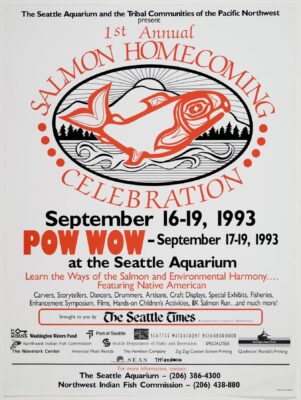
The Seattle Aquarium held its first Salmon Homecoming celebration in 1992, with a month of educational events highlighting the return of salmon to the streams of their spawning grounds. The following year, Tribal communities partnered with the Aquarium to launch the First Annual Salmon Homecoming Celebration, a four-day gathering that featured a Pow Wow, an 8K Salmon Fun Run, and a symposium on salmon and habitat restoration.

By 2001, The Salmon Homecoming Alliance had grown into its own non-profit organization dedicated to salmon stewardship, water quality, marine protection issues, and strengthening ties between tribal and non-tribal communities.

Below, explore the cultural, environmental, and economical role salmon has played in the Pacific Northwest since time immemorial.
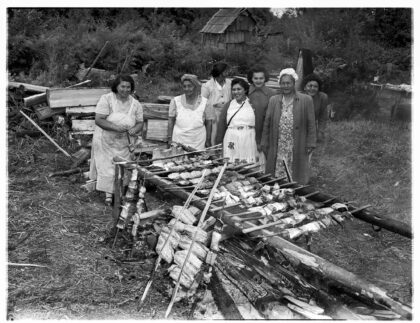
Women cooking salmon, Muckleshoot Reservation, circa 1950

A group of Indigenous women cooking salmon over a fire on the Muckleshoot Reservation.

MOHAI, Seattle Post-Intelligencer Collection, PI23907

Salmon has been a staple in the diets of the Indigenous tribes of the Pacific Northwest since time immemorial. Catching, preparing, and cooking salmon continue to play a significant cultural role for many Indigenous peoples in Washington.
In this photo, several women on the Muckleshoot Reservation help prepare salmon, which has been cut and strung onto sticks and then suspended over an open fire to grill. The wood is likely alder, which gives a distinctive flavor to fresh-cooked salmon.

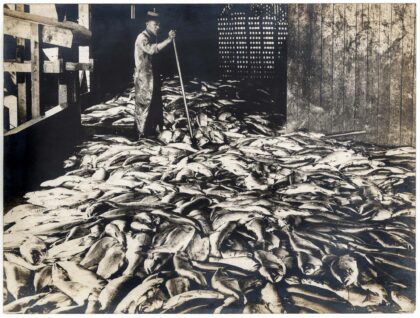
10,000 salmon on cannery wharf and Chinese worker, circa 1900

Photo of a Chinese worker surrounded by salmon in a cannery wharf.

MOHAI, George and Louisa Frye Family Papers, 1990.45.20

Once European settlers began moving into the region in the 1850s, industries focused on extracting natural resources began to grow. These included logging as well as salmon canning. Here, a Chinese worker sorts salmon at a Puget Sound cannery sometime around 1900. At the time, white workers caught the fish and took care of the equipment while Chinese laborers sorted, butchered, and canned the fish.

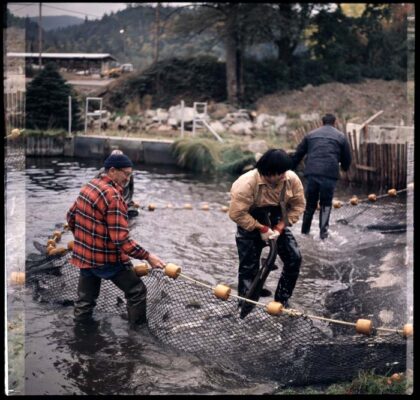
Indigenous fishers practicing their fishing rights, 1972

A group of Indigenous fishers spreading a fishing net while wading in the water.

MOHAI, Seattle Post-Intelligencer Collection, 1986.5.56319.1

In the 1960s and 1970s, Indigenous Peoples and their supporters began protesting Washington State laws that restricted Native fishing rights.

The Survival of the American Indian Society (SAIA), the NAACP, and the National Indian Youth Council (NIYC) coordinated a series of protests and peaceful demonstrations known at the time collectively as the “fish wars,” which eventually led to the Boldt Decision (United States v. Washington, 1974), a federal ruling guaranteeing Washington tribes half the state’s salmon and steelhead trout catch. Here a group of Indigenous fishers spread a net an un unidentified location in 1972.

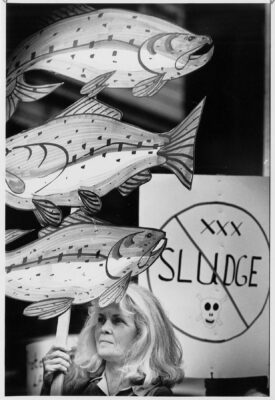
Amanda Van Orden protesting Metro pollution, Seattle, May 18, 1989

Amanda Van Orden holding a protest sign featuring drawings of three salmon.

MOHAI, Seattle Post-Intelligencer Collection, 2000.107.124.28.01, photo by Paul Joseph Brown

Salmon have long been central to environmental debates in the region. Their decline in population, driven by polluted waters, has fueled efforts to clean up Puget Sound and tributaries such as the Duwamish River.

Just one example of this ongoing tension is shown here: in 1989 South Sound residents rallied outside the Metro Council chambers in Seattle. Activists protested a Metro plan to spray sewage sludge on 2,200 acres of Thurston County forest land near the Nisqually River, highlighting the harm the plan would cause to the salmon population.

First Annual Salmon Homecoming poster, Seattle, September 16-19, 1993

Poster advertising the Salmon Homecoming Celebration September 16-19, 1993 at the Seattle Aquarium.

MOHAI, 2007.25.14

This poster advertises the First Annual Salmon Homecoming Celebration, which took place September 16-19, 1993. The artwork on the poster features a salmon illustrated using Northwest Coast Native American art formline designs, with a sun, mountain, and water in the background. This design would become the logo for both the event and the Salmon Homecoming Alliance.

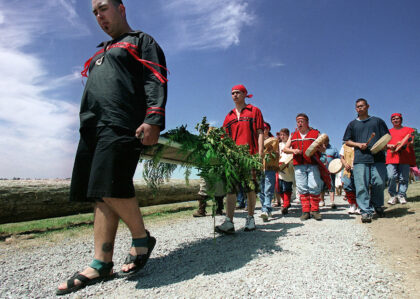
Traditional Indigenous ceremony honoring first salmon of the season, Seattle, November 9, 2002

Group of Indigenous people carrying salmon on a cedar plank as part of a traditional Tulalip ceremony.

MOHAI, Seattle Post-Intelligencer Collection, 2000.107.20021101.CD01.011, photo by Paul Joseph Brown

Despite legal and environmental challenges, many Coast Salish Peoples continue their traditions of celebrating annual salmon harvests. In this photo from 2002, members of the Tulalip Tribe participate in the tradition of honoring the season’s first salmon. The salmon is greeted, wrapped in ferns and cedar and they shared among the tribe and guests in a feast.

Categories:
Indigenous

Related Blog Posts

Black and white photograph of a group of Indigenous men at work picking hops.
October 1, 2025

Hop Harvesting in Puget Sound: From Indigenous Labor to Local Brews

Late Summer through early fall is the season for harvesting hops in the Pacific Northwest. Hop farming was an important…
Read More
Black and white photograph of the Seattle waterfront with two long docks and several buildings.
April 30, 2025

From Indigenous Crossroads to Urban Promenade: The Evolving History of Seattle’s Waterfront

Seattle’s waterfront is changing. Most recently, the area that was once the Alaskan Way Viaduct was redeveloped into a park…
Read More