400 results for: Indigenous Peoples
Photograph
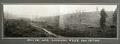
View west on Boyer Avenue, Seattle, December 15, 1911
The Montlake neighborhood of Seattle has a rich history that dates back to its earliest settlement, where both Indigenous Peoples and European settlers acknowledged the significance of the region as a vital portage route for watercraft. This area, being the narrowest stretch of land between Lake Union and Lake Washington, naturally led early inhabitants to envision a future canal connecting…
ID Number:1952.146.1
Date:1911
Photograph
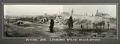
View west on Boyer Avenue, Seattle, March 15, 1913
The Montlake neighborhood of Seattle has a rich history that dates back to its earliest settlement, where both Indigenous Peoples and European settlers acknowledged the significance of the region as a vital portage route for watercraft. This area, being the narrowest stretch of land between Lake Union and Lake Washington, naturally led early inhabitants to envision a future canal connecting…
ID Number:1952.146.2
Date:1913
Photograph
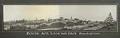
View east on Boyer Avenue, Seattle, March 15, 1913
The Montlake neighborhood of Seattle has a rich history that dates back to its earliest settlement, where both Indigenous Peoples and European settlers acknowledged the significance of the region as a vital portage route for watercraft. This area, being the narrowest stretch of land between Lake Union and Lake Washington, naturally led early inhabitants to envision a future canal connecting…
ID Number:1952.146.3
Date:1913
Document
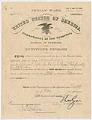
Survivor's Pension Certificate issued to Carson D. Boren, May 20, 1903
Carson Dobbins Boren (1824-1912) arrived in Seattle in 1851 as part of the group of White settlers known as the Denny party. He built a cabin at what is now the corner of Second and Cherry in downtown Seattle. Mr. Boren served as King County's first sheriff and also helped explore wagon routes over the Cascades. He preferred a solitary…
ID Number:1952.986.56
Date:1903
Photograph
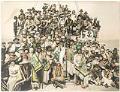
Sourdough Club on ship "Portland" during Golden Potlatch, Seattle, July 17, 1912
The Tilikums of Elttaes were a fraternal civic organization composed primarily of influential white Seattle area businessmen, who used Native American imagery to promote tourism and the economic development of the city. The appropriation of culture in order to market products or events is a common example of discrimination and marginalization faced by Indigenous peoples in the United States. In…
ID Number:1954.776.1
Date:1912
Photograph
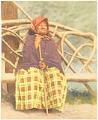
Kikisoblu (Princess Angeline) seated at Madrona Park, Seattle, circa 1892
Kick-is-on-lo Cud, or Kikisoblu (circa 1816-1896), was the eldest daughter of Chief Seattle (Si'ahl), the leader of the Suquamish and Duwamish tribes. During her lifetime, she saw the coming of white settlers, the exile of her people from their traditional lands, and the growth of the new city named for her father. She didn't move to the Port Madison Reservation…
ID Number:1954.812.1
Date:Circa 1892
Photograph
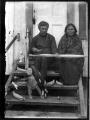
Young Doctor and his wife Lizzie, Neah Bay, circa 1900
The Makah people of the northwest tip of the Olympic Peninsula refer to themselves as Kwih-dich-chuh-ahtx, which translates roughly to "the people who live by the rocks and seagulls." The early Makah were skilled mariners, using several types of canoes which they carved from western red cedar for various purposes - war, whaling, fishing, sealing, carrying cargo, and long voyages.…
ID Number:1955.970.470.1
Date:Circa 1900
Photograph
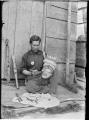
Atlieu, Nuu-cha-nulth carver, Neah Bay, circa 1900
The Nuu-chah-nulth are a group of 14 First Nations peoples living on the west side of Vancouver Island: Ditidaht, Huu-ay-aht, Hupacasath, Tse-shaht, Uchucklesaht, Ahousaht, Hesquiaht, Tla-o-qui-aht, Toquaht, Ucluelet, Ehattesaht, Kyuqout/Checlesaht, Mowachat/Muchalaht, and Nuchatlaht. They share cultural traditions and language but remain distinct nations, each with a hereditary chief. The Nuu-chah-nulth peoples were previously called the Nootka after European colonizers misunderstood…
ID Number:1955.970.470.2
Date:Circa 1900
Photograph
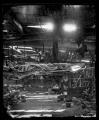
Interior of a longhouse, Neah Bay, circa 1900
The Makah people of the northwest tip of the Olympic Peninsula refer to themselves as Kwih-dich-chuh-ahtx, which translates roughly to "the people who live by the rocks and seagulls." The early Makah were skilled mariners, using several types of canoes which they carved from western red cedar for various purposes - war, whaling, fishing, sealing, carrying cargo, and long voyages.…
ID Number:1955.970.470.10
Date:Circa 1900
Photograph
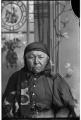
Quedessa, Makah woman, circa 1900
The Makah people of the northwest tip of the Olympic Peninsula refer to themselves as Kwih-dich-chuh-ahtx, which translates roughly to "the people who live by the rocks and seagulls." The early Makah were skilled mariners, using several types of canoes which they carved from western red cedar for various purposes - war, whaling, fishing, sealing, carrying cargo, and long voyages.…
ID Number:1955.970.470.13
Date:Circa 1900