98 results for: Boeing Company
Program
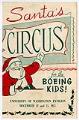
Boeing Children's Christmas Party program, 1953
The workforce and economy of Seattle from WWII through the 1970s was largely dependent on the Boeing Company and the commercial-airplane market. In 1957 business was booming due to the rise of the jet airplane. At the time Boeing employed about 100,000 people, including half of King County's manufacturing workers, while the Seattle's total population was only 550,000. This program…
ID Number:2018.3.3.31
Date:1953
Ephemera
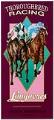
Longacres Thoroughbred Racing brochure, 1990
Longacres Park racetrack in the Green River Valley near Renton was the home of thoroughbred racing in western Washington from 1933 to 1992, and was the longest continually operated track on the West Coast. Designed by famed Seattle architect B. Marcus Priteca (1889-1971), the track took advantage of soil composition favorable to racing due to regular flooding by the river.…
ID Number:2018.3.3.52
Date:1990
Videorecording
Oral history interview with Jeremy Jaech, July 23, 2002
Interview with Jeremy Jaech by Jessah Foulk on July 23, 2002 at MOHAI for the Speaking of Seattle: Information Technology Oral History Project. Jaech is a technology and software entrepreneur, serving as a co-founder of Aldus, best known for its PageMaker software, and Visio. He also led the teams that founded Trumba and SNUPI, and served as CEO of Verdiem.…
ID Number:2019.35.6.9
Date:2002
Poster
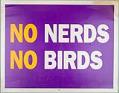
"No Nerds, No Birds," poster from Boeing engineers strike, 2000
On February 9, 2000, more than 17,000 engineers and technicians from the Society of Professional Engineering Employees in Aerospace (SPEEA) walked out of Boeing plants across the country. This was the first major strike for the engineers' organization, which formed in Seattle in 1944. After the 40-day standoff, a mediated contract was approved with significant SPEEA gains on pay increases…
ID Number:2020.8.1
Date:2000
Ephemera
The Gear Works brochure, Seattle, circa 1999
The Gear Works was founded in 1946 by Ingwald Ramberg in Seattle’s South Park neighborhood. By the 1990s, the family-owned company had grown to become one of the largest gear-manufacturing companies in North America. Its huge gears were used in wind turbines, large earth moving equipment, NASA aerospace projects, and more. The company also repaired and replaced the gear boxes…
ID Number:2021.86.7
Date:Circa 1999
Photograph
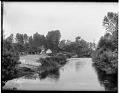
Black River, near Renton, circa 1898
The Black River, at the south end of Lake Washington, was once the lake's main drainage channel. It was also the main route for commerce between the lakeside towns and Seattle on Elliott Bay. In the 1910s, the building of the Lake Washington Ship Canal changed the drainage pattern of the lake, and the Black River slowly disappeared. The old…
ID Number:Lib1988.33.92
Date:Circa 1898
Photograph
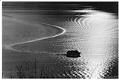
Boeing hydrofoil in Elliott Bay, Seattle, November 1978
In the mid-twentieth century Seattle's aerospace giant, The Boeing Company, saw a market in fast ferries. The company began adapting many systems used in jet airplanes for passenger-carrying waterjet-propelled hydrofoils. Boeing Marine Systems (BMS) built their first hydrofoil at the Renton plant in 1960, and manufactured about 8 hydrofoils for the U. S. military, and 28 that were used in…
ID Number:Lib1993.20.185
Date:1978
Photograph
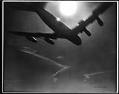
First 707 passenger flight from Sea-Tac Airport, Bow Lake, 1958
The Boeing 707 Stratoliner was the first American jetliner and would prove to be the first of the company's successful line of commercial jets. This image of the first passenger 707 flight out of SeaTac taken by Josef Scaylea was intended to convey the feeling of speed.Photographer Josef Scaylea (1913-2004) worked for 35 years as chief photographer for the Seattle…
ID Number:Lib1993.20.192
Date:1958
Photograph
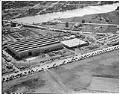
Aerial of Boeing Plant #2 looking southeast, Seattle, 1943
Boeing's Plant #2 was built in 1936 in Seattle's Georgetown neighborhood next to the Duwamish River, with additional construction in 1941. The main saw manufacturing of iconic planes like the B-17 "Flying Fortress" bombers, B-29 "Superfortress" bombers, B-52 bomber, and the 737. A crucial site of production during World War II, the plant was camouflaged at one point during the…
ID Number:PI23924
Date:1943
Photograph
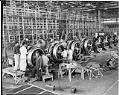
Men working on B-17 engines at the Boeing plant, November 1940
In 1940, some 7,500 Boeing Aircraft Company employees worked 24 hours per day to build B-17 Flying Fortress bombers for the British and American military. These long-range propeller-driven planes were capable of attacking an enemy fleet more than 1,000 miles offshore and conducting bombing raids on Germany from England. At this time, the United States had not yet entered World…
ID Number:PI23926
Date:1940