896 results for: Performing Arts
Ephemera
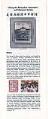
Chong Wa Benevolent Association and Education Society brochure, Seattle, circa 2015
The Chong Wa Benevolent Association was founded in the late 1890s by Seattle’s Chinese community to promote social and cultural welfare and support Chinese causes in the greater community. This brochure gives a history of the Association and describes its wide variety of programs and activities. These have included financial and legal assistance, language and citizenship classes, performing arts, and…
ID Number:2025.10.10
Date:Circa 2015
Ephemera
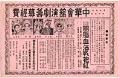
Poster for Luck Ngi Music Society's benefit for the Chong Wa Benevolent Association, printed in Chinese, October 1975
Founded in 1938, Seattle’s Luck Ngi Music Society specialized in Chinese opera. Located at 512 Seventh Avenue South, they often practiced and performed at nearby Chong Wa Hall. In 1975, as advertised on this flier, the group performed the Chinese opera “Bloodbath” as a benefit for the Chong Wa Benevolent Association. Edward Shui “Ping” Chow (photo third from the right)…
ID Number:2025.10.17
Date:1975
Ephemera
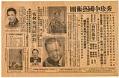
Chinese language poster advertising performance by Seattle Chinese arts group in Vancouver, August 1962
This poster advertises an upcoming performance at the Majestic Theater in Vancouver BC by the Seattle-based Xiu Zhen Chinese Arts Group on August 19, 1962. Billed as "one performance only," the show included Cantonese opera excerpts performed by Ping Chow (center bottom), a leader in Seattle's Chinese American community and the husband of Ruby Chow; the Cantonese opera movie star,…
ID Number:2025.10.24
Date:1962
Musical sound recording
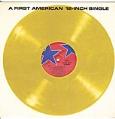
"I'm Little Ray Rapper" recording on 12-inch vinyl disk, 1981
David Perry is a musician, producer, and studio engineer who moved to Seattle in 1978, where he produced hits for disco artists like Salazar. Inspired by early rap coming out of New York and with access to studio time, Perry decided to record his own rap album in 1980 under the name "Little Ray Rapper." Working with Moyes Lucas on…
ID Number:2025.28.1
Date:1981
Photograph
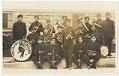
Tulalip Indian School boys band, 1912
The Tulalip Tribes are a confederation of several Coast Salish peoples including the Snohomish, Snoqualmie, Skykomish, Skagit, Suiattle, Samish, Stillaguamish, and other allied tribes and bands. In the 1855 Treaty of Point Elliott, these groups ceded most of their land to the United States and reserved the Tulalip Indian Reservation for their permanent homeland. They also reserved rights for hunting,…
ID Number:Lib1988.11.83
Date:1912
Photograph
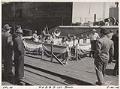
Puget Sound Bridge and Dredging Company band playing for the APL 49 launch party, Seattle, May 29, 1945
Founded in 1889, the Puget Sound Bridge and Dredging Company was also called Puget Sound Bridge and Drydock, Associated Shipbuilders, and Lockheed Shipbuilding and Construction Company. The company participated in most major construction sites in the Pacific Northwest, and they are responsible for many ships, including some of the Washington State ferries and many naval vessels during and after World…
ID Number:Lib1988.13.10.30b.1
Date:1945
Article
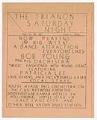
The Trianon Saturday Night, Vol. 8 No. 24, June 4, 1938
The Trianon Ballroom, located at Third Avenue and Bell Street, was an important entertainment venue in Seattle's musical history. One of several large dance clubs in the area which drew national Big Band talent, it was founded in 1927 by hotelier John Edward Savage (1879-1958) and had a 30 x 135-foot dance floor that accommodated more than 5,000 dancers. Operating…
ID Number:Lib1988.27.4
Date:1938
Photograph
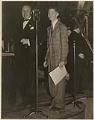
Bob Young and radio announcer on stage at Trianon, Seattle, circa 1938
The Trianon Ballroom, located at Third Avenue and Bell Street, was an important entertainment venue in Seattle's musical history. One of several large dance clubs in the area which drew national Big Band talent, it was founded in 1927 by hotelier John Edward Savage (1879-1958) and had a 30 x 135-foot dance floor that accommodated more than 5,000 dancers. Operating…
ID Number:Lib1988.27.8
Date:Circa 1938
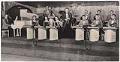
Photograph
Jackie Souder's Orchestra, circa 1945
Jackie Souder and his Orchestra performed at various venues around Seattle in the 1920s-1940s, and were the featured band at the Olympic Hotel in the mid-1920s.
ID Number:Lib1990.8.192
Date:Circa 1945
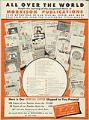
Poster
Morrison Music Company advertisement, Seattle, circa 1950
Howell O. “Morrie” Morrison (1888-1984) and Alice Nadine (Lanterman) Morrison (1982-1978) created the Pacific Northwest’s first local popular music empire, the Morrison Music Company. The Morrison’s business began as a sheet music publication company, capitalizing on the success of Alice’s hit songs, the royalties from which provided the company’s start-up capital. The sheet music company evolved into a series of…
ID Number:Lib1990.8.198
Date:Circa 1950