1344 results for: Seattle Center
Ephemera
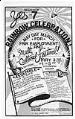
Yes on Referendum 7 flier, May 1986
This flier advertises a May Day March for Fair Employment and Multi Cultural Festival. The march occurred on May 3, 1986, beginning at Seattle Center and ending at Occidental Square. It was co-sponsored by several community and activist groups representing marginalized people in Seattle. The purpose of the march was to encourage "yes" votes for Referendum 7, which would maintain…
ID Number:2002.23.4.79.1
Date:1986
Ephemera
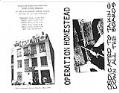
Operation Homestead leaflet, 1991
The building of the Seattle Convention Center and other buildings in the 1980s displaced many low-income residents in the downtown area. In 1988, housing activists, displaced and homeless people, and others formed Operation Homestead to take direct action. In 1989 they estimated that the city had 3,000 to 5,000 people experiencing homelessness, and that some 2,000 people had been displaced…
ID Number:2002.23.5.32.1
Date:1991
Ephemera
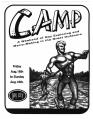
CAMP registration card, from Gay City and Boyz in the Woods, 1996
This card advertises a weekend camping trip focused on gay men, organized by Gay City and Boyz in the Woods. It promises "gay exploring and merry-making," arts and play, and homo spirituality. The illustration on the front shows two scantily-clad idealized male figures driving logs down a river. Gay City, now called Seattle's LGBTQ+ Center, was founded in 1995 by…
ID Number:2002.23.6.27.1
Date:1996
Ephemera
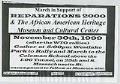
Reparations 2000 march flier, Seattle, November 30, 1999
This flier advertises a march organized by the Reparations 2000 Coalition and the African American Heritage Museum and Cultural Center (AAHM&CC), to take place on the first evening of the WTO rallies. The march was set to end at the vacant Colman School, where an encampment for anti-WTO activists would be established. Omari Tahir-Garrett and other activists first occupied this…
ID Number:2002.23.6.42.1
Date:1999
Ephemera
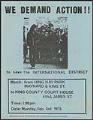
Committee for Corrective Action march flier, Seattle, February 3, 1975
The Kingdome construction project broke ground on November 2, 1972, in spite of concerns from residents of the nearby Chinatown - International District (CID) regarding the impact on their neighborhood. From the protests and march at the groundbreaking, and on into the 1970s, the Asian American movement advocated for more affordable housing in the district, for services such as a…
ID Number:2002.23.7.83.1
Date:1975
Ephemera
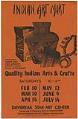
Poster advertising Indian Art Mart at Daybreak Star Art Center, Seattle, 1979
In 1970, some 100 Native Americans and supporters occupied Fort Lawton, a Seattle Army base that had been declared surplus. The group wanted to reclaim what had been part of their historic lands. After being ejected by military police, group members camped nearby, maintaining their rights and involving celebrities in their cause. In 1977, after much negotiation and Congressional involvement,…
ID Number:2002.23.8.9.3
Date:1979
Ephemera
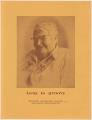
Seattle Gray Panthers poster, 1992
The Gray Panthers, founded in 1972 and still active as of 2020, are a series of multi-generational local advocacy networks in the United States which confront ageism and many other social justice issues. During the early years of the 1970s and 1980s, the main issues of the Gray Panthers included forced retirement, ageist stereotypes, cuts to Medicare and Social Security,…
ID Number:2002.23.8.14.2
Date:1992
Ephemera
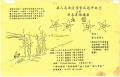
Chinese Baptist Church 5 Years Celebration & New Year Talk poster, Seattle, 1989
The Chinese Baptist Church building on South King Street in the Chinatown - International District, completed in 1924, served as a focal point for the local Chinese spiritual community for over half a century. In 1977, the congregation moved into a new building in the Beacon Hill neighborhood and the building was purchased by the Cathay Post of the American…
ID Number:2002.23.8.14.3
Date:1989
Photograph
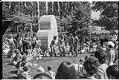
Crowd watching a performance at the Bumbershoot festival, Seattle, August 27, 1976
Since 1971, Bumbershoot has drawn artists representing the best in music, film, comedy, spoken word, dance, theatre, performance, and visual arts to Seattle over Labor Day weekend. North America's largest urban arts festival, Bumbershoot takes place in the heart of the city at the 74-acre Seattle Center. Here, a crowd gathers outside on a sunny day to watch a performance…
ID Number:2002.46.2022.1
Date:1976
Photograph
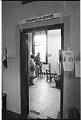
Roberto Maestas in classroom during occupation of Beacon Hill School, November 1972
Seattle had a growing Latino population in the late 1960s, and activists had been pressing the city for a building in which to establish a Chicano community center. Tired of having their requests ignored, in October 1972 they took over the abandoned Beacon Hill School on 16th Avenue South and renamed it El Centro de la Raza. After a 75-day…
ID Number:2002.46.272.24
Date:1972