3246 results for: Seattle Post-Intelligencer, The
Photograph
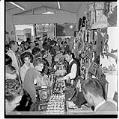
Interior of a souvenir shop filled with fairgoers on closing day, Seattle World's Fair, October 21, 1962
A souvenir shop is crowded with shoppers on the closing day of the Seattle World's Fair. Visitors often brought their own shopping bags to fill with bargains as prices were marked down during the last days of the fair. Date photograph was filed at the Seattle Post-Intelligencer (date of photograph and file date may differ by a month or more):…
ID Number:1986.5.2652.1
Date:1962
Photograph
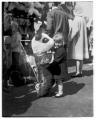
Little girl hugging a giant stuffed toy panda, Seattle World's Fair, 1962
Oversized plush toys were popular prizes sold and given away on the Gayway. The toys were two-thirds as tall as an average adult and weighed as much as a toddler. Here, a giant toy panda bear exceeds in size the little girl hugging it. Date photograph was filed at the Seattle Post-Intelligencer (date of photograph and file date may differ…
ID Number:1986.5.2698.1
Date:1962
Photograph
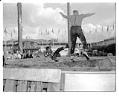
Logrollers at a lumberjack show, Seattle World's Fair, 1962
Two lumberjacks, one falling and one still upright, demonstrating logrolling in an outdoor tank during a popular lumberjack show at the Seattle World's Fair. Date photograph was filed at the Seattle Post-Intelligencer (date of photograph and file date may differ by a month or more): October 13, 1962
ID Number:1986.5.2739.1
Date:1962
Photograph
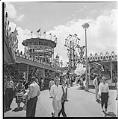
World's Fair Gayway on opening day, Seattle, 1962
The amusement rides at the $2 million Gayway included a brightly lit sky wheel, a simulated trip to Mars, the Wild Mouse, and the gondola-style Sky Ride. Between opening day and October 21, when the fair closed, over 10 million admission tickets were sold to the first U.S. World's Fair in 22 years. Date photograph was filed at the Seattle…
ID Number:1986.5.2768.1
Date:1962
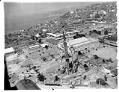
Photograph
Aerial view, looking northwest, of the construction of the Space Needle, Seattle, 1961
Designed by architect John Graham, the Space Needle is easily the most recognizable structure built for the 1962 Century 21 Exposition (Seattle World's Fair). The Space Needle was built in less than one year for 4.5 million dollars by the Howard S. Wright Construction Company. The top of the Needle is 605 feet high, with the main observation deck at…
ID Number:1986.5.2794.1
Date:1961
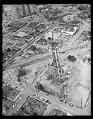
Photograph
Aerial view of construction of the Space Needle, Seattle, 1961
Designed by architect John Graham, the Space Needle is easily the most recognizable structure built for the 1962 Century 21 Exposition (Seattle World's Fair). The Space Needle was built in less than one year for 4.5 million dollars by the Howard S. Wright Construction Company. The top of the Needle is 605 feet high, with the main observation deck at…
ID Number:1986.5.2795.2
Date:1961
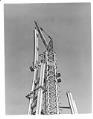
Photograph
Core and legs of the Space Needle under construction, Seattle, 1961
Designed by architect John Graham, the Space Needle is easily the most recognizable structure built for the 1962 Century 21 Exposition (Seattle World's Fair). The Space Needle was built in less than one year for 4.5 million dollars by the Howard S. Wright Construction Company. The top of the Needle is 605 feet high, with the main observation deck at…
ID Number:1986.5.2796.1
Date:1961
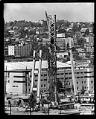
Photograph
Construction of the Seattle World's Fair, looking northwest, 1961
The science-themed Century 21 Exposition (Seattle World's Fair) opened on April 21, 1962. Visitors to the Fair could ride the Monorail, take the elevator to the top of the Space Needle, and see the exhibits in five themed areas: The World of Science, The World of Tomorrow, The World of Commerce & Industry, The World of Art, and The World…
ID Number:1986.5.2825.5
Date:1961
Photograph
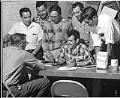
Tomas Villanueva with Co-op members at the United Farm Workers Cooperative, Toppenish, Washington, July 1967
In July 1967, Mexican-American farm workers in the Yakima Valley started the United Farm Workers Cooperative in Toppenish. At the time, the Co-op was not affiliated with the United Farm Workers (UFW) movement led by Cesar Chavez. The Co-op sold shares for $5 and by August 1967, 150 families had purchased shares. Co-op prices averaged 7% less than grocery stores…
ID Number:1986.5.2894.1
Date:1967
Photograph
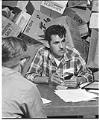
Tomas Villanueva at the United Farm Workers Cooperative, Toppenish, Washington, July 1967
In July 1967, Mexican-American farm workers in the Yakima Valley started the United Farm Workers Cooperative in Toppenish. At the time, the Co-op was not affiliated with the United Farm Workers (UFW) movement led by Cesar Chavez. The Co-op sold shares for $5 and by August 1967, 150 families had purchased shares. Co-op prices averaged 7% less than grocery stores…
ID Number:1986.5.2894.2
Date:1967