234 results for: Northwest Coast Native Peoples
Photograph
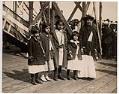
Snoqualmie woman and girls at the launching of the steamer "Snoqualmie," 1919
On August 11, 1919, the Puget Sound Bridge & Dredging Company launched the steamer "Snoqualmie" at its Seattle shipyard on Harbor Island. The vessel was named for the Snoqualmie Tribe, in honor of the aid they gave the settlers against other Indigenous groups in the war of 1855-1856, now referred to as the Puget Sound War. This photo shows some…
ID Number:1995.37.19.2.62
Date:1919
Photograph
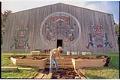
Greg Broad building walkway at Tillicum Village prior to APEC conference, Blake Island, November 5, 1993
The Asia-Pacific Economic Cooperation conference (APEC) was founded in 1989 as an informal dialog group with limited participation by ministers and cabinet-level officials in the Asian-Pacific region, and rose to world prominence in Seattle in 1993 when President Clinton endorsed the organization and used it for what is now an annual summit meeting of Asian and Pacific leaders. The group…
ID Number:2000.107.009.35.01
Date:1993
Photograph
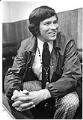
Richard Belmont speaking at press conference, Seattle, October 6, 1972
When 140 acres of their ancestral land on Oyster Bay was declared surplus by the federal government, the Suquamish Tribe sought to have it returned to the tribe. They wanted to use to site for an Indian canoe house and racing area, an Indian historical and cultural center, an center for marine science and ecology, and a meeting facility that…
ID Number:2000.107.019.39.01
Date:1973
Photograph
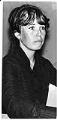
Ramona Bennett during meeting with church officials, September 17, 1970
Ramona Bennett (b. 1938) is a prominent Puyallap Tribe leader and activist. She was elected to the Puyallup Tribal Council in 1968, and served as Tribal Chairwoman from 1971 to 1978.Much of Bennett’s work focuses on social welfare issues, mainly fighting for the rights of women, children, and families. She began her social service work in the 1950s, with the…
ID Number:2000.107.020.10.01
Date:1970
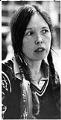
Photograph
Ramona Bennett, October 1976
Ramona Bennett (b. 1938) is a prominent Puyallap Tribe leader and activist. She was elected to the Puyallup Tribal Council in 1968, and served as Tribal Chairwoman from 1971 to 1978. Bennett is also a pioneer of fishing rights advocacy, co-founding the Survival of American Indians Association in 1964, and helping to bring “fish-in” protests to national prominence. Much of…
ID Number:2000.107.020.10.02
Date:1976
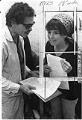
Photograph
Ramona Bennett and Hank Adams during trial on Native fishing rights, Tacoma, September 1970
Ramona Bennett (b. 1938) is a prominent Puyallup Tribe leader and activist. She was elected to the Puyallup Tribal Council in 1968, and served as Tribal Chairwoman in from 1971 to 1978. Hank Adams (Assiniboine-Sioux, 1943-2020) fought for Indian civil rights and sovereignty beginning in the 1960s and throughout his life. Both Bennett and Adams were involved with the National…
ID Number:2000.107.020.10.03
Date:1970
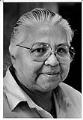
Photograph
Portrait of Maiselle Bridges, Seattle, February 28, 1986
Theresa "Maiselle" (Frank) Bridges (b. 1924) has spent a lifetime "seeking to improve the quality of life, health, and education for Indians, and manning the front line of the Indians' battle to ensure their living through treaty-secured fishing rights." A respected leader and member of the Puyallup Indian Tribe, Ms. Bridges was born near Olympia, Washington, and like many Indigenous…
ID Number:2000.107.026.32.03
Date:1986
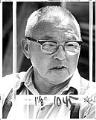
Photograph
Ray Charles at ceremony to close Swinomish beaches, July 12, 1971
In July 1971, the Swinomish tribal council voted to close 15 miles of beachland on their reservation to non-Indians. At issue were the general despoliation of the land and the depletion of marine life. The Swinomish were attempting to rebuild and preserve the diminishing butter clam population. Though outsiders were required to obtain a permit and observe state shellfish restrictions…
ID Number:2000.107.034.24.01
Date:1971
Photograph
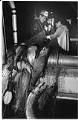
Stanley Moses and Jeff Sheldon removing salmon from a gillnet on Lake Washington, July 16, 1984
After the Boldt decision of 1974, Indigenous tribes in western Washington were legally entitled to half the harvestable salmon run each year. Fishers from the Muckleshoot and Suquamish Tribes were allowed to fish from Lake Washington during specific four-hour windows, under the supervision of fishery officials representing both the state and the Tribes.Here, Stanley Moses (Muckleshoot) and his 12-year-old crew…
ID Number:2000.107.064.01.01
Date:1984
Photograph
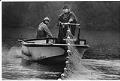
Julian Lawrence and Louis Horn, Jr. netting salmon on Nooksack River, October 1991
Fish hatcheries in Washington state provided most of the yearly salmon catch. In this image, Julian Lawrence (left) and Louis Horn, Jr. pull in their net while fishing for coho salmon on the Nooksack River. Lawrence and Horn, both members of the Lummi Nation, were catching salmon to use as breeding stock in the Lummi tribal hatchery. At the time,…
ID Number:2000.107.064.01.02
Date:1991