116 results for: Miller, Robert H.
Photograph
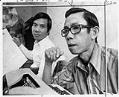
Vinh Duc Vu and Hoi Ba Tran working on Vietnamese-language newspaper, Seattle, August 1975
In August 1975, the first Vietnamese-language newspaper in Washington state headed to the press. The free, bimonthly tabloid, Dat Moi (“New Land”) was to be mailed to 1500 Washington refugees and their American sponsors. It was sponsored by the national Vietnamese-American Association and was funded by the WA State Department of Emergency Services and the Catholic Archdiocese. Plans were for…
ID Number:2000.107.220.25.01
Date:1975
Photograph
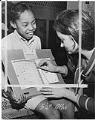
Demonstration of punch-card voting machine, Seattle, March 25, 1969
On March 29, 1969 over 4,500 Seattle residents went to the polls to elect the 16-member Central Area School Council. This was the first community council elected to help the Seattle School Board run an attendance area’s schools. It was also the city’s first computer-assisted election, and it used IBM Votomatic machines, on loan from Clark County, WA. After the…
ID Number:2000.107.220.41.01
Date:1969
Photograph
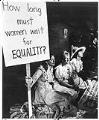
Women holding sit-in at Federal Building, August 26, 1981
The Equal Rights Amendment (ERA) was introduced in the U. S. Congress for the first time in 1921 and has prompted conversations about the meaning of equality for women and men ever since. With the rise of the women's movement in the 1960s, the ERA garnered increasing support, was reintroduced to Congress in 1972, and was submitted to the state…
ID Number:2000.107.232.25.02
Date:1981
Photograph
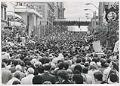
Crowd at victory parade for NBA Champions the Seattle SuperSonics, June 4, 1979
This photograph of the victory parade for the Seattle SuperSonics, taken by staff photographer Bob Miller, appeared on the front page of the Seattle Post-Intelligencer on June 5, 1979.The parade on June 4, 1979, was given in honor of the Sonics victory over the Washington Bullets on June 1, 1979 in game 5 of the NBA Championship. An estimated 300,000…
ID Number:2000.107.240.01.01
Date:1979
Photograph
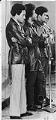
Aaron Dixon, with bodyguards, speaking at rally at HUB Ballroom, Seattle, April 4, 1969
Aaron Dixon was born in Chicago, and grew up in Seattle's Central Area. His father worked at Boeing, and both parents taught Aaron and his brothers the importance of fighting for social justice. As a college student at the University of Washington (UW), Dixon played a key role in the formation of the Black Student Union (BSU) and the Seattle…
ID Number:2000.107.246.07.02
Date:1969
Photograph
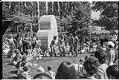
Crowd watching a performance at the Bumbershoot festival, Seattle, August 27, 1976
Since 1971, Bumbershoot has drawn artists representing the best in music, film, comedy, spoken word, dance, theatre, performance, and visual arts to Seattle over Labor Day weekend. North America's largest urban arts festival, Bumbershoot takes place in the heart of the city at the 74-acre Seattle Center. Here, a crowd gathers outside on a sunny day to watch a performance…
ID Number:2002.46.2022.1
Date:1976
Photograph
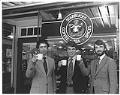
Starbucks founders posing outside their store, Seattle, February 1979
American coffee company Starbucks Corporation was founded in Seattle in 1971 by partners Jerry Baldwin, Zev Siegl, and Gordon Bowker. Sold to Howard Schultz in 1987, the company quickly expanded beyond Seattle and now operates almost 24,000 locations worldwide.In this image the three founders hold cups of coffee outside of the “original Starbucks,” actually the second location of the original…
ID Number:2002.46.3067
Date:1979
Photograph
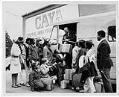
Girls with luggage outside the Central Area Youth Association (CAYA) building, Seattle, April 5, 1968
The Central Area Youth Association was formed in the 1950s to provide youth football programs in Seattle’s Central Area. In 1964, CAYA expanded its programs to include education, social development, and additional sports programs for both minority and white youth.One spring evening, sixteen girls from the CAYA track team left for an AAU (Amateur Athletic Union) invitational track meet in…
ID Number:2002.46.8225
Date:1968
Photograph
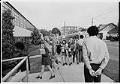
White students arriving at Meany Middle School, Seattle, September 6, 1972
In the 1960s, after decades of discrimination in housing had created an increasingly segregated school system in Seattle, civil rights activists wanted the School Board to promote integration and, with it, intercultural empathy and understanding. After various attempts to promote voluntary integration, and faced with the threat of legal action from advocates of integration, in 1972 the School District launched…
ID Number:2002.46.197.4
Date:1972
Photograph
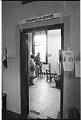
Roberto Maestas in classroom during occupation of Beacon Hill School, November 1972
Seattle had a growing Latino population in the late 1960s, and activists had been pressing the city for a building in which to establish a Chicano community center. Tired of having their requests ignored, in October 1972 they took over the abandoned Beacon Hill School on 16th Avenue South and renamed it El Centro de la Raza. After a 75-day…
ID Number:2002.46.272.24
Date:1972