80 results for: Case

Scrapbook
"The Trial of Perry Bayne," Seattle Daily Post-Intelligencer, October 28, 1885
Seattle's earliest Chinese residents are believed to have arrived in the early 1860s, and while welcomed at first for the role they played in the region's development, Chinese immigrants were not allowed to vote and were subjected to numerous laws that restricted their rights. In the mid-1870s and early 1880s the national economy took a downturn, increasingly leading white workers…
ID Number:2022.3.3.4.1
Date:1885

Photograph
Unveiling the totem pole at Pioneer Square, Seattle, 1899
This Tlingit totem was carved around 1790 to honor a tribal woman named Chief-of-All-Women and it was placed in the village of Tongass on the Alaska coast. In 1899, a group of leading Seattle businessmen on a goodwill tour of southeastern Alaska stole the totem and brought it back to Pioneer Square. The businessmen were indicted for the theft, but…
ID Number:Lib1988.33.146
Date:1899

Music, notated
There's Something Else Goes With It!
Between 1900 and 1925 Seattle was a thriving music publishing center with at least half a dozen houses printing songs. As many as 10,000 copies of each musical piece would be sold, some of them peddled from door to door. Most songs were written by amateur or professional singers, although many songs were written as "singing commercials" to promote a…
ID Number:Lib1996.28.14
Date:1907
Ephemera
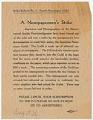
Seattle Newspaper Guild Strike Bulletin No. 1, August 1936
Spurred by "arbitrary" dismissals and assignment changes and other 'efficiency' moves" by the Seattle Post-Intelligencer, 35 newspaper writers went on strike from August 19 to November 29, 1936. This small group of strikers was able to force P-I owner William Randolph Hearst to recognize the union. Through the strike, the union was able to negotiate a 40-hour work week, originally…
ID Number:MS.COLL.1432
Date:1936
Photograph
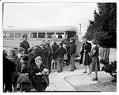
Civil defense workers in first aid drill, March 1942
During World War II, Seattle-area communities set up volunteer civil defense groups to help in case they were attacked. Men, women and even children joined up to help with such things as fighting fires, running air raid shelters, driving ambulances, and caring for the injured. Each community held periodic drills to make sure that everything would run smoothly in an…
ID Number:PI27990
Date:1942
Photograph
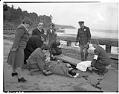
Civil defense workers in first aid drill, Vashon Island, 1942
During World War II, Seattle-area communities set up volunteer civil defense groups to help in case they were attacked. Men, women and even children joined up to help with such things as fighting fires, running air raid shelters, driving ambulances, and caring for the injured. Each community held periodic drills to make sure that everything would run smoothly in an…
ID Number:PI27991
Date:1942
Photograph
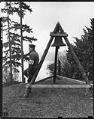
Paul Billingsley at civil defense lookout, Vashon Island, 1942
During World War II, Seattle-area communities set up volunteer civil defense groups to help in case they were attacked. Men, women and even children joined up to help with such things as fighting fires, running air raid shelters, driving ambulances, and caring for the injured. Each community held periodic drills to make sure that everything would run smoothly in an…
ID Number:PI27993
Date:1942
Photograph
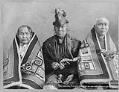
Three brothers, headmen of the Chilkat, Alaska, 1907
The Chilkat are a Tlingit tribe who have lived in and around their village of Klukwan on the Chilkat River, in southeastern Alaska since time immemorial. They lived on foods available on their lands as well as trading with other tribes on the Pacific coast and inland. Settlers came to Chilkat lands in large numbers in the early 20th century,…
ID Number:SHS11398
Date:1907
Photograph
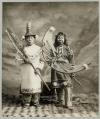
Tlingit man and woman in full potlatch costumes, Alaska, 1906
The Tlingit people have lived on the coast and islands of what is now southeastern Alaska since time immemorial. Tlingit society is organized into clans, which follow maternal descent. Fishing, gathering, and hunting were central to historic Tlingit lifeways – they used salmon, shellfish, seals, berries, deer, and other food sources. They used every part for different purposes, not wasting…
ID Number:SHS14102
Date:1906
Photograph
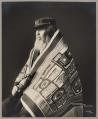
Chief Anotklosh of the Taku, Alaska, circa 1913
The Tlingit people have lived on the coast and islands of what is now southeastern Alaska since time immemorial. Tlingit society is organized into clans, which follow maternal descent. Fishing, gathering, and hunting were central to historic Tlingit lifeways – they used salmon, shellfish, seals, berries, deer, and other food sources. They used every part for different purposes, not wasting…
ID Number:SHS14163
Date:Circa 1913