1668 results for: Webster
Photograph
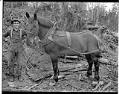
A logger and his horse, circa 1905
Horses were used widely in the logging industry because they were strong, surefooted, and intelligent. They could pull cut logs from steep slopes and dense woods.In this photo, taken sometime around 1905, a logger stands by his brawny horse. The horse's harness would be attached by ropes to one end of a log, and the logger would lead the animal…
ID Number:1983.10.6885
Date:Circa 1905
Photograph
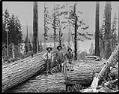
Loggers with large logs, circa 1902
Handwritten on sleeve: Crew & big logs at top of chute.Webster & Stevens number: 2438
ID Number:1983.10.6886
Date:Circa 1902
Photograph
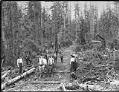
Horse team pulling log on skid road, circa 1902
At first, loggers used oxen to haul logs out of the woods. Later, they used horses, which were more intelligent and easier to handle. The teams pulled the logs along skid roads to a river or railroad line. Skid roads were built of logs laid across or along the track. Greasing the skid road logs made it easier to pull…
ID Number:1983.10.6887
Date:Circa 1902
Photograph
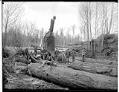
Yarding logs with a steam donkey, April 11, 1903
Yarding is the process of hauling logs to a central loading area or landing. Starting in the 1880s, steam engines began to replace animal teams for yarding logs. These steam donkeys or donkey engines were fueled with ever-plentiful wood. A long cable was attached to a log, and the donkey engine reeled it in. Many donkey engines were built on…
ID Number:1983.10.6888
Date:1903
Photograph
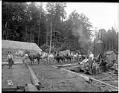
Horse team in logging camp, circa 1902
At first, loggers used oxen to haul logs out of the woods. Later, they used horses, which were more intelligent and easier to handle. The teams pulled the logs along skid roads to a river or railroad line. Handwritten on sleeve: 14 horse team & Donkey engine with crew at camp.Webster & Stevens number: 2447
ID Number:1983.10.6892
Date:Circa 1902
Photograph
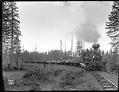
Train hauling logs, circa 1902
At first, logging companies cut trees along rivers and other bodies of water. They floated the logs downstream to the sawmill. After these areas were logged over, companies began using railroads to haul logs to a river or directly to the mill. The tracks could be moved as needed. Handwritten on sleeve: Log train.Webster & Stevens number: 2444
ID Number:1983.10.6893
Date:Circa 1902
Photograph
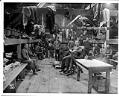
Loggers in a logging camp bunkhouse, circa 1903
The men who worked in logging camps lived together in crude bunkhouses. Conditions in the camps were harsh, uncomfortable, and dirty.This photo was taken at a logging camp somewhere in Oregon or Washington. Many of the men are seated at the edge of their straw-filled bunks. Clothes and other belongings hang from the rafters or sit on the floor. Due…
ID Number:1983.10.6899
Date:Circa 1903
Photograph
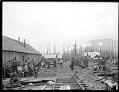
Logging camp with crew, circa 1910
Logging companies set up temporary camps near areas where trees were being cut. The camps had many buildings: bunkhouses for the logging crews to live in, cookhouses for meals, and buildings for other camp operations. Some companies built their camp buildings on skids or wheels. As each area was logged out, the buildings could be moved to the next location.This…
ID Number:1983.10.6904
Date:Circa 1910
Photograph
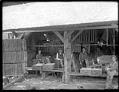
Workmen packing shingles at the Holcom-Hartley mill, circa 1905
For many years, strong and waterproof cedar shingles have been used on the roofs and outside walls of houses throughout the United States. Shingle-making has been an important part of the Northwest's lumber industry.In this photo, taken sometime around 1905, workers are packing shingles into bales for shipment from a mill in Snohomish County. Webster & Stevens number: 2468
ID Number:1983.10.6906
Date:Circa 1905
Photograph
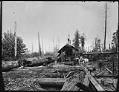
Yarding logs with a steam donkey, circa 1902
Yarding is the process of hauling logs to a central loading area or landing. Starting in the 1880s, steam engines began to replace animal teams for yarding logs. These steam donkeys or donkey engines were fueled with ever-plentiful wood. A long cable was attached to a log, and the donkey engine reeled it in. Many donkey engines were built on…
ID Number:1983.10.6910
Date:Circa 1902