1868 results for: Seattle Times
Photograph
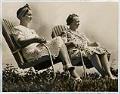
Marjorie Jones and Helen Dorman planning for UW garden party, Seattle, July 18, 1941
Marjorie (Macklen) Jones (1892-1987) was a prominent social services activist in Seattle, and was married to Robert M. Jones (1882-1954), a long-time King County Superior Court judge. Ms. Jones was named to the state's first committee on aging in the 1930s, established the statewide Friendly Visiting Service to help the elderly, and organized day care for women who went to…
ID Number:2000.107.101.12.03
Date:1941
Photograph
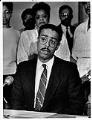
James Kelly speaking at press conference at Mt. Zion Baptist Church, Seattle, December 5, 1988
James Kelly came to Seattle from his native Illinois in 1976, and received a Masters degree in Social Work from the University of Washington in 1980. Kelly worked as an investigator for Washington State Child Protective Services, and in the Seattle City Attorney’s Office, before being appointed by Governor Booth Gardner to head the newly created Commission on African-American Affairs…
ID Number:2000.107.103.19.01
Date:1988
Photograph
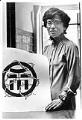
Cherry Kinoshita holding symbol of Japanese American incarceration, Seattle, July 22, 1988
Born in Seattle, Cherry Tanaka Kinoshita (1923-2008) was incarcerated at Minidoka Relocation Center during World War II. She married, returned to Seattle in 1950, and raised a family. Kinoshita was particularly active in efforts to obtain an apology and reparations from the United States government for the wartime incarceration of Japanese Americans. In 1980, Kinoshita became a founder of the…
ID Number:2000.107.105.35.01
Date:1988
Photograph
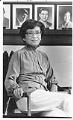
Cherry Kinoshita, Seattle, July 22, 1988
Born in Seattle, Cherry Tanaka Kinoshita (1923-2008) was interned at Minidoka Relocation Center during World War II. She married, returned to Seattle in 1950, and raised a family. Kinoshita was particularly active in efforts obtain an apology and reparations from the United States government for the wartime incarceration of Japanese Americans. In 1980, Kinoshita became a founder of the Washington…
ID Number:2000.107.105.35.02
Date:1988
Photograph
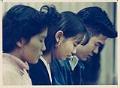
High school students at Korean Presbyterian Church of Seattle, Mountlake Terrace, January 1990
The Korean Presbyterian Church of Seattle was founded around 1974. In the late 1980s, the roughly 1,000-member congregation purchased a building in Mountlake Terrace in southern Snohomish County. The church has remained there, serving the spiritual and social needs of Koreans in the greater Seattle area. In late January 1990, a Seattle Post-Intelligencer photographer took this image of three young…
ID Number:2000.107.107.32.03
Date:1990
Photograph
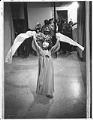
Young girl performing Crown Dance at Sand Point Community Church, Seattle, January 23, 1977
In late January 1977, Seattle's Sand Point Community Church celebrated Korea Day. Korean families entertained attendees with dances, a fashion show of traditional costumes, movies, and language lessons. Here, Young-Mi Song performs the Crown Dance. Sand Point Community Church, in northeast Seattle, was founded sometime around 1944. It is now known as Sand Point Community United Methodist Church. Caption information…
ID Number:2000.107.107.32.04
Date:1977
Photograph
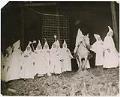
Klansmen at initiation ceremony at Wilson Station, Renton, July 14, 1923
A resurgence of Ku Klux Klan (KKK) movement between 1915 and the mid-1920s, in what historians call the "Second Klan," reached all 48 states, with membership over four million in the mid-1920s. Although the Klan's core belief in white supremacy, at least with regard to African Americans, had less resonance in Washington State, by 1921 there was a ready audience…
ID Number:2000.107.108.16.05
Date:1923
Photograph
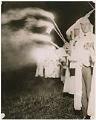
Klansmen at initiation ceremony at Wilson Station, Renton, July 14, 1923
A resurgence of Ku Klux Klan (KKK) movement between 1915 and the mid-1920s, in what historians call the "Second Klan," reached all 48 states, with membership over four million in the mid-1920s. Although the Klan's core belief in white supremacy, at least with regard to African Americans, had less resonance in Washington State, by 1921 there was a ready audience…
ID Number:2000.107.108.16.06
Date:1923
Photograph
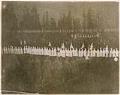
Klansmen at initiation ceremony at Wilson Station, Renton, July 14, 1923
A resurgence of Ku Klux Klan (KKK) movement between 1915 and the mid-1920s, in what historians call the "Second Klan," reached all 48 states, with membership over four million in the mid-1920s. Although the Klan's core belief in white supremacy, at least with regard to African Americans, had less resonance in Washington State, by 1921 there was a ready audience…
ID Number:2000.107.108.16.07
Date:1923
Photograph
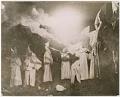
Klansmen at initiation ceremony at Wilson Station, Renton, July 14, 1923
A resurgence of Ku Klux Klan (KKK) movement between 1915 and the mid-1920s, in what historians call the "Second Klan," reached all 48 states, with membership over four million in the mid-1920s. Although the Klan's core belief in white supremacy, at least with regard to African Americans, had less resonance in Washington State, by 1921 there was a ready audience…
ID Number:2000.107.108.16.08
Date:1923