896 results for: Performing Arts
Photograph
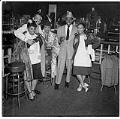
Group near bar at Black & Tan nightclub, Seattle, circa 1945
Seattle's Jackson Street jazz clubs flourished in the first half of the twentieth century, with their popularity peaking in the late 1930s through early 1950s. Seattle-born photographer Al Smith was a familiar figure in the clubs, often taking pictures of musicians and patrons, then returning the following week to sell prints.Here Al Smith photographs a group of friends posing in…
ID Number:2014.49.16.076.01
Date:Circa 1945
Photograph
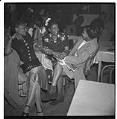
Three women talking at nightclub table, Seattle, circa 1945
Seattle's Jackson Street jazz clubs flourished in the first half of the twentieth century, with their popularity peaking in the late 1930s through early 1950s. Seattle-born photographer Al Smith was a familiar figure in the clubs, often taking pictures of musicians and patrons, then returning the following week to sell prints.Here, Smith photographs three women sitting at a table enjoying…
ID Number:2014.49.16.085.10
Date:Circa 1945
Photograph
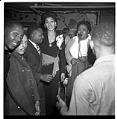
Women singing at microphone at the Black & Tan nightclub, 1944
Seattle's Jackson Street jazz clubs flourished in the first half of the twentieth century, with their popularity peaking in the late 1930s through early 1950s. Seattle-born photographer Al Smith was a familiar figure in the clubs, often taking pictures of musicians and patrons, then returning the following week to sell prints.Here, Smith photographs two women singing at a microphone at…
ID Number:2014.49.16.101.03
Date:1944
Photograph
Crowd at nightclub, Seattle. circa 1945
Seattle's Jackson Street jazz clubs flourished in the first half of the twentieth century, with their popularity peaking in the late 1930s through early 1950s. Seattle-born photographer Al Smith was a familiar figure in the clubs, often taking pictures of musicians and patrons, then returning the following week to sell prints. Here, Smith photographs patrons enjoying themselves at an unidentified…
ID Number:2014.49.16.108.01
Date:Circa 1945
Photograph
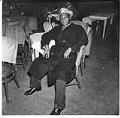
Man seated at table at the Black and Tan nightclub, Seattle, February 1945
Seattle's Jackson Street jazz clubs flourished in the first half of the twentieth century, with their popularity peaking in the late 1930s through early 1950s. Seattle-born photographer Al Smith was a familiar figure in the clubs, often taking pictures of musicians and patrons, then returning the following week to sell prints.On this occasion, Smith photographed a comfortably seated club patron…
ID Number:2014.49.16.111.06
Date:1945
Photograph
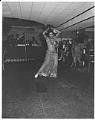
Dancer performing at club, Seattle, circa 1948
Here, a woman bellydances for a small audience at an unidentified Seattle nightclub, possibly the Basin Street on S. Jackson Street and Maynard Avenue S.
ID Number:2014.49.018.042.0091
Date:Circa 1948
Photograph
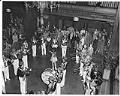
Marching band at the U.S. Post Office convention, Seattle, 1950
The marching band from Seattle Branch 79 of the National Association of Letter Carriers plays at an unidentified hotel for the 1950 U.S. Post Office convention.
ID Number:2014.49.018.045.0098
Date:1950
Photograph
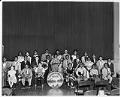
Neighborhood House youth band, 1954
Neighborhood House opened in 1906 as a settlement established by the National Council of Jewish Women to provide services to Jewish immigrants. In 1956, with the help of the Seattle Housing Authority, the agency secured building space in the Yesler Terrace community. Neighborhood House continues to serve the Central District, immigrant communities, and public housing residents of King County.Here, the…
ID Number:2014.49.29.01.10
Date:1954
Photograph
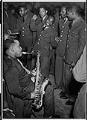
Pete Peterson playing saxophone for a group of servicemen, Seattle, circa 1944
Seattle's Jackson Street jazz clubs flourished in the first half of the twentieth century, with their popularity peaking in the late 1930s through early 1950s. Seattle-born photographer Al Smith was a familiar figure in the clubs, often taking pictures of musicians and patrons, then returning the following week to sell prints.On this occasion, Smith photographed a group of servicemen listening…
ID Number:2014.49.29.09.01
Date:Circa 1944
Photograph
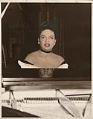
Hazel Scott at the piano, Seattle, October 11, 1947
Hazel Scott (1920-1981), a classical and jazz pianist and singer, performed at Seattle's Civic Auditorium on October 11, 1947. MOHAI’s 2022 Curator’s Fellow Brittney Frantece explored the photographs in the Al Smith Collection for how they demonstrate Black worldbuilding in Seattle. Looking at this photograph, Frantece offered the following analysis:The Al Smith collection demonstrates that experimentation is key to worldbuilding…
ID Number:2014.49.36.01.01
Date:1947