135 results for: Tolman, Cary W.
Photograph
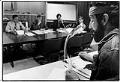
Roberto Maestas speaking to city council members, Seattle, June 11, 1974
Seattle had a growing Latino population in the late 1960s, and activists had been pressing the city for a building in which to establish a Chicano community center. Tired of having their requests ignored, in October 1972 they took over the abandoned Beacon Hill School on 16th Avenue South and renamed it El Centro de la Raza. After a 75-day…
ID Number:2000.107.117.04.03
Date:1974
Photograph
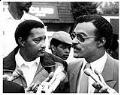
Jim Mason and Eddie Rye, Jr. talking to press, Spetember 15, 1986
On September 15, 1986, about two dozen African American contractors and unemployed workers visited the Guy F. Atkinson Co. job site near the Mount Baker tunnel to express their dissatisfaction with minority hiring and contracting procedures used by the firm. Eddie Rye Jr., a representative of the Black Contractors Coalition, told Atkinson representative Ira Fell that the group was particularly…
ID Number:2000.107.119.28.01
Date:1986
Photograph
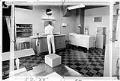
Infirmary at McNeil Island Penitentiary, March 1971
McNeil Island is a 6.6 square mile island located in south Puget Sound, lying 2.8 miles across the water from the nearest town. The site was utilized for 142 continuous years as an island-based penal institution, beginning in 1869 with a jail built by the U.S. Army Corps of Engineers. In 1909 the facility became a federal prison, the McNeil…
ID Number:2000.107.123.17.04
Date:1971
Photograph
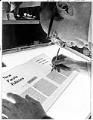
Chuck McClellan working on magazine at McNeil Island Penitentiary, January 3, 1975
McNeil Island is a 6.6 square mile island located in south Puget Sound, lying 2.8 miles across the water from the nearest town. The site was utilized for 142 continuous years as an island-based penal institution, beginning in 1869 with a jail built by the U.S. Army Corps of Engineers. In 1909 the facility became a federal prison, the McNeil…
ID Number:2000.107.123.18.04
Date:1975
Photograph
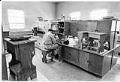
Inmate working in hobby shop at McNeil Island Penitentiary, March 20, 1968
McNeil Island is a 6.6 square mile island located in south Puget Sound, lying 2.8 miles across the water from the nearest town. The site was utilized for 142 continuous years as an island-based penal institution, beginning in 1869 with a jail built by the U.S. Army Corps of Engineers. In 1909 the facility became a federal prison, the McNeil…
ID Number:2000.107.123.18.05
Date:1968
Photograph
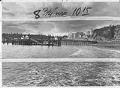
View of McNeil Island Penitentiary, March 3, 1971
McNeil Island is a 6.6 square mile island located in south Puget Sound, lying 2.8 miles across the water from the nearest town. The site was utilized for 142 continuous years as an island-based penal institution, beginning in 1869 with a jail built by the U.S. Army Corps of Engineers. In 1909 the facility became a federal prison, the McNeil…
ID Number:2000.107.123.19.03
Date:1971
Photograph
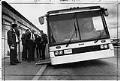
Metro drivers inspecting prototype kneeling bus, Seattle, March, 1975
In this image, the Rohn Industries Transbus, one of three prototype transit buses built by U. S. firms for possible production in the 1980s, gets the once-over from Metro drivers as it "knelt" on its air suspension system, allowing near-level entry up a front door wheelchair ramp. At the time Metro, was planning to replace its fleet of buses and…
ID Number:2000.107.124.28.02
Date:1975
Photograph
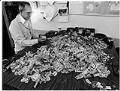
Metro cashier unfolding dollar bills, Seattle, September 24, 1984
In this image, Metro cashier Forrest Wright unfolds dollar bills that have been stuffed into the fare boxes on buses. He said he could easily do without Metro riders who fold a dollar bill into a triangle. "The tricky part for me is to find which side of the triangle opens so I don't tear the bill," he said. Caption…
ID Number:2000.107.124.31.05
Date:1984
Photograph
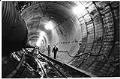
Two men walking in bus tunnel, Seattle, January 19, 1988
In this image, Seattle P.I. reporter James Wallace is accompanied through the bus tunnel by a Metro Transit inspector after the project was delayed because digging farther without stabilizing the soil could endanger building foundations. Most of the tunnel has a concrete structure; the wooden "whiskey barrel" structure at the right edge of the frame indicates a location where a…
ID Number:2000.107.124.34.04
Date:1988
Photograph
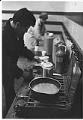
Isidoro Gonzales working in kitchen during occupation of Beacon Hill School, October 18, 1972
Seattle had a growing Latino population in the late 1960s, and activists had been pressing the city for a building in which to establish a Chicano community center. Tired of having their requests ignored, in October 1972 they took over the abandoned Beacon Hill School on 16th Avenue South and renamed it El Centro de la Raza. After a 75-day…
ID Number:2000.107.124.39.01
Date:1972