71 results for: Moore
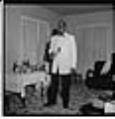
Photograph
Durwood Moore posing in formal attire, Seattle, circa 1953
Durwood Moore, holding a cocktail glass, stands on a flowered rug in the living room of an unidentified home. He wears semi-formal "black-tie" attire, complete with white dinner jacket and shirt, dark tie and cummerbund, and tuxedo pants. Shirley (Norris) Phelps sits at the table behind him. Traditionally, white dinner jackets were worn between Memorial Day and Labor Day, so…
ID Number:2014.49.006.021.0061
Date:Circa 1963
Photograph
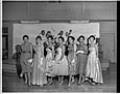
Seven women standing in front of stage, Seattle, circa 1953
Renee Moore (second from left), Mrs. James Jackson (third from right), and five unidentified women stand in front of a stage, all wearing fancy dresses and gloves. Playing onstage behind the women are saxophonist Terry Cruise, third from left, and his swing band. The venue is probably Washington Hall at 14th Avenue and Jackson Street.
ID Number:2014.49.014.036.0078
Date:Circa 1953
Photograph
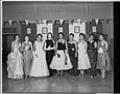
Nine women in formal attire, Seattle, circa 1953
Renee Moore (second from left), Marian Cousins (fourth from left), and seven unidentified women stand together, all wearing formal dresses and gloves. The location is probably Washington Hall at 14th Avenue and Jackson Street.
ID Number:2014.49.014.037.0079
Date:Circa 1953
Poster
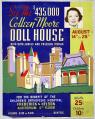
Colleen Moore's Doll House at Frederick & Nelson exhibit poster, Seattle, August 14-28, 1937
In 1928, silent film star Colleen Moore (1899-1988) assembled a legion of her industry colleagues to help craft a miniature home of fantastic proportions. Horace Jackson, an architect and set designer who worked for First National Studios, created the floor plan and layout of the doll house with the basic idea that "the architecture must have no sense of reality.…
ID Number:2015.70.1
Date:1937
Poster
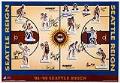
Seattle Reign poster with autographs, 1998-1999
The American Basketball League (ABL), the first women's professional basketball league, started in 1996 with the Seattle Reign as one of its charter member teams. Midway through its third season on December 22, 1998, the ABL suspended operations and filed for Chapter 11 bankruptcy protection, due to poor attendance, lack of sponsorship, and competition from the Women's National Basketball Association…
ID Number:2017.23.4
Date:1998
Ephemera
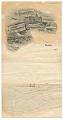
Washington Hotel stationery, 1905
The Denny Hotel project was begun in Seattle in 1889 by a group of developers that included Seattle founding father Arthur Denny (1822-1899). Unfortunately, the Panic of 1893 halted the proceedings with interiors incomplete, and the building was unfinished until 1903 when developer James A. Moore (1861-1929) bought the building at about Second Avenue and Pine Street. Mr. Moore convinced…
ID Number:2018.3.3.93
Date:1905
Music, notated
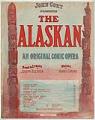
Mother Did from The Alaskan
Seattle landmark The Moore Theatre, the city's oldest still-active theater, opened on December 28, 1907, to a crowd of nearly 3,000. The first show, "The Alaskan," was a comic opera about prospecting during the Klondike Gold Rush, and featured falling snow, sled dogs, and 13 singing totem poles. This song "Mother Did" was one of several in the opera.Joseph Blethen,…
ID Number:2018.3.2.7
Date:1907
Poster
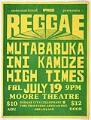
Reggae at the Moore poster, Seattle, circa 1986
Jamaican dub poet, educator, and reggae artist Mutabaruka (b. 1952) began publishing his poetry in 1971 and gained popularity as a musician in 1981, with the release of his first single. Jamaican reggae artist Ini Kamoze (b. 1975) also released his first single in 1981, and in 1986, Komze and Mutabaruka began to collaborate, with both artists singing on each…
ID Number:2018.86.119
Date:Circa 1986
Photograph
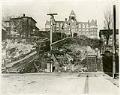
Counterbalance streetcar on 3rd Ave, Seattle, 1903
Denny Hill once stood north of what is now Seattle’s central business district, between Second and Fifth Avenues. Between 1889 and 1906, the Denny (later Washington) Hotel dominated its southern slope. The hill was so steep that the hotel’s second owner James Moore built a counterbalance streetcar on Third Avenue to carry guests up the two blocks from Pine Street.…
ID Number:SHS727
Date:1903
Photograph
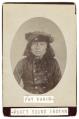
Pat Kanim, Snoqualmie Chief, circa 1855
The Snoqualmie people are a Coast Salish group who have lived in the Snoqualmie River Valley since time immemorial. They made dugout canoes which they used to navigate the river and reach Puget Sound. Traditionally the Snoqualmie burned off the bottom lands of the Snoqualmie Valley to create open areas that ensured an abundance of edible plants for foraging as…
ID Number:SHS1679
Date:Circa 1855