94 results for: Chicano/a Latino/a Culture
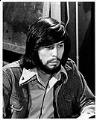
Photograph
Manuel Sandoval being interviewed about MEChA, Seattle, May 7, 1975
The activist Chicano student organization MEChA (Movimiento Estudiantil Chicanx de Aztlan) was founded in Santa Barbara, CA, in 1969, and has been active on college campuses for 50 years. The University of Washington (UW) MEChA chapter formed in 1970, a successor to the United Mexican American Students (UMAS). The organization addressed historical, social, religious, and political issues as well as…
ID Number:2000.107.159.38.01
Date:1975
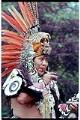
Photograph
Aztec dancer performing at Folklife Festival, Seattle Center, May 28, 1993
In this image Juan Salinas, leader of Ximali, a group of Aztec dancers from Mexico City, performs during Seattle's annual Northwest Folklife Festival. The festival has been held each Memorial Day weekend since 1972 at Seattle Center as a free celebration of folk and ethnic music, dance, and arts. Caption information derived from captions written by Post-Intelligencer staff.
ID Number:2000.107.172.37.10
Date:1993
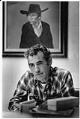
Photograph
Tomás Villanueva at United Farm Workers office, Granger, May 3, 1989
Tomás Villanueva (1941-2014) was a labor activist who spent decades advocating for the rights and welfare of farmworkers, especially Latino migrant workers. Villanueva was born in Monterrey in northern Mexico and immigrated to the United States with his family at age 13. The Villanueva family settled in Toppenish, Washington in 1958 after traveling across the US following farm work for…
ID Number:2000.107.220.23.02
Date:1989
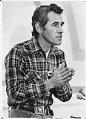
Photograph
Tomás Villanueva speaking at press conference, Seattle, October 29, 1987
Tomás Villanueva (1941-2014) was a labor activist who spent decades advocating for the rights and welfare of farmworkers, especially Latino migrant workers. Villanueva was born in Monterrey in northern Mexico and immigrated to the United States with his family at age 13. The Villanueva family settled in Toppenish, Washington in 1958 after traveling across the US following farm work for…
ID Number:2000.107.220.23.03
Date:1987
Photograph
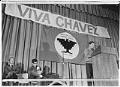
Cesar Chavez speaking at Garfield High School, December 19, 1969
Cesar Estrada Chávez (1927-1993) was a Mexican-American labor leader, community organizer, businessman, and civil rights activist. He co-founded, with Dolores Huerta, the National Farm Workers Association (NFWA), which later merged with the Agricultural Workers Organizing Committee (AWOC) to become the United Farm Workers (UFW) labor union. Chavez advocated for the use of direct but nonviolent actions, such as pickets and…
ID Number:2000.107.243.07.01
Date:1969
Photograph
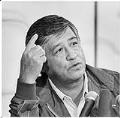
Cesar Chavez speaking at press conference, Seattle, December 3, 1985
Cesar Estrada Chávez (1927-1993) was a Mexican-American labor leader, community organizer, businessman, and civil rights activist. He co-founded, with Dolores Huerta, the National Farm Workers Association (NFWA), which later merged with the Agricultural Workers Organizing Committee (AWOC) to become the United Farm Workers (UFW) labor union. Chavez advocated for the use of direct but nonviolent actions, such as pickets and…
ID Number:2000.107.243.07.02
Date:1985
Photograph
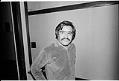
Roberto Gallegos, Seattle, October 13, 1972
While 1970 census figures showed that Spanish-speaking residents made up 5% of Seattle's population – similar in numbers to Black residents - the fact that they were scattered in various parts of the city made them less visible as an ethnic group. Language issues and historically based fears of deportation were also a factor, particularly for those from Mexico. In…
ID Number:2000.107.19721013.1.08a
Date:1972
Photograph
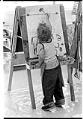
Terrez Weir painting at El Centro de la Raza's bilingual child care program, Seattle, September 1974
As more women started working outside the home, child day care and after-school activities became critical. In the Seattle area, El Centro de la Raza (The Center for People of All Races) stepped in to provide this. In 1974, El Centro opened a bilingual day care program in the basement of Beacon Hill United Methodist Church. The center, run by…
ID Number:2000.107.19740924.2.11
Date:1974
Photograph
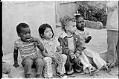
Children at El Centro de la Raza's bilingual child care program, Seattle, September 1974
As more women started working outside the home, child day care and after-school activities became critical. In the Seattle area, El Centro de la Raza (The Center for People of All Races) stepped in to provide this. In 1974, El Centro opened a bilingual day care program in the basement of Beacon Hill United Methodist Church. The center, run by…
ID Number:2000.107.19740924.2.14
Date:1974
Photograph
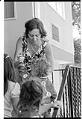
Director Lucia Rios at bilingual child care program sponsored by El Centro de la Raza, Seattle, September 1974
As more women started working outside the home, child day care and after-school activities became critical. In the Seattle area, El Centro de la Raza (The Center for People of All Races) stepped in to provide this. In 1974, El Centro opened a bilingual day care program in the basement of Beacon Hill United Methodist Church. The center, run by…
ID Number:2000.107.19740924.2.20
Date:1974