1669 results for: Webster
Photograph
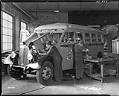
Men building bus in Kenworth plant, Seattle, 1934
The Kenworth Motor Truck Company got its start building heavy-duty trucks for the timber industry. It later expanded its line to include moving vans, delivery trucks, fire trucks, and buses. Kenworth is now a subsidiary of PACCAR. This 1934 photo shows men working on a bus in the Seattle Kenworth factory at Yale and Mercer streets in Seattle. During the…
ID Number:1983.10.4964.39
Date:1934
Photograph
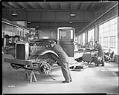
Assembly line at the Kenworth truck plant, 1934
The Kenworth Motor Truck Company got its start building heavy-duty trucks for the timber industry. It later expanded its line to include moving vans, delivery trucks, fire trucks, and buses. This 1934 photo shows men assembling a truck in the Seattle Kenworth factory. Webster & Stevens number: 34-344
ID Number:1983.10.4964.40
Date:1934
Photograph
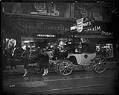
Horse and carriage outside Bender & Kohlstad, Seattle, 1934
Edwin Bender (1901-1984) opened his menwear shop (also known as Bender Kohlstad) in the Medical Dental Building in Seattle in the late 1920s. Bender ran the store at this location until 1969 when he retired and sold the business to Ben Lerner. Signs in image: Bender & Kohlstad. Dobbs Hats. We Aim to Save You At Least $10. Florsheim Shoes…
ID Number:1983.10.4965.51
Date:1934
Photograph
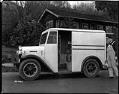
Milkman with Kenworth delivery truck, probably in Seattle, 1932
The Kenworth Motor Truck Company got its start building heavy-duty trucks for the timber industry. It later expanded its line to include moving vans, delivery trucks, fire trucks, and buses. Kenworth is now a subsidiary of PACCAR.This photo, taken around 1932, shows a milkman with a Kenworth delivery truck. Although the truck does not have any identification, the eggs the…
ID Number:1983.10.4968.13
Date:1932
Photograph
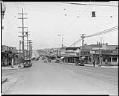
Greenwood street scene, circa 1932
In the 1930s, Seattle's northern city limits were at 85th Street, in the Greenwood neighborhood. People could take the streetcar to Greenwood and catch the interurban railway north to Everett and other outlying towns.This photo shows what the Greenwood business district looked like around 1932. Webster & Stevens number: P1304
ID Number:1983.10.4969.24
Date:1932
Photograph
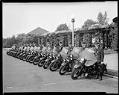
Motorcycle patrolmen, Seattle, 1931
Seattle's police department started using motorcycles some time after 1912. In 1932, the department had 33 motorcycles, and patrolmen drove over 173,000 miles in the course of duty. In this 1931 photo, Seattle's motorcycle police stand in Volunteer Park with their cycles.
ID Number:1983.10.4969.31
Date:1931
Photograph
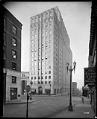
Exchange Building, Seattle, circa 1930
The Exchange Building is one of several Art Deco office buildings in Seattle. It was designed as a home for stock and commodity exchanges. The Exchange Building was the last large downtown building built before the Depression of the 1930s hit the city. It was Seattle's tallest building until after World War II ended in 1945. Sign in image: The…
ID Number:1983.10.4971.41
Date:Circa 1930
Photograph
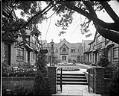
Tudor Manor Apartments, Seattle, circa 1931
During the 1920s, English Tudor style courtyard apartments were constructed in several Seattle neighborhoods, especially Capitol Hill. Frederick William Anhalt was the most notable architect responsible for these apartments, which are highly regarded today. Handwritten on sleeve: Tudor Manor Apts.Webster & Stevens number: P061; P559
ID Number:1983.10.4971.48
Date:Circa 1931
Photograph
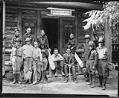
Boy Scouts at ranger station, circa 1930
The Boy Scout organization began in England and came to the United States in 1910. It quickly became the largest youth group in the country. Scouts went hiking, camping, and learned many outdoor skills. In this photo, taken around 1930, a group of Boy Scouts and their leaders visit a ranger station during a hike. Description in handwritten inventory: Boy…
ID Number:1983.10.4971.60
Date:Circa 1930
Photograph
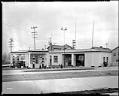
Mac's Complete Service automobile service station, circa 1933
Automobile drivers originally bought gasoline from streetside pumps at hardware stores, blacksmith shops, and other businesses. This practice often caused traffic jams and other problems. The Standard Oil Company opened its first drive-in filling station in Seattle in 1907, solving one cause of traffic congestion. By the 1920s, gas stations also offered oil changes, new tires, and complete car care.This…
ID Number:1983.10.4971.67
Date:Circa 1933