63 results for: Pacific Car
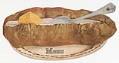
Menu
Northern Pacific Railway, Yellowstone Park Line menu, circa 1910
This dining car menu features a "Great Big Baked Potato" on its cover. In 1909, Northern Pacific served its first oversized baked potato on their North Coast line, utilizing a special rack with spikes to cook inexpensive extra large Yakima Valley potatoes on board the train. The dish became part of Northern Pacific's marketing and even led the North Coast…
ID Number:2014.3.1.71
Date:Circa 1910
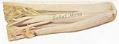
Menu
Northern Pacific Railway, Yellowstone Park Line salad menu, circa 1920
The Northern Pacific Railway Dining Car Department issued this salad menu in June 1915. The cover shows a bunch of celery, as salads are the sole offerings.
ID Number:2014.3.1.72
Date:Circa 1920
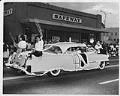
Photograph
Mardi Gras parade float, Seattle, circa 1955
For over 70 years, Seattle’s Black community has a held a summer festival that was part of Seattle's International Festival, now Seafair. The first, in 1952, was called the East Madison/East Union Mardi Gras. Mardi Gras later transformed into the Pacific Northwest Black Community Festival, and in 1997 it became the Umoja Fest African Heritage Festival. Here, a group of…
ID Number:2014.49.29.01.13
Date:Circa 1955
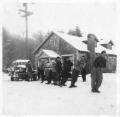
Photograph
Pacific Northwest Cycling Association group pulling a car in the snow, Glacier, Washington, January 1, 1950
The Pacific Northwest Cycling Association was founded in 1940 by a group of racing cyclists and University of Washington students who had purchased some of the new "lightweight" English bicycles imported to Seattle prior to World War II. The increased popularity of recreational cycling dovetailed with the growing youth hostel movement in the Puget Sound area and British Columbia area,…
ID Number:2016.16.8.1
Date:1950
Ephemera
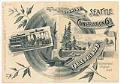
Invitation to opening of Cable Railroad, September 29, 1888
In September 1888, Seattle's second street railway line was built by Pacific Cable Construction Company as a single-track cable car line, running in a loop from Pioneer Square to Leschi Park. This line, the Yesler Way line, effectively linked the steamers docking at Elliott Bay with the ferries crossing Lake Washington. When the line was built the residential and recreational…
ID Number:2018.3.3.75
Date:1888
Music, notated
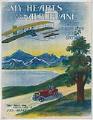
My Heart's in the Aeroplane
“My Heart’s in the Aeroplane” was published in 1911, some eight years after the Wright Brothers made their first flight. The subtitle, “The Latest Air Ship Love Song Success”, implies that this new topic was a popular one. The sheet music cover shows two men flying a fragile airplane, watched from below by a couple in a car. The setting,…
ID Number:2018.3.2.10
Date:1911
Photograph
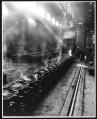
Pacific Car and Foundry plant, Renton, 1954
The Pacific Car and Foundry Company got its start in Seattle in the early 1900s building railroad cars for the logging industry. The company expanded quickly and, in 1905, bought land in Renton for a new plant. Now known as PACCAR, the company has factories in five countries, making heavy-duty trucks and other vehicles, railcars, and mining equipment.This photo of…
ID Number:Lib1993.20.193
Date:1954
Photograph
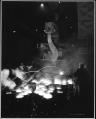
Bethlehem Steel Company factory, Seattle, 1957
New York City-born William Pigott (1860-1929) founded two of Seattle's major industrial enterprises, Seattle Steel Company and Seattle Car Manufacturing Company (later Pacific Car and Foundry Company, or PACCAR). Seattle Steel Company (later Bethlehem Steel Company and Birmingham Steel Company) began operations in 1905 on 55 acres of tide flats in Humphrey (later Youngstown and West Seattle). The steel and…
ID Number:Lib1993.20.313
Date:1957
Photograph
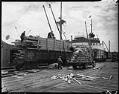
Truck and railroad car with cargo, Seattle, 1934
Since the latter part of the 19th century, Seattle has been a transshipment point for goods traveling between the United States and other Pacific Ocean ports. At the docks, longshoremen transferred the cargo between ships and the railroad. In the 1930s, they did most of this work by hand; by the 1990s, many dockworkers had been replaced by machinery. Handwritten…
ID Number:PI24029
Date:1934
Photograph
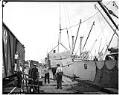
Men unloading cargo from ship, circa 1935
Since the latter part of the 19th century, Seattle has been a transshipment point for goods traveling between the United States and other Pacific Ocean ports. At the docks, longshoremen transferred the cargo between ships and the railroad. In the 1930s, they did most of this work by hand; by the 1990s, many dockworkers had been replaced by machinery.In this…
ID Number:PI24030
Date:Circa 1935