584 results for: Alaska
Photograph
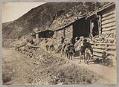
Mule train moving by the side of the Klondike River, circa 1904
Even after the opening of railroad and steamboat routes along the Yukon River and its tributaries, mules and other pack animals still carried some of the supplies to the Klondike gold fields. This was hard work, and good packtrain owners knew to pack their animals carefully and feed them well.In this photo, taken by Larss & Duclos around 1904, a…
ID Number:SHS9581
Date:Circa 1904
Photograph
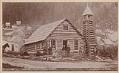
Log cabin church, Juneau, Alaska, 1896
Juneau, Alaska, was settled in 1880. In 1900, the capital of Alaska moved to Juneau from Sitka. In 1905, Juneau was a city of 2,000 people with about 6,000 miners and prospectors working in nearby gold-bearing quartz deposits. Most of the trees on the hillsides above the town were cut to supply wood for buildings, fuel, and other needs.This photo…
ID Number:SHS9764
Date:1896
Photograph
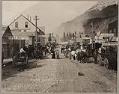
Skagway street scene, 1898
By 1898, Skagway, Alaska, had a busy business district which sold goods and services to people leaving for the Klondike gold fields.This photo shows downtown Skagway in 1898. Businesses which can be seen in the photo include drugstores, outfitters, an agency for hiring packers to carry one's supplies along the trail, a hardware store and tinsmith, and several saloons. Two…
ID Number:SHS9768
Date:1898
Photograph
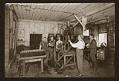
Bayview Brewery bottling room, 1902
The Seattle Brewing & Malting Company built its Bayview Brewery on Ninth Avenue South in 1890. The brewery's premium Rainier Beer and its other brews satisfied thirsts from the Alaska gold fields to California and across the Pacific to Asia.This photo, taken at Bayview Brewery in 1902, shows the what is probably the bottling room. Several brewery workers stand near…
ID Number:SHS9788
Date:1902
Photograph
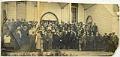
Members of the Seattle Chamber of Commerce, circa 1904
The Seattle Metropolitan Chamber of Commerce was founded on April 17, 1882, by a group of 26 business and community leaders, to devise a way to win a $12,000 annual mail route to Alaska over a competing San Francisco steamship company. The Chamber's first decade was dominated by the fight to obtain a railroad for Seattle. Chamber founders Thomas Burke,…
ID Number:SHS9796
Date:Circa 1904
Photograph
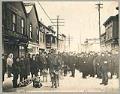
Ned Darling posing with dog sled team before departure for Seattle, Nome, Alaska, February 2, 1906
The world's record for the fastest time of a midwinter "mush" from Nome to Seattle via Valdez was set by Charles Edward "Ned" Darling (1871-1923) at 42 days, beating the previous record by four days. Born in Ireland, at the time of this image Ned was a hardware merchant in Nome, Alaska. He moved to Berkeley, California, before 1920 with…
ID Number:SHS9888
Date:1906
Photograph
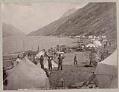
Klondikers sailing down Lake Bennett, May 30, 1898
In the spring of 1898, the air at Bennett was filled with the sound of hammering and sawing as gold seekers cut trees and built boats to head downstream. The ice on Lake Bennett broke up on May 29, 1898. Within a week, over 1,000 boats started across the lake and down the Yukon River to the Klondike gold fields.This…
ID Number:SHS9906
Date:1898
Photograph
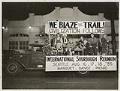
Sourdoughs posing on truck at reunion, Seattle, August 1935
The Klondike Gold Rush was a migration by an estimated 100,000 prospectors to the Klondike region of the Yukon in north-western Canada between 1896 and 1899. The events of the Klondike gold rush rapidly became embedded in North American culture, being captured in poems, stories, photographs, and promotional campaigns long after the end of the stampede. Some terminology from the…
ID Number:SHS10085
Date:1935
Photograph
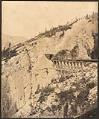
White Pass & Yukon Route train, trestle, and tunnel, circa 1899
The first leg of the White Pass & Yukon Route railroad line was the most difficult to build. Between Skagway and White Pass, the tracks climbed 2,885 feet in just 21 miles. This required several switchbacks and careful tracklaying in order to make the route safe and passable. A 250 foot tunnel had to be blasted through solid rock. This…
ID Number:SHS10117
Date:Circa 1899
Photograph
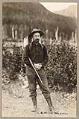
Alaska prospector, circa 1901
Sometime between 1897 and 1908, a photographer by the name of Reese took two photographs of the same Alaskan miner and gave them different titles. This photo, taken from the front, shows the miner holding his rifle and wearing a pack on his back. His coffeepot hangs by his side. Another photo in this collection, entitled "Alaska Packer," shows the…
ID Number:SHS10342A
Date:Circa 1901