1951 results for: ACT-UP/Seattle
Ephemera
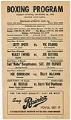
Al Hostak and Kid Matthews boxing program, September 29, 1942
Seattle boxing champ Albert "Al" Hostak (1916-2006), nicknamed "the Savage Slav," was born in Minneapolis to Czech immigrants who later moved to Seattle's Georgetown neighborhood. He dropped out of Cleveland High School at 16 years old to pursue a career in boxing, and had his debut fight in 1932. He retired from boxing in 1949 with a record of 64…
ID Number:1982.216.135
Date:1942
Photograph
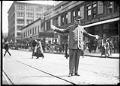
Police officer directing traffic at 4th and Pike, Seattle, circa 1920
In this image an unidentified Seattle Police officer directs pedestrian, automobile, and wagon traffic from the intersection of Fourth Avenue and Pike Street. On the right side of the frame, the menswear store Tailored Ready Co. is visible on the northwest corner of the intersection. The store sold "men's and boys' clothing, uniforms, hats, caps, trunks, and suit cases," at…
ID Number:1983.10.1089.2
Date:Circa 1920
Photograph
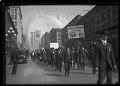
U.S. Army draftees parading through downtown, Seattle, May 10, 1918
On May 10, 1918, 62 men, conscripted from Seattle and King County through the new Selective Service system, paraded through downtown Seattle streets before entraining for Vancouver Barracks, where they would join the U.S. Army. The men assembled at the Soldiers' and Sailors' Club, where they received packages of food, tobacco, and other useful items, then marched to King Street…
ID Number:1983.10.1091.1
Date:1918
Photograph
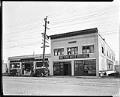
Exterior of The Nut House, Seattle, circa 1920
In 1909 Atlanta-born Anton Louis Delkin (1889-1974) arrived in Seattle from British Columbia with $40 cash and five barrels of peanuts. By 1918 Delkin, the "Chief Nut," was selling $1,350,000 worth of nuts per year through his company, The Nut House. After an attempt in the early 1920s to expand into additional cities, the board of trustees decided in 1923…
ID Number:1983.10.1287
Date:Circa 1920
Photograph
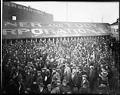
General strike participants leaving shipyards, Seattle, February 1919
The Seattle General Strike was a work stoppage by more than 65,000 workers in Seattle from February 6-11, 1919. The strike began in shipyards when workers were refused pay increases after two years of World War I wage controls. Most of the city's 110 local unions, including members of the American Federation of Labor (AFL) and the Industrial Workers of…
ID Number:1983.10.1347.3
Date:1919
Photograph
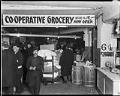
Customers shopping inside Co-operative Grocery Store No. 1, Seattle, circa 1918
The Co-operative Grocery was part of the South End Public Market operating at Washington Street and Third Avenue South. The union-run market's offerings included restaurants, fresh produce, fresh and cured meats, and free delivery. This photo shows men and women shopping at the grocery, with a cart full of Crescent Baking Powder in the middle, a sign explaining that "This…
ID Number:1983.10.1377
Date:Circa 1918
Photograph
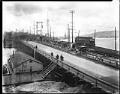
View of Latona Bridge and Lake Union, Seattle, circa 1915
Seattle's first substantial bridge to cross Lake Union was the Latona Bridge, a pile-driven, fixed-span bridge linking the Eastlake neighborhood to the University District at Portage Bay. Constructed in 1891 for Seattle pioneer and investor David T. Denny (1832-1903) as an extension of his Rainier Power & Railway Co., the bridge was rebuilt in 1902 to allow pedestrian and vehicular…
ID Number:1983.10.1383.2
Date:Circa 1915
Photograph
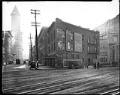
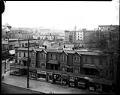
View of Yesler Way from Railroad Ave., Seattle, circa 1915
This image of Yesler Way was taken facing east, looking towards the Smith Tower at Second Avenue and Yesler Way. The tracks in the foreground are part of what was Railroad Avenue (now Alaskan Way), which ran along Seattle's waterfront. The brick building in the center of the frame holds several businesses, the Bedford Hotel, listed at 73 1/2 Yesler…
ID Number:1983.10.1413.2
Date:Circa 1915
Photograph
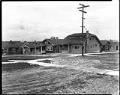
View of Pine Street between Fifth and Sixth avenues, Seattle, circa 1917
This view of Seattle faces southwest from Pine Street (running left to right in foreground of image) towards First Hill, with the two 175 foot-tall towers of St. James Cathedral visible in the center distance. The photo must have been taken after February 2, 1916, the date of the collapse of the domed roof of the cathedral. It may have…
ID Number:1983.10.1430
Date:Circa 1917
Photograph
New homes on Capitol Hill, Seattle, circa 1915
Seattle's Capitol Hill neighborhood is part of a long ridge that overlooks downtown, and was logged off beginning in the 1880s. The neighborhood's chief developer, James Moore (1861-1929), gave the hill its name in 1901.This view of newly constructed craftsman-style houses was taken at what appears to be 18th Avenue NE and E Galer Street. The residences may have been…
ID Number:1983.10.1538.10
Date:Circa 1915