518 results for: Protests and Demonstrations
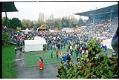
Photograph
Labor union rally at Memorial Stadium, Seattle, November 30, 1999
The Third Ministerial Conference of the World Trade Organization (WTO) was held in Seattle from November 30 to December 3, 1999. Trade ministers and other officials from the WTO's 135 member nations met in an unsuccessful attempt to plan negotiations to further deregulate free trade. Tens of thousands of activists for many causes gathered to protest what they saw as…
ID Number:2024.54.21.09
Date:1999
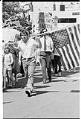
Photograph
Anti-abortion demonstration, Seattle, October 5, 1986
This image shows a protest against legal abortion, held in Seattle in early October 1986. Based on signs visible in this photo and other images of the same demonstration, the protesters were attempting to raise support for Initiative 479, which would have banned public spending on abortion services. Initiative 479 failed to gather enough signatures to make it to the…
ID Number:Lib1991.1.43.2
Date:1986
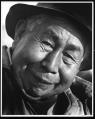
Photograph
Sherman Dominick, 1970
In the 1960s, Native Americans and their supporters began protesting Washington State laws restricting Native American fishing rights that had been granted in a series of treaties with the United States between 1854 and 1855. The Survival of the American Indian Society (SAIA), the NAACP, and the National Indian Youth Council (NIYC), coordinated a series of protests and peaceful demonstrations…
ID Number:Lib1993.20.240
Date:1970
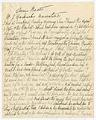
Manuscript
Morgan Carkeek's recollection of 1886 anti-Chinese riots, Seattle, circa 1900
A stone mason originally from England, Morgan James Carkeek (1847-1931) arrived in Seattle in 1870 and began building a construction and real estate empire. Mr. Carkeek and his wife, Emily (Gaskill) Carkeek (1852-1926), donated the land for Seattle's Carkeek Park. Deeply interested in conservation and the study of Seattle-area history, in 1911 the Carkeeks founded the Seattle Historical Society, which…
ID Number:MS.COLL.41
Date:Circa 1900
Ephemera
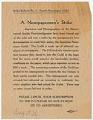
Seattle Newspaper Guild Strike Bulletin No. 1, August 1936
Spurred by "arbitrary" dismissals and assignment changes and other 'efficiency' moves" by the Seattle Post-Intelligencer, 35 newspaper writers went on strike from August 19 to November 29, 1936. This small group of strikers was able to force P-I owner William Randolph Hearst to recognize the union. Through the strike, the union was able to negotiate a 40-hour work week, originally…
ID Number:MS.COLL.1432
Date:1936
Photograph
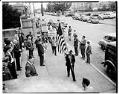
Protestors outside Canwell Committee hearings, Seattle, 1948
The Committee on Un-American Activities, also known as the Canwell Committee, held hearings in 1948 in the Seattle Armory. Organizations under investigation included the Seattle Repertory Theatre, the Building Service Employees Union, the Washington Pension Union, and University of Washington faculty. After being accused of Communist involvement many individuals lost their jobs and organizations were shut down. Protest signs read:…
ID Number:PI21683
Date:1948
Photograph
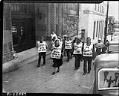
Demonstrators with signs outside Seattle Chamber of Commerce during WPA strike, Seattle, 1937
In 1936, the federal Works Progress Administration hired some 9,000 unemployed King County residents on 271 different projects ranging from improving roads and parks to serving school lunches. Congress reduced funding for the WPA in 1937, causing nationwide layoffs. In Seattle, some workers stormed the WPA offices to protest the layoffs. Others staged sitdown strikes or picketed on downtown sidewalks.This…
ID Number:PI22387
Date:1937
Photograph
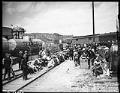
Striking longshoremen blocking train tracks at Pier 40, Smith Cove, Seattle, July 19, 1934
In the early 1930s, the International Longshoremen's Association, led by San Francisco-based Harry Bridges, tried to unionize all West Coast dockworkers to improve pay and working conditions. In 1934, after employers refused to recognize the union, West Coast longshoremen went out on strike for 98 days, seriously disrupting trade. At Seattle's Smith Cove, picketing strikers blocked access to the piers…
ID Number:PI23998
Date:1934
Photograph
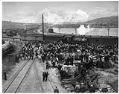
Policemen and striking longshoremen at Pier 40, Seattle, June 1934
In the early 1930s, the International Longshoremen's Association, led by San Francisco-based Harry Bridges, tried to unionize all West Coast dockworkers to improve pay and working conditions. In 1934, after employers refused to recognize the union, West Coast longshoremen went out on strike for 98 days, seriously disrupting trade. At Seattle's Smith Cove, picketing strikers blocked access to the piers…
ID Number:PI24001
Date:1934
Photograph
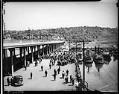
Waterfront strike at Smith Cove, July 19, 1934
In the early 1930s, the International Longshoremen's Association, led by San Francisco-based Harry Bridges, tried to unionize all West Coast dockworkers to improve pay and working conditions. In 1934, after employers refused to recognize the union, West Coast longshoremen went out on strike for 98 days, seriously disrupting trade. At Seattle's Smith Cove, picketing strikers blocked access to the piers…
ID Number:PI24004
Date:1934