835 results for: Neighborhoods
Photograph
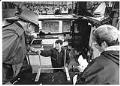
James Guilmet selling fish at Fishermen's Terminal, Seattle, January 30, 1992
In this image James Guilmet passes change back to a customer while another customer writes a check for her order. Guilmet and his wife Marilyn sold fish from their boat, the Faith, at their tie-up at Fishermen's Terminal, on Salmon Bay between the Interbay and Ballard neighborhoods. The Port of Seattle's Fishermen's Terminal has been the home of the Pacific…
ID Number:2000.107.172.35.01
Date:1992
Photograph
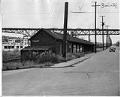
Abandoned Fremont railroad station, Seattle, July 28, 1948
This derelict railroad station in Seattle's Fremont neighborhood is located just east of the George Washington Memorial Bridge (commonly called the Aurora Bridge), which is visible in the background of this image. The small depot building was remodeled and is still standing at the foot of Stone Way North as of 2017. The station was probably part of the Seattle,…
ID Number:2000.107.173.03.01
Date:1948
Photograph
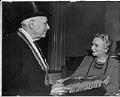
Fremont "Mayor" Bert Williams, Seattle, March 14, 1954
Each year, the Fremont Old Timers' Association elected an honorary "Mayor" of their Seattle neighborhood. In 1954, Albert Paul "Bert" Williams (1876-1955), who had come to Seattle in 1888, accepted the honor. He remembered the Great Seattle Fire and also went to Alaska during the Gold Rush. The retired machinist recalled that when he moved to Fremont in 1901, it…
ID Number:2000.107.173.03.02
Date:1954
Photograph
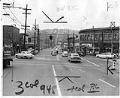
Patrolman handing out Civil Defense evacuation cards, Seattle, May 20, 1955
In this image Robert Vincent, Seattle Police Department patrolman, stands in the center of southbound traffic on Fremont Avenue North to hand out civil defense evacuation cards to motorists. At the time Fremont Avenue was designated a northbound evacuation route for the city. The Fremont Bridge is visible in the background. Signs in image: Salvation Army: Your Throw-Aways Make Work…
ID Number:2000.107.173.03.03
Date:1955
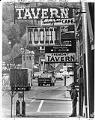
Photograph
Fremont Avenue looking south across Fremont Bridge, Seattle, April 26, 1974
This image of Fremont was taken looking south along Fremont Avenue, toward the Fremont Bridge. A man stands on the sidewalk smoking a cigarette in front of one of the many taverns in the small business district, which earned the neighborhood the nickname "Tavern Town, Washington." Although the businesses depicted here no longer exist, Fremont is still known as one…
ID Number:2000.107.173.03.04
Date:1974
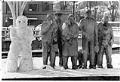
Photograph
Public sculpture with snowman, Seattle, January 6, 1982
Sculptor Richard Beyer's (1925-2012) "People Waiting for the Interurban," one of the most popular works of art in Seattle, was commissioned by the Fremont Arts Council and dedicated in 1978. It is located on the southeast corner of N. 34th Street and Fremont Avenue N., and depicts six people and a dog waiting for the Seattle to Everett Interurban, a…
ID Number:2000.107.173.03.05
Date:1982
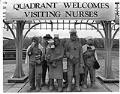
Photograph
Public sculpture decorated as nurses, Seattle, January 23, 1989
Sculptor Richard Beyer's (1925-2012) "People Waiting for the Interurban," one of the most popular works of art in Seattle, was commissioned by the Fremont Arts Council and dedicated in 1978. It is located on the southeast corner of N. 34th Street and Fremont Avenue N., and depicts six people and a dog waiting for the Seattle to Everett Interurban, a…
ID Number:2000.107.173.03.06
Date:1989
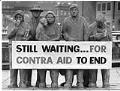
Photograph
Public sculpture with political sign, Seattle, January 27, 1988
Sculptor Richard Beyer's (1925-2012) "People Waiting for the Interurban," one of the most popular works of art in Seattle, was commissioned by the Fremont Arts Council and dedicated in 1978. It is located on the southeast corner of N. 34th Street and Fremont Avenue N., and depicts six people and a dog waiting for the Seattle to Everett Interurban, a…
ID Number:2000.107.173.03.07
Date:1988
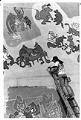
Photograph
Student painting mural in Fremont, May 15, 1991
In this image Susan Spong of Seattle helps paint the Medieval Adventures of Reynard the Fox on the walls of the Fremont Fine Arts Foundry. The art student is part of a crew that is working on the mural designed by Richard Beyer (1925-2012), who also created "People Waiting for the Interurban," one of the most popular works of public…
ID Number:2000.107.173.03.08
Date:1991
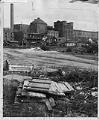
Photograph
Rainier Brewing Company in Georgetown, Seattle, March 18, 1948
This image of Seattle's Georgetown neighborhood was taken facing east from Corson Avenue and Homer Street, an example by the photographer of the run-down nature of the neighborhood at the time. The large brick buildings in the background are part of the Rainier Brewing Company's brewery, which operated at 3100 Airport Way South from 1878-1999. Now called the Georgetown Brewhouse…
ID Number:2000.107.173.08.01
Date:1948