517 results for: Museum of History
Photograph
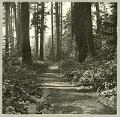
Military road on Beacon Hill, Seattle, circa 1900
The Fort Steilacoom to Fort Bellingham Military Road was a network of roads running through the Puget Sound area to promote the migration of settlers to Washington Territory and to secure U. S. interests in the region from those of Native Americans. Today’s I-5 roughly follows the route north from Fort Vancouver, built in 1924 by the Hudson's Bay Company…
ID Number:SHS2354
Date:Circa 1900
Photograph
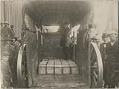
Crates of gold on the way to the Seattle assay office, circa 1902
Gold from the Nome and Klondike gold fields was often shipped to Seattle in wooden crates. Wagons waiting at the waterfront hauled the heavy shipment up the hill to the U. S. Assay Office on Ninth Avenue. This photo, probably taken between 1898 and 1906, shows a group of men and boys looking at a shipment of gold in the…
ID Number:SHS2505
Date:Circa 1902
Photograph
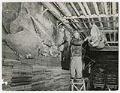
Man with display at the Frozen Fish Museum, Seattle, 1950
From 1926-1956 the Port of Seattle operated the Frozen Fish Museum on the Port’s Spokane Street wharf (now Terminal 30). Strange fish would be presented to the museum, where it could be viewed by the public. In this image taken at the museum, a man poses with a fish hanging from the ceiling. Caption information source: http://www.portseattle.org/About/History/Pages/1950-1959.aspxCaption information source: The…
ID Number:SHS6176
Date:1950
Photograph
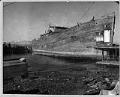
Derelict ship Bering on Shilshole Bay, Seattle, January, 1957
The steamer Bering was badly damaged following a stranding in southeastern Alaska waters. The ship was towed to Seattle, where it was condemned and sold for $1.00 to the Tregoning Boat Company, located on Seaview Avenue in Ballard. The Tregoning Co. moored her as a breakwater for a proposed small boat mooring at the entrance to the Lake Washington Ship…
ID Number:SHS6717
Date:1957
Photograph
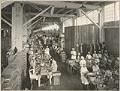
Women cleaning strawberries at Spokane Street terminal, Seattle, circa 1921
In 1921 the Port of Seattle completed the Spokane Street Terminal, with nearly 200,000 square feet of space and state-of-the-art cold storage facilities used for freezing, handling, and storing fish from Alaska and local produce until they were exported or sent to local markets. That same year, Puget Sound berry growers harvested 3,160 acres of strawberries, mainly for the processing…
ID Number:SHS7309
Date:Circa 1921
Photograph
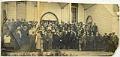
Members of the Seattle Chamber of Commerce, circa 1904
The Seattle Metropolitan Chamber of Commerce was founded on April 17, 1882, by a group of 26 business and community leaders, to devise a way to win a $12,000 annual mail route to Alaska over a competing San Francisco steamship company. The Chamber's first decade was dominated by the fight to obtain a railroad for Seattle. Chamber founders Thomas Burke,…
ID Number:SHS9796
Date:Circa 1904
Photograph
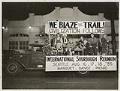
Sourdoughs posing on truck at reunion, Seattle, August 1935
The Klondike Gold Rush was a migration by an estimated 100,000 prospectors to the Klondike region of the Yukon in north-western Canada between 1896 and 1899. The events of the Klondike gold rush rapidly became embedded in North American culture, being captured in poems, stories, photographs, and promotional campaigns long after the end of the stampede. Some terminology from the…
ID Number:SHS10085
Date:1935
Photograph
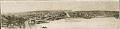
North-facing panorama of Fremont, Seattle, circa 1894
Seattle's Fremont neighborhood started out as cluster of small industries on the north shore of Lake Union. This north-facing view of Fremont appears to have been taken from the eastern slope of Queen Anne Hill. The bridge at the bottom left of the frame is probably a spur of the Seattle, Lake Shore, and Eastern Railway, built in 1888 across…
ID Number:SHS10120
Date:Circa 1894
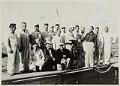
Photograph
Stan Sayres with his hydroplane crew, Seattle, circa 1952
Stanley St. Claire Sayres (1896-1956) was a hydroplane racer who broke the world water speed record with his "Slo-mo-shun IV" boat. In the early 1930s, after moving to Seattle, Sayres owned the American Automobile Company, a Chrysler car dealership at 1001 Broadway in Seattle, an auto parts store in the University District, and the Jen-Cel-Lite Corporation, a manufacturer of cold…
ID Number:SHS10362
Date:Circa 1952
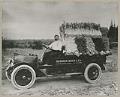
Photograph
Richard Desimone in his family’s produce truck, Seattle, circa 1946
Desimone has been a big name in the history of Seattle’s Pike Place Market. Giuseppe “Joe” Desimone, a Neapolitan immigrant, farmed successfully in the South Park area, and sold his produce at the Market. He invested his earnings in real estate and business, and by 1941, had become the majority owner of the Pike Place Market. Richard Desimone, Joe’s son,…
ID Number:SHS10720
Date:Circa 1946