86 results for: Innovation and Invention
Photograph
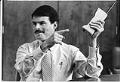
Craig McCaw holding cell phone, September 1986
Craig McCaw (b. 1949) was an early investor in cellular technology. McCaw's father owned a cable TV company in Centralia which Craig and his brothers inherited and ran together under Craig's leadership. In 1981, McCaw began buying cellular licenses in cities across the US, and in 1987 he sold the cable TV business and fully transitioned the company to cellular…
ID Number:2000.107.121.04.01
Date:1986
Photograph
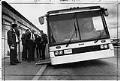
Metro drivers inspecting prototype kneeling bus, Seattle, March, 1975
In this image, the Rohn Industries Transbus, one of three prototype transit buses built by U. S. firms for possible production in the 1980s, gets the once-over from Metro drivers as it "knelt" on its air suspension system, allowing near-level entry up a front door wheelchair ramp. At the time Metro, was planning to replace its fleet of buses and…
ID Number:2000.107.124.28.02
Date:1975
Photograph
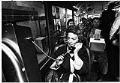
Nancy Lightfoot making the first phone call from a bus, Seattle, September 11, 1985
In September 1985, cellular telephones were installed on four Washington State ferries and five Metro buses for a trial period of four and three months, respectively. The phones required a credit card to use, and cost a dollar for a two-minute local call, with 50 cents for each additional minute. In this image passenger Nancy Lightfoot places one of the…
ID Number:2000.107.124.31.03
Date:1985
Photograph
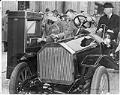
Bank customer in car using "snorkel" depository, Seattle, March 30, 1956
As the oldest customer of the Seattle office of the Bank of California, Judge Kenneth Mackintosh made the first deposit in the bank's new "snorkel" sidewalk installation. The "snorkel" curb teller was designed for customers to pull up to the window in their car. A teller was stationed at an underground office, able to see the customer (and vice versa)…
ID Number:2000.107.165.11.01
Date:1956
Photograph
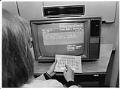
Woman using Peoples Bank home banking program, September 20, 1984
In 1984 sixty customers of Peoples Bank began a one-year trial of the bank's experimental new home-banking system. For a $7.50 monthly fee and a charge for each transaction, the customers could pay bills, transfer funds, check account balances, and even play a few video games on a home banking system available 24 hours a day, using their home computers.…
ID Number:2000.107.165.14.02
Date:1984
Photograph
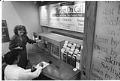
SeaFirst self-serve banking desk, Seattle, August 5, 1993
In August 1993, Seattle's SeaFirst Bank opened its first self-service Banker-on-Call center at its Westlake Park branch. It included a video conferencing system that allowed customers to talk directly with a banker about loans, credit cards, new accounts, and other bank services.Here, SeaFirst vice president and branch manager Jeri Lee Jump (standing) and personal banker Reid Warner test the Banker-on-Call…
ID Number:2000.107.165.17.01
Date:1993
Photograph
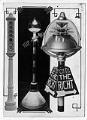
Collage of automatic traffic signals, April 21, 1924
Traffic signals were first tested in Seattle in 1924, through a collaboration between the Street Department and the police traffic division. The first automatic traffic signal was installed at Fourth Avenue South and Jackson Street for motorists to determine whether the automatic method was better than traffic control by an officer stationed in the center of the intersection.This graphic by…
ID Number:2000.107.190.05.02
Date:1924
Photograph
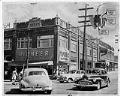
New traffic signal operating at 85th and Greenwood, Seattle, August 28, 1952
In this image a new type of traffic signal is tested by Seattle traffic engineering division at North 85th Street and Greenwood Avenue. In addition to the usual red, amber and green signals was added a glass column of green panels (indicated by added lettering). When the green signal was lit, the column at right also lit up green and…
ID Number:2000.107.190.06.06
Date:1952
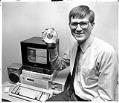
Photograph
Carl Stork with Microsoft demonstration disk, Redmond, February 1987
In the 1980s, Microsoft was helping with research and development of a new technology to store and access computer files – the CD-ROM. Standing for “compact disk, read-only memory,” the CD-ROM could store about 1,500 times more data than the then-standard floppy disk. In order to increase interest in CD-ROMs, in 1987 Microsoft created an electronic encyclopedia as a demonstration…
ID Number:2000.107.206.15.01
Date:1987
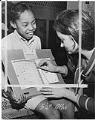
Photograph
Demonstration of punch-card voting machine, Seattle, March 25, 1969
On March 29, 1969 over 4,500 Seattle residents went to the polls to elect the 16-member Central Area School Council. This was the first community council elected to help the Seattle School Board run an attendance area’s schools. It was also the city’s first computer-assisted election, and it used IBM Votomatic machines, on loan from Clark County, WA. After the…
ID Number:2000.107.220.41.01
Date:1969