587 results for: Asian American
Photograph
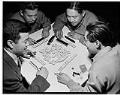
Four men playing mahjong, Seattle, April 1947
This photo shows Henry K.K. Ching, the "unofficial mahjong champion of Seattle," according to the Post-Intelligencer caption, playing a game with three other men. Chinn is at the lower right and his opponents are, left to right, Moses Kay, David Chinn, and Harry Tang. Date photograph was filed at the Seattle Post-Intelligencer (date of photograph and file date may differ…
ID Number:1986.5.5375.1
Date:1947
Photograph
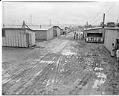
Barracks at Puyallup Assembly Center, Puyallup, 1942
In the spring of 1942, persons of Japanese descent living on the West Coast were forcibly removed by the US Army into temporary "assembly centers" while permanent incarceration camps were built. The Puyallup Assembly Center, euphemistically named “Camp Harmony," was hastily constructed at the Washington State fairgrounds, and temporarily housed over 7,000 residents of Seattle, Tacoma, and Alaska.This photo shows…
ID Number:1986.5.6680.1
Date:1942
Photograph
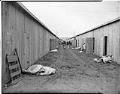
Incarcerees moving into barracks at the Puyallup Assembly Center, Puyallup, March 1942
In the spring of 1942, persons of Japanese descent living on the West Coast were forcibly removed by the US Army into "assembly centers" while permanent incarceration camps were built. The Puyallup Assembly Center, euphemistically named "Camp Harmony," was hastily constructed at the Washington State fairgrounds in Puyallup and temporarily housed over 7,000 residents of Seattle, Tacoma and Alaska. Here,…
ID Number:1986.5.6680.2
Date:1942
Photograph
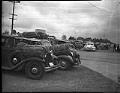
Cars packed with belongings during forced removal of Japanese Americans, Bainbridge Island, March 1942
In the spring of 1942, persons of Japanese descent living on the West Coast were forcibly removed by the US Army to assembly centers while permanent incarceration camps were built. The Puyallup Assembly Center, euphemistically named "Camp Harmony," was hastily constructed at the Washington State fairgrounds in Puyallup and temporarily housed over 7,000 residents of Seattle, Tacoma and Alaska. Buses…
ID Number:1986.5.6680.3
Date:1942
Photograph
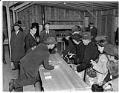
Incarcerees registering at the Puyallup Assembly Center, Puyallup, 1942
In the spring of 1942, persons of Japanese descent living on the West Coast were forcibly removed by the US Army into "assembly centers" while permanent incarceration camps were built. The Puyallup Assembly Center, euphemistically named "Camp Harmony," was hastily constructed at the Washington State fairgrounds in Puyallup and temporarily housed over 7,000 residents of Seattle, Tacoma and Alaska. This…
ID Number:1986.5.6680.8
Date:1942
Photograph
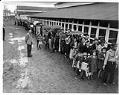
Incarcerees lined up in the rain at the Puyallup Assembly Center, Puyallup, 1942
In the spring of 1942, persons of Japanese descent living on the West Coast were forcibly removed by the US Army into temporary "assembly centers" while permanent incarceration camps were built. The Puyallup Assembly Center, euphemistically named “Camp Harmony," was hastily constructed at the Washington State fairgrounds, and temporarily housed over 7,000 residents of Seattle, Tacoma, and Alaska.This photograph shows…
ID Number:1986.5.6681.3
Date:1942
Photograph
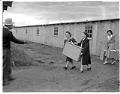
Incarcerees moving into barracks at the Puyallup Assembly Center, Puyallup, March 1942
In the spring of 1942, persons of Japanese descent living on the West Coast were forcibly removed by the US Army into "assembly centers" while permanent incarceration camps were built. The Puyallup Assembly Center, euphemistically named "Camp Harmony," was hastily constructed at the Washington State fairgrounds in Puyallup and temporarily housed over 7,000 residents of Seattle, Tacoma and Alaska. Here,…
ID Number:1986.5.6681.12
Date:1942
Photograph
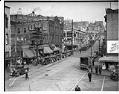
Chinatown street scene looking northeast, Seattle, 1934
In the early 1900s, Chinese businesses began moving to the area around King Street. By the 1920s, most of Seattle's Chinese residents lived and worked there. Other Asian immigrants soon followed, notably Japanese and Filipinos attracted by the area's inexpensive housing and storefronts for their own businesses and restaurants. By the late 1930s, Chinatown was established as a distinct neighborhood…
ID Number:1986.5.7828.4
Date:1934
Photograph
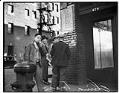
Men on a corner in Seattle's Chinatown, 1932
In the early 1900s, Chinese businesses began moving to the area around King Street. By the 1920s, most of Seattle's Chinese residents lived and worked there. Other Asian immigrants soon followed, notably Japanese and Filipinos attracted by the area's inexpensive housing and storefronts for their own businesses and restaurants. By the late 1930s, Chinatown was established as a distinct neighborhood…
ID Number:1986.5.7830.1
Date:1932
Photograph
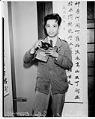
Chinese man with camera, Seattle, 1935
Handwritten on sleeve: SEATTLE, Chinese.Written on photo: Chinese Globe trotterDate photograph was filed at the Seattle Post-Intelligencer (date of photograph and file date may differ by a month or more): December 30, 1935.
ID Number:1986.5.7831.1
Date:1935