517 results for: Celebrations
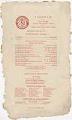
Program
Great Seattle Fire Reunion program, Seattle, June 6, 1917
On June 6, 1889, Seattle's Great Fire destroyed most of the city's business district. In 1917, a group of businessmen and officials held an anniversary party they called "The First Annual Family Get-Together Party." Calling themselves the "Associates of 89", the group's Officers and Executive Committee were a Who's Who of living fire survivors.The event included historical talks and recollections,…
ID Number:MS.COLL.678a
Date:1917
Photograph
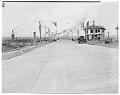
Decorating Ballard Bridge for reopening celebration, Seattle, May 1940
The Ballard Bridge, also known as the 15th Avenue Bridge, is a double-leaf bascule bridge in Seattle which connects Ballard to the Magnolia and Queen Anne neighborhoods. Opened in 1917 and spanning the Lake Washington Ship Canal, the Bridge originally had wooden approaches intended to last only ten years. The bridge was closed for repairs in 1939 and the approaches…
ID Number:PI20464
Date:1940

Photograph
Ballard Bridge crossing Salmon Bay, Seattle, May 1940
The Ballard Bridge, also known as the 15th Avenue Bridge, is a double-leaf bascule bridge in Seattle which connects Ballard to the Magnolia and Queen Anne neighborhoods. Opened in 1917 and spanning the Lake Washington Ship Canal, the Bridge originally had wooden approaches intended to last only ten years. The bridge was closed for repairs in 1939 and the approaches…
ID Number:PI20465
Date:1940
Photograph
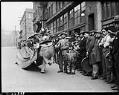
Chinese Lion Dance, circa 1930
Chinese American communities often hold a Lion Dance at the time of the lunar new year or when a new business opens. In Seattle during Chinese New Year, the lion dances through the Chinatown - International District and stops in front of businesses to wish them a prosperous year. The businesses offer the lion red envelopes of money, wrapped in…
ID Number:PI22398
Date:Circa 1930
Photograph
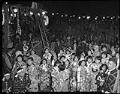
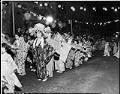
Dancers at Bon Odori festival, Seattle, 1935
During the summer of 1932, Seattle's first Bon Odori festival was held by the Seattle Buddhist Church (Seattle Betsuin Buddhist Temple). Bon Odori is a traditional Japanese style of dancing performed during Obon, a Buddhist memorial service. The joyful dance celebrates selfless giving and expresses gratitude to departed family members and ancestors. Over the years, the annual event open to…
ID Number:PI22448
Date:1935
Photograph
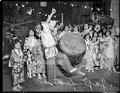
Dancers at Bon Odori festival, Seattle, 1935
During the summer of 1932, Seattle's first Bon Odori festival was held by the Seattle Buddhist Church (Seattle Betsuin Buddhist Temple). Bon Odori is a traditional Japanese style of dancing performed during Obon, a Buddhist memorial service. The joyful dance celebrates selfless giving and expresses gratitude to departed family members and ancestors. Over the years, the annual open-to-all event has…
ID Number:PI22449
Date:1935
Photograph
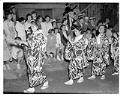
Taiko drummer and children at Bon Odori festival, Seattle, 1935
During the summer of 1932, Seattle's first Bon Odori festival was held by the Seattle Buddhist Church (Seattle Betsuin Buddhist Temple). Bon Odori is a traditional Japanese style of dancing performed during Obon, a Buddhist memorial service. The joyful dance celebrates selfless giving and expresses gratitude to departed family members and ancestors. Over the years, the annual open-to-all event has…
ID Number:PI22450
Date:1935
Photograph
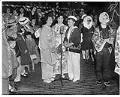
Children dancing at Bon Odori festival, Seattle, 1936
During the summer of 1932, the Seattle Buddhist Church (Seattle Betsuin Buddhist Temple) held the city's first Bon Odori festival. Bon Odori is a Japanese dance which is part of the observance of Obon, a Buddhist memorial service. The joyful dance, which celebrates the Buddhist tradition of selfless giving, expresses gratitude to departed family members and ancestors. Over the years,…
ID Number:PI22451
Date:1936
Photograph
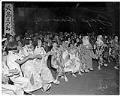
Three women singing at Bon Odori festival, Seattle, 1937
During the summer of 1932, Seattle's first Bon Odori festival was held by the Seattle Buddhist Church (Seattle Betsuin Buddhist Temple). Bon Odori is a traditional Japanese style of dancing performed during Obon, a Buddhist memorial service. The joyful dance celebrates selfless giving and expresses gratitude to departed family members and ancestors. Over the years, the annual open-to-all event has…
ID Number:PI22454
Date:1937
Photograph
Dancers at Bon Odori festival, Seattle, circa 1935
During the summer of 1932, Seattle's first Bon Odori festival was held by the Seattle Buddhist Church (Seattle Betsuin Buddhist Temple). Bon Odori is a traditional Japanese style of dancing performed during Obon, a Buddhist memorial service. The joyful dance celebrates selfless giving and expresses gratitude to departed family members and ancestors. Over the years, the annual open-to-all event has…
ID Number:PI22458
Date:Circa 1935