780 results for: Activism
Photograph
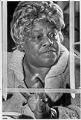
Flo Ware, October 1974
Florestine “Flo” Ware (1912-1981) was a tireless activist who fought for 30 years for the rights of children, the poor, and the aged, particularly in Seattle’s Black community. Within a few years after she moved to Seattle in 1946, Ware was agitating for improvements to Central Area public schools, for better healthcare for elderly people, and for employment opportunities for…
ID Number:2000.107.222.08.04
Date:1974
Photograph
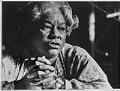
Flo Ware, August 1976
Florestine “Flo” Ware (1912-1981) was a tireless activist who fought for 30 years for the rights of children, the poor, and the aged, particularly in Seattle’s Black community. Within a few years after she moved to Seattle in 1946, Ware was agitating for improvements to Central Area public schools, for better healthcare for elderly people, and for employment opportunities for…
ID Number:2000.107.222.08.05
Date:1975
Photograph
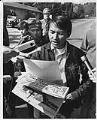
Bernie Whitebear reading proclamation ending protester's encampment at Fort Lawton, Seattle, April 3, 1970
On March 8, 1970, about 100 members and sympathizers of United Indian People's Council (later United Indians of All Tribes Foundation, or UIATF) occupied Fort Lawton, a 1,100-acre army post in Seattle's Magnolia neighborhood. They were inspired by the passage of a bill signed by President Richard Nixon, which granted non-federal entities the ability to obtain surplus federal lands for…
ID Number:2000.107.230.06.02
Date:1970

Photograph
Hazel Wolf paddling a kayak, November 4, 1985
Social activist and environmentalist Hazel "Leo" Wolf (1898-2000) was born Hazel Anna Cummings Anderson in Victoria, British Columbia and lived in the Seattle area for most of her life. Wolf's causes ranged from the rights of workers, women, and minorities to the protection of wilderness, wetlands, and wildlife. She became involved in labor issues after moving to Seattle in 1923,…
ID Number:2000.107.232.20.01
Date:1985
Photograph
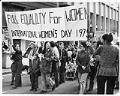
Women marching on International Women's Day, Seattle, March 8, 1975
This image was taken as about 300 women, men, and children marched through downtown Seattle in observance of International Women's Day, and to demand equitable working conditions for all. The group assembled at the Federal Building and paraded to Westlake Center, where they listened to speeches, including one on the history of International Women's Day, which was established in Europe…
ID Number:2000.107.232.25.01
Date:1975
Photograph
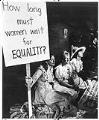
Women holding sit-in at Federal Building, August 26, 1981
The Equal Rights Amendment (ERA) was introduced in the U. S. Congress for the first time in 1921 and has prompted conversations about the meaning of equality for women and men ever since. With the rise of the women's movement in the 1960s, the ERA garnered increasing support, was reintroduced to Congress in 1972, and was submitted to the state…
ID Number:2000.107.232.25.02
Date:1981
Photograph
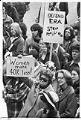
Demonstrators holding signs supporting ERA, Seattle, March 5, 1977
The Equal Rights Amendment (ERA) was introduced in the U. S. Congress for the first time in 1921 and has prompted conversations about the meaning of equality for women and men ever since. With the rise of the women's movement in the 1960s, the ERA garnered increasing support, was reintroduced to Congress in 1972, and was submitted to the state…
ID Number:2000.107.232.25.03
Date:1977
Photograph
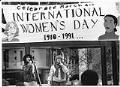
Performers singing at International Women's Day rally, March 8, 1991
This image was taken as Susan Lewis, left, and Janet Stecher of the group Rebel Voices sing at the International Women's Day (IWD) rally held at Westlake Center in downtown Seattle. Lewis and Stecher have been performing together as Rebel Voices since 1989, and prior to that as The Belles of Hoboken, and Shays' Rebellion. Their concerts and workshops combine…
ID Number:2000.107.232.25.04
Date:1991
Photograph
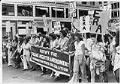
Demonstrators marching with signs supporting the ERA, Seattle, July 8, 1978
The Equal Rights Amendment (ERA) was introduced in the U.S. Congress for the first time in 1921 and has prompted conversations about the meaning of equality for women and men ever since. With the rise of the women's movement in the 1960s, the ERA garnered increasing support, was reintroduced to Congress in 1972, and was submitted to the state legislatures…
ID Number:2000.107.232.26.01
Date:1978
Photograph
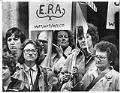
Demonstrators holding signs supporting the ERA, Seattle, June 30, 1991
The Equal Rights Amendment (ERA) was introduced in the U. S. Congress for the first time in 1921 and has prompted conversations about the meaning of equality for women and men ever since. With the rise of the women's movement in the 1960s, the ERA garnered increasing support, was reintroduced to Congress in 1972, and was submitted to the state…
ID Number:2000.107.232.26.02
Date:1991