869 results for: P.A.W.S.
Photograph
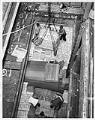
Employees loading bags of bulgur at Fisher Flouring Mills, Seattle, July 24, 1961
In different administrative and organizational forms, the Food for Peace program of the United States has provided food assistance around the world since President Dwight D. Eisenhower signed the Agricultural Trade Development and Assistance Act, or Public Law (P.L.) 480, in 1954. Initially a means to donate surplus U.S. commodities, the U.S. government now purchases food from American farmers through…
ID Number:2000.107.172.34.06
Date:1961
Photograph
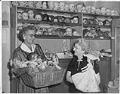
Goodwill Auxiliary members displaying dolls for sale, Seattle, November 2, 1958
Seattle Goodwill was founded in 1923 by a group of local businessmen, and provides employment training and basic education to individuals experiencing significant barriers to economic opportunity. Today a significant portion of its operating funds are derived from its nine thrift stores in the area.In this image, Mrs. E. P. Pamment and Mrs. J. R. Hawley display the many dolls…
ID Number:2000.107.173.09.04
Date:1958
Photograph
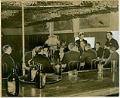
Jurors in coroner's inquest convening at speakeasy, Seattle, August 8, 1941
A deadly gun battle during an robbery attempt in Seattle left three men dead and seven more wounded on August 3, 1941, at a basement speakeasy at 410B Second Avenue. A coroner's jury was convened a few days later for the inquest into the killings. At the time, Seattleites had widely differing views over the city government's role in the…
ID Number:2000.107.174.16.02
Date:1941
Photograph
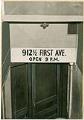
Entrance to the Stork Club, 912 1/2 1st Ave., Seattle, May 3, 1945
The repeal of federal prohibition in 1933 was not the end of laws controlling the sale and consumption of liquor in Seattle. Public support for prohibition had waned as liquor-related crime continued to increase and enforcement efforts continued to strain staff and budgets. However, regulating the manufacture and consumption of alcohol remained a regular part of the business of Seattle…
ID Number:2000.107.174.16.05
Date:1945
Photograph
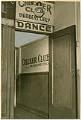
Entrance to the Checker Club, 1115 1/2 1st Ave., Seattle, May 3, 1945
The repeal of federal prohibition in 1933 was not the end of laws controlling the sale and consumption of liquor in Seattle. Public support for prohibition had waned as liquor-related crime continued to increase and enforcement efforts continued to strain staff and budgets. However, regulating the manufacture and consumption of alcohol remained a regular part of the business of Seattle…
ID Number:2000.107.174.16.06
Date:1945
Photograph
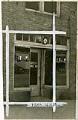
Entrance to the U&I Club, 1223 Jackson Street, Seattle, May 3, 1945
The repeal of federal prohibition in 1933 was not the end of laws controlling the sale and consumption of liquor in Seattle. Public support for prohibition had waned as liquor-related crime continued to increase and enforcement efforts continued to strain staff and budgets. However, regulating the manufacture and consumption of alcohol remained a regular part of the business of Seattle…
ID Number:2000.107.174.16.07
Date:1945
Photograph
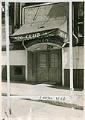
Entrance to the 420 Club, 420 2nd Ave., Seattle, May 3, 1945
The repeal of federal prohibition in 1933 was not the end of laws controlling the sale and consumption of liquor in Seattle. Public support for prohibition had waned as liquor-related crime continued to increase and enforcement efforts continued to strain staff and budgets. However, regulating the manufacture and consumption of alcohol remained a regular part of the business of Seattle…
ID Number:2000.107.174.16.08
Date:1945
Photograph
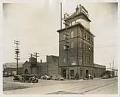
Exterior of Horluck Brewing Co., Seattle, 1939
Nebraska-born George Fausbol Horluck (1901-1975) came to Seattle with his parents and siblings before 1910. Beginning with the purchase of a number of ice cream parlors, Horluck Creameries, Inc., soon gained enough profit that George and his father, Hans Jorgen Horluck (1863-1933), formed their Horluck Investment Company with a starting capital of $99,000. Seeing a new opportunity with the end…
ID Number:2000.107.175.05.01
Date:1939
Photograph
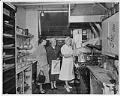
Visitors touring the kitchen of the old Ballard hospital, Seattle, April 20, 1952
In 1952 residents of Seattle's thriving Ballard neighborhood began raising money for a new hospital to replace the aging Ballard Accident and General Hospital, which had opened in 1928 with 21 beds on the third floor of the Ballard Building on Market Street. Ballard General Hospital (later Ballard Community Hospital) opened in 1954 at 5300 Tallman Avenue with 100 beds…
ID Number:2000.107.175.05.02
Date:1952
Photograph
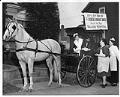
Employees in costume raising money for new Ballard Hospital, Seattle, May 7, 1952
In 1952 residents of Seattle's thriving Ballard neighborhood began raising money for a new hospital to replace the aging Ballard Accident and General Hospital, which had opened in 1928 with 21 beds on the third floor of the Ballard Building on Market Street. Ballard General Hospital (later Ballard Community Hospital) opened in 1954 at 5300 Tallman Avenue with 100 beds…
ID Number:2000.107.175.05.03
Date:1952