525 results for: Government and Public Services
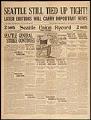
Serial
Seattle Union Record, February 8, 1919
The Seattle General Strike was a work stoppage by more than 65,000 workers in Seattle from February 6-11, 1919. The strike began in shipyards when workers were refused pay increases after two years of World War I wage controls. Most of the city's 110 local unions, including members of the American Federation of Labor (AFL) and the Industrial Workers of…
ID Number:2019.3.54
Date:1919
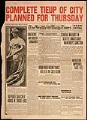
Serial
Seattle Times, February 3, 1919
The Seattle General Strike was a work stoppage by more than 65,000 workers in Seattle from February 6-11, 1919. The strike began in shipyards when workers were refused pay increases after two years of World War I wage controls. Most of the city's 110 local unions, including members of the American Federation of Labor (AFL) and the Industrial Workers of…
ID Number:2019.3.55
Date:1919
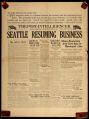
Serial
Seattle Post-Intelligencer, February 8, 1919
The Seattle General Strike was a work stoppage by more than 65,000 workers in Seattle from February 6-11, 1919. The strike began in shipyards when workers were refused pay increases after two years of World War I wage controls. Most of the city's 110 local unions, including members of the American Federation of Labor (AFL) and the Industrial Workers of…
ID Number:2019.3.56
Date:1919
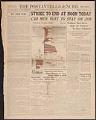
Serial
Seattle Post-Intelligencer, February 11, 1919
The Seattle General Strike was a work stoppage by more than 65,000 workers in Seattle from February 6-11, 1919. The strike began in shipyards when workers were refused pay increases after two years of World War I wage controls. Most of the city's 110 local unions, including members of the American Federation of Labor (AFL) and the Industrial Workers of…
ID Number:2019.3.57
Date:1919
Ephemera
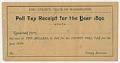
Poll tax receipt, King County, 1890
The poll tax, an annual levy on voting, was a major source of revenue for states and municipalities in the late 19th and early 20th centuries. The tax was a flat fee on voter registration, regardless of income. In practice, poll taxes suppressed the vote of low-income people who could not afford the fee.In 1854, Washington Territory levied its first…
ID Number:2019.3.81
Date:1890
Ephemera
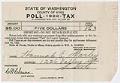
Hannah E. Marley poll tax receipt, King County, 1922
The poll tax, an annual levy on voting, was a major source of revenue for states and municipalities in the late 19th and early 20th centuries. The tax was a flat fee on voter registration, regardless of income. In practice, poll taxes suppressed the vote of low-income people who could not afford the fee.In 1854, Washington Territory levied its first…
ID Number:2019.3.82
Date:1922
Videorecording
Oral history interview with Aubrey Davis, July 13, 2010
Interview with Aubrey Davis conducted by Marsha King at KCTS Studios in Seattle for the Experienced Leaders Oral History Project in July 2010. Davis served as a federal public housing official, city councilmember, and mayor of Mercer Island. He was also the lead figure in the state's redesign of the I-90 bridge. Topics discussed include his passion for public service,…
ID Number:2019.35.16.2
Date:2010
Videorecording
Oral history interview with Charles V. (Tom) Gibbs., December 22, 2010
Interview with Charles V. (Tom) Gibbs, the former executive director of Seattle Metro, conducted by Marsha King at KCTS Studios in Seattle for the Experienced Leaders Oral History Project in December. Topics discussed include his background, his military service and career, and his environmental activism.
ID Number:2019.35.16.7
Date:2010
Ephemera
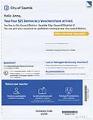
City of Seattle Democracy Vouchers for Seattle City Council District 2, 2019
In 2015, voters in Seattle passed a campaign finance reform initiative which limited contributions from lobbyists and contractors, and began a first-of-its-kind public financing system called "Democracy Vouchers." Four vouchers worth 25 dollars each are distributed annually to eligible Seattle residents, to be used to support participating candidates of their choice. In 2021, the vouchers may be used to support…
ID Number:2019.86.1
Date:2019
Videorecording
Human Rights: The Constitution and Public Access, Community Television Agency program, July 12, 1989
Started in 1976 by Virginia Brookbush, CTA produced up to seven half-hour public access television shows a week in the late 1970s and 1980s. Designed to let anyone use public air time to talk about local issues, CTA produced regular shows like "You Have the Right to Know," "Community Bulletin Board," "Visiting Over the Backyard Fence," "This Town's Talent," and…
ID Number:2021.84.21
Date:1989