450 results for: Military
Photograph
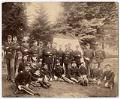
National Guard of Washington officers posing after the fire, Seattle, June 1889
The Great Fire of June 6, 1889 was a significant turning point in Seattle's history and changed both the physical and political landscapes of the City. 100 acres of Seattle's business district and waterfront were destroyed. The burned areas were guarded and patrolled by members of the Washington National Guard from Seattle, Tacoma, and Port Townsend until June 11, 1889.…
ID Number:SHS685
Date:1889
Photograph
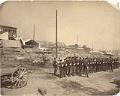
Members of the Washington National Guard in Seattle, June 1889
The Great Fire of June 6, 1889 was a significant turning point in Seattle's history and changed both the physical and political landscapes of the City. One hundred acres of Seattle's business district and waterfront were destroyed. The burned areas were guarded and patrolled by members of the Washington National Guard from Seattle, Tacoma, and Port Townsend until June 11,…
ID Number:SHS710
Date:1889
Photograph
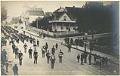
Washington National Guard 1st Infantry Regiment parade to Alki Point, West Seattle, May 13, 1886
During the period before statehood, the U. S. Federal Government authorized Washington Territory to form militia units to assist the civil authorities in maintaining law and order. A more permanent force was created on March 9, 1886, with the formation of the First Infantry Regiment of the Washington National Guard, led by Lieutenant-Colonel George D. Hill. The 2nd Infantry Regiment followed…
ID Number:SHS812
Date:1886
Photograph
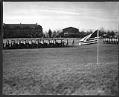
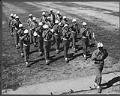
Signal Corps troops marching at Fort Lawton, January 29, 1944
In 1897, the city of Seattle donated land on Magnolia Bluff to the US government to build a new Army post as part of a defense system for Puget Sound; this was designated as Fort Lawton in 1900. During most of its active service, the fort served as an embarkation station where troops gathered before being sent to duty in…
ID Number:SHS822
Date:1944
Photograph
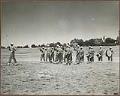
Signal Corp marching band at Fort Lawton, August 6, 1946
In 1897, the city of Seattle donated land on Magnolia Bluff to the US government to build a new Army post as part of a defense system for Puget Sound; this was designated as Fort Lawton in 1900. During most of its active service, the fort served as an embarkation station where troops gathered before being sent to duty in…
ID Number:SHS827
Date:1946
Photograph
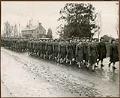
Military band parading at Fort Lawton, Seattle, August 9, 1946
In 1897, the city of Seattle donated land on Magnolia Bluff to the US government to build a new Army post as part of a defense system for Puget Sound; this was designated as Fort Lawton in 1900. During most of its active service, the fort served as an embarkation station where troops gathered before being sent to duty in…
ID Number:SHS873
Date:1946
Photograph
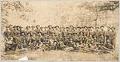
WACs parading at Fort Lawton, Seattle, February 3, 1944
In 1897, the city of Seattle donated land on Magnolia Bluff to the US government to build a new Army post as part of a defense system for Puget Sound; this was designated as Fort Lawton in 1900. During most of its active service, the fort served as an embarkation station where troops gathered before being sent to duty in…
ID Number:SHS876
Date:1944
Photograph
Members of Washington National Guard, Company A, 2nd Infantry, posing together, 1914
During the period before statehood, the U.S. Federal Government authorized Washington Territory to form militia units to assist the civil authorities in maintaining law and order. A more permanent force was created on March 9, 1886, with the formation of the First Infantry Regiment of the Washington National Guard, led by Lieutenant-Colonel George D. Hill. The 2nd Infantry Regiment followed…
ID Number:SHS2052
Date:1914
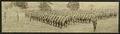
Photograph
Members of the National Guard of Washington posing in formation, 1910
During the period before statehood, the U.S. Federal Government authorized Washington Territory to form independent militia units to assist the civil authorities in maintaining law and order. A more permanent force was created on March 9, 1886, with the formation of the First Infantry Regiment of the Washington National Guard, led by Lieutenant-Colonel George D. Hill. The Second Infantry Regiment…
ID Number:SHS2173
Date:1910
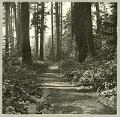
Photograph
Military road on Beacon Hill, Seattle, circa 1900
The Fort Steilacoom to Fort Bellingham Military Road was a network of roads running through the Puget Sound area to promote the migration of settlers to Washington Territory and to secure U. S. interests in the region from those of Native Americans. Today’s I-5 roughly follows the route north from Fort Vancouver, built in 1924 by the Hudson's Bay Company…
ID Number:SHS2354
Date:Circa 1900