672 results for: Lake Washington
Postcard
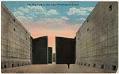
Empty chamber in Ballard Locks, Seattle, circa 1917
For years, there was no easy or cheap way to move logs, coal, and other resources directly from the east side of Lake Washington to Elliott Bay. There were many plans and several attempts to build a canal via Lake Union. However, none was successful until the Lake Washington Ship Canal was built in 1911 to 1917. The Hiram Chittenden…
ID Number:2002.48.947
Date:Circa 1917
Postcard
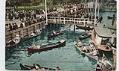
Canoeists at Leschi Park, Seattle, circa 1905
Leschi Park, on the shore of Lake Washington, was a popular place for Seattle's city-dwellers to go for recreation. Many people caught a cable car at Pioneer Square and rode to the park along Yesler Way. This postcard shows people canoeing near the shore of the busy park. Caption on image: Boating scene at Leschi Park, Seattle, Washington.Stamped on verso:…
ID Number:2002.48.1156
Date:Circa 1905
Photograph
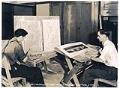
James Fitzgerald and Lloyd Lovegren working on the East Tunnel Portal models for the Lake Washington Floating Bridge, May 9, 1940
Architect Lloyd Lovegren and artist James Fitzgerald designed the East Tunnel Portals, basing a set of sculptural panels on Northwest Coast Native American motifs. Here, Fitzgerald (left) works on a model for one of the panels while Lovegren (right) works with the overall design. Caption on photo: Unit 2. Modeling for precast concrete slabs of east tunnel portal.Photographer's Reference Number:…
ID Number:2003.30.151
Date:1940
Photograph
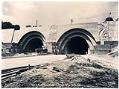
East tunnel portals on the Lake Washington Floating Bridge, June 21, 1940
A decorative concrete facade marked the eastern entrance of the twin-bore tunnel that connected Seattle to the Lake Washington Floating Bridge. Architect Lloyd Lovegren and artist James Fitzgerald designed the portals, basing their sculptural panels on Northwest Coast Native American motifs. In this June 1940 image, two of the three panels have been installed. Caption on photo: Unit 2. East…
ID Number:2003.30.159
Date:1940
Document
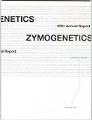
ZymoGenetics annual report, 2001
ZymoGenetics was established in Seattle in 1981 by University of Washington professors Earl Davie and Benjamin Hall, along with University of British Columbia professor Michael Smith. One of the oldest biotechnology/pharmaceutical companies in the U.S., ZymoGenetics was involved in the development of therapeutic proteins. The company was acquired by Novo Nordisk in 1988, and was spun off as a public…
ID Number:2005.26.1
Date:2001
Ephemera
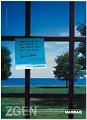
ZymoGenetics NASDAQ advertisement, 2002
ZymoGenetics was established in Seattle in 1981 by University of Washington professors Earl Davie and Benjamin Hall, along with University of British Columbia professor Michael Smith. One of the oldest biotechnology/pharmaceutical companies in the U.S., ZymoGenetics was involved in the development of therapeutic proteins. The company was acquired by Novo Nordisk in 1988, and was spun off as a public…
ID Number:2005.26.2.1
Date:2002
Poster
Japanese language ZymoGenetics posters, 2002
ZymoGenetics was established in Seattle in 1981 by University of Washington professors Earl Davie and Benjamin Hall, along with University of British Columbia professor Michael Smith. One of the oldest biotechnology/pharmaceutical companies in the U.S., ZymoGenetics was involved in the development of therapeutic proteins. The company was acquired by Novo Nordisk in 1988, and was spun off as a public…
ID Number:2005.26.3
Date:2002
Photograph
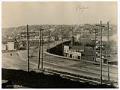
Temporary Fremont Bridge, Seattle, March 18, 1915
The original bridge to Fremont was razed in 1911 to make way for the dredging of the Lake Washington Ship Canal; during this time, all traffic was rerouted to the temporary Stone Way Bridge, just five blocks to the east. A second temporary bridge served the original gap until 1915, when traffic was again rerouted to the Stone Way Bridge…
ID Number:2006.7.1
Date:1915
Photograph
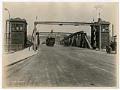
Fremont Bridge on opening day, Seattle, June 15, 1917
The original Fremont Bridge was razed in 1911 to make way for the dredging of the Lake Washington Ship Canal, and a new permanent bridge was constructed to connect Fremont Avenue North in Fremont and Fourth Avenue North in Queen Anne. The new bridge is one of four double-leaf bascule bridges that carry vehicle and pedestrian traffic across the Lake…
ID Number:2006.7.2
Date:1917
Photograph
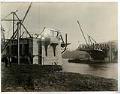
Fremont Bridge under construction, Seattle, November 16, 1916
The original bridge to Fremont was razed in 1911 to make way for the dredging of the Lake Washington Canal and temporary bridges were constructed to reroute traffic. This image was taken during construction of the new permanent bridge, which was completed in 1917 and connects Fremont Avenue North on the Fremont side of the Lake Washington Ship Canal and…
ID Number:2006.7.16
Date:1916