365 results for: Discrimination
Photograph
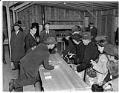
Incarcerees registering at the Puyallup Assembly Center, Puyallup, 1942
In the spring of 1942, persons of Japanese descent living on the West Coast were forcibly removed by the US Army into "assembly centers" while permanent incarceration camps were built. The Puyallup Assembly Center, euphemistically named "Camp Harmony," was hastily constructed at the Washington State fairgrounds in Puyallup and temporarily housed over 7,000 residents of Seattle, Tacoma and Alaska. This…
ID Number:1986.5.6680.8
Date:1942
Photograph
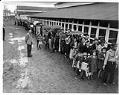
Incarcerees lined up in the rain at the Puyallup Assembly Center, Puyallup, 1942
In the spring of 1942, persons of Japanese descent living on the West Coast were forcibly removed by the US Army into temporary "assembly centers" while permanent incarceration camps were built. The Puyallup Assembly Center, euphemistically named “Camp Harmony," was hastily constructed at the Washington State fairgrounds, and temporarily housed over 7,000 residents of Seattle, Tacoma, and Alaska.This photograph shows…
ID Number:1986.5.6681.3
Date:1942
Photograph
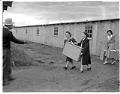
Incarcerees moving into barracks at the Puyallup Assembly Center, Puyallup, March 1942
In the spring of 1942, persons of Japanese descent living on the West Coast were forcibly removed by the US Army into "assembly centers" while permanent incarceration camps were built. The Puyallup Assembly Center, euphemistically named "Camp Harmony," was hastily constructed at the Washington State fairgrounds in Puyallup and temporarily housed over 7,000 residents of Seattle, Tacoma and Alaska. Here,…
ID Number:1986.5.6681.12
Date:1942
Photograph
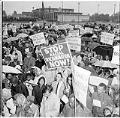
Open housing demonstration at Garfield playfield, Seattle, October 20, 1963
In the mid-20th century, protesters began challenging long-established inequitable practices in housing. Racially restrictive housing covenants and discriminatory lending (“redlining”) excluded people of color from buying or renting housing in most of Seattle’s neighborhoods. In 1963, the Seattle Human Rights Commission drafted an open housing ordinance and presented it to the City Council for approval. The Council held public hearings…
ID Number:1986.5.9653.7
Date:1963
Photograph
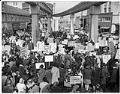
Civil rights supporters demonstrate at Westlake Plaza, Seattle, March 7, 1964
This image was taken as more than 1,500 demonstrators attended a rally at Westlake Plaza in support of open-housing in Seattle. Several local clergy and representatives of the NAACP spoke to the crowd, encouraging everyone to vote for a local ordinance that would provide for criminal penalties for acts of housing discrimination on the basis of race, ethnic origin, or…
ID Number:1986.5.9654.1
Date:1964
Photograph
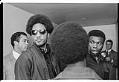
Aaron Dixon and Trolice Flavors at court hearing for Franklin High School sit-in, Seattle, April 5, 1968
In March of 1968 two Black students, cousins Charles Oliver and Trolice Flavors, where suspended from Seattle's Franklin High School after an altercation with a white student, who was not reprimanded. Franklin's outraged Black students, with the help of UW Black Student Union (BSU) activists Carl Miller, Aaron Dixon and Larry Gossett, planned a peaceful demonstration at the school to…
ID Number:1986.5.11579.11
Date:1968
Photograph
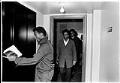
Franklin High School sit-in defendants leaving prison, Seattle, April 5, 1968
In March of 1968 two Black students, cousins Charles Oliver and Trolice Flavors, where suspended from Seattle's Franklin High School after an altercation with a white student, who was not reprimanded. Franklin's outraged Black students, with the help of UW Black Student Union (BSU) activists Carl Miller, Aaron Dixon and Larry Gossett, planned a peaceful demonstration at the school to…
ID Number:1986.5.11580.6
Date:1968
Photograph
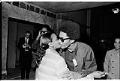
Aaron Dixon with his mother at courthouse, April 5, 1968
In March of 1968 two Black students, cousins Charles Oliver and Trolice Flavors, where suspended from Seattle's Franklin High School after an altercation with a white student, who was not reprimanded. Franklin's outraged Black students, with the help of UW Black Student Union (BSU) activists Carl Miller, Aaron Dixon and Larry Gossett, planned a peaceful demonstration at the school to…
ID Number:1986.5.11580.13
Date:1968
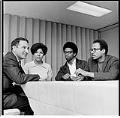
Photograph
UW Black Student Union officers receiving Sidney Gerber Memorial Award, June 6, 1968
In June 1968, the University of Washington Black Student Union (BSU) received the Sidney Gerber Memorial Award, given for "outstanding accomplishments in the field of intergroup relations and human rights." The BSU received the award specifically for "intelligent, productive and non-violent work in bringing about progress at the University of Washington." This photo shows three officers of the UW BSU…
ID Number:1986.5.26555.2
Date:1968
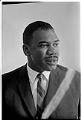
Photograph
Portrait of Charles V. Johnson, Seattle, August 22, 1967
Charles Vernon Johnson (b. 1928) was raised in Arkansas and moved to Seattle in 1954 to attend law school at the University of Washington. Upon graduation, Mr. Johnson went into private practice, and shortly thereafter took on leading roles in both the Seattle Branch of the NAACP and in the Central Area Civil Rights Organization. He was heavily involved in…
ID Number:1986.5.30323.6
Date:1967