517 results for: Museum of History
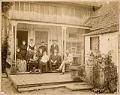
Photograph
Horton family posing together on porch, Seattle, circa 1890
In 1871, developer Julius Horton purchased property on the Duwamish River formerly owned by the Luther Collins family, pioneers in the Duwamish Valley. In 1890, Horton incorporated the area, naming it Georgetown after his oldest child. Julius Horton was the brother of Seattle banker Dexter Horton (1825-1904).Here, members and friends of the Horton family sit on the porch of a…
ID Number:2016.33.3
Date:Circa 1890
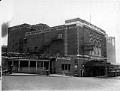
Photograph
Metropolitan Theatre, University St., Seattle, circa 1920
This south-west facing view of University Street between Fifth Avenue and Fourth Avenue includes the Metropolitan Theater. Though the Metropolitan Theatre was designed originally as a stage house, it began showing movies within two years of its opening, and alternated between presenting live theatre and movies throughout its history. Between 1925 and 1928, the Olympic Hotel was built on three…
ID Number:2016.59.40
Date:Circa 1920
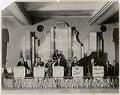
Photograph
Earl Whaley's band on stage in Shanghai, China, December 20, 1934
Many American jazz musicians traveled to Shanghai during the city's golden age in the 1930s, when "the Paris of the Orient" was the newest horizon on an increasingly international jazz music scene. For Black musicians, who were often excluded from white musicians' unions in the U. S. and subjected to other forms of segregation, Shanghai provided steady, well-paid work, and…
ID Number:2016.84.2.10.1
Date:1934
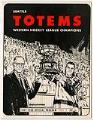
Program
Seattle Totems program, 1967
The Seattle Totems were a professional ice hockey franchise in the Pacific Coast Hockey League (later Western Hockey League or WHL) from 1944-1974 and in the Central Hockey League for the 1974-1975 season. The Totems won three WHL Lester Patrick Cup championships: 1959, 1967, and 1968.The appropriation of Indigenous names for professional sports teams has been popular since the 19th…
ID Number:2017.19.1
Date:1967
Poster
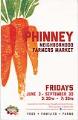
Phinney Neighborhood Farmers Market poster, Seattle, June 3 - September 30, 2016
On May 29, 1993, the University District Farmers Market opened in Seattle at the University Heights Community Center. Continuing from late May through early November, the market drew on Seattle's long history of the Pike Place Market, which opened in August of 1907 and allowed farmers to sell directly to consumers. In 2000, Chris Curtis, one of the originators of…
ID Number:2017.60.2
Date:2016
Poster
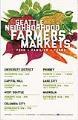
Seattle Neighborhood Farmers Markets poster, 2016
On May 29, 1993, the University District Farmers Market opened in Seattle at the University Heights Community Center. Continuing from late May through early November, the market drew on Seattle's long history of the Pike Place Market, which opened in August of 1907 and allowed farmers to sell directly to consumers. In 2000, Chris Curtis, one of the originators of…
ID Number:2017.60.6
Date:2016
Poster
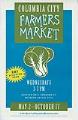
Columbia City Farmers Market poster, Seattle, May 2 - October 17, 2007
On May 29, 1993, the University District Farmers Market opened in Seattle at the University Heights Community Center. Continuing from late May through early November, the market drew on Seattle's long history of the Pike Place Market, which opened in August of 1907 and allowed farmers to sell directly to consumers. In 2000, Chris Curtis, one of the originators of…
ID Number:2017.60.9
Date:2007
Ephemera
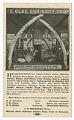
Ye Olde Curiosity Shop advertising card, 1915
Ohio-born curio collector Joseph Edward "Daddy" Standley (1854-1940) came to Seattle in 1899 and opened Ye Olde Curiosity Shop on Second Avenue and Pike Street. He moved the shop to the Colman Dock on the waterfront in 1904, and since 1988 the shop has been located at Pier 54. Still a family-run business after five generations, the store attracts about…
ID Number:2018.3.3.1
Date:1915
Ephemera
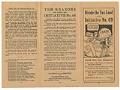
"Divide the tax load with initiative no. 69" leaflet, 1932
Two hotly contested initiatives were on the November 8, 1932 ballot in Washington State: The Washington 40-Mill Tax Levy Limit Initiative, also known as Initiative 64, was approved by 61% of voters, limiting property taxes to 2 percent of assessed value; and the Washington Income Tax for Schools Initiative, also known as Initiative 69, which won 71 percent of the…
ID Number:2018.3.3.11
Date:1932
Ephemera
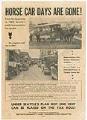
"Horse car days are gone!" leaflet, 1937
Seattle’s transportation system grew out of a mixture of privately-owned cable car lines, streetcars, and buses. When the city took these over in 1918, it turned out to be a financial disaster. By 1936, the infrastructure was aging, and the system was $4 million in debt. The city explored alternatives and, in 1937, promoted a plan to modernize the system…
ID Number:2018.3.3.14
Date:1937