427 results for: Civil Rights
Ephemera
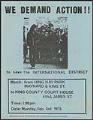
Committee for Corrective Action march flier, Seattle, February 3, 1975
The Kingdome construction project broke ground on November 2, 1972, in spite of concerns from residents of the nearby Chinatown - International District (CID) regarding the impact on their neighborhood. From the protests and march at the groundbreaking, and on into the 1970s, the Asian American movement advocated for more affordable housing in the district, for services such as a…
ID Number:2002.23.7.83.1
Date:1975
Photograph
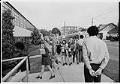
White students arriving at Meany Middle School, Seattle, September 6, 1972
In the 1960s, after decades of discrimination in housing had created an increasingly segregated school system in Seattle, civil rights activists wanted the School Board to promote integration and, with it, intercultural empathy and understanding. After various attempts to promote voluntary integration, and faced with the threat of legal action from advocates of integration, in 1972 the School District launched…
ID Number:2002.46.197.4
Date:1972
Photograph
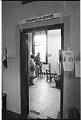
Roberto Maestas in classroom during occupation of Beacon Hill School, November 1972
Seattle had a growing Latino population in the late 1960s, and activists had been pressing the city for a building in which to establish a Chicano community center. Tired of having their requests ignored, in October 1972 they took over the abandoned Beacon Hill School on 16th Avenue South and renamed it El Centro de la Raza. After a 75-day…
ID Number:2002.46.272.24
Date:1972
Photograph
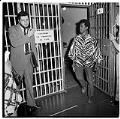
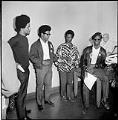
Franklin High School sit-in defendant Carl Miller at King County jail, April 1968
In March of 1968 two Black students, cousins Charles Oliver and Trolice Flavors, were suspended from Seattle's Franklin High School after an altercation with a white student, who was not reprimanded. Franklin's outraged Black students, with the help of UW Black Student Union (BSU) activists Carl Miller, Aaron Dixon and Larry Gossett, planned a peaceful demonstration at the school to…
ID Number:2002.68.9.5
Date:1968
Photograph
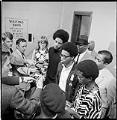
Franklin High School sit-in defendants at King County jail, April 1968
In March of 1968 two Black students, cousins Charles Oliver and Trolice Flavors, were suspended from Seattle's Franklin High School after an altercation with a white student, who was not reprimanded. Franklin's outraged Black students, with the help of UW Black Student Union (BSU) activists Carl Miller, Aaron Dixon and Larry Gossett, planned a peaceful demonstration at the school to…
ID Number:2002.68.9.9
Date:1968
Photograph
Franklin High School sit-in defendants speaking with the press at King County jail, April 1968
In March of 1968 two Black students, cousins Charles Oliver and Trolice Flavors, were suspended from Seattle's Franklin High School after an altercation with a white student, who was not reprimanded. Franklin's outraged Black students, with the help of UW Black Student Union (BSU) activists Carl Miller, Aaron Dixon and Larry Gossett, planned a peaceful demonstration at the school to…
ID Number:2002.68.9.10
Date:1968
Photograph
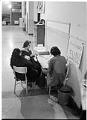
Three people playing cards during Beacon Hill School occupation, October 18, 1972
Seattle had a growing Latino population in the late 1960s, and activists had been pressing the city for a building in which to establish a Chicano community center. Tired of having their requests ignored, in October 1972 they took over the abandoned Beacon Hill School on 16th Avenue South and renamed it El Centro de la Raza. After a 75-day…
ID Number:2002.68.1595.23
Date:1972
Photograph
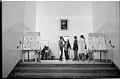
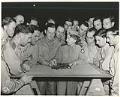
Protesters inside Beacon Hill School, October 18, 1972
Seattle had a growing Latino population in the late 1960s, and activists had been pressing the city for a building in which to establish a Chicano community center. Tired of having their requests ignored, in October 1972 they took over the abandoned Beacon Hill School on 16th Avenue South and renamed it El Centro de la Raza. After a 75-day…
ID Number:2002.68.1595.26
Date:1972
Photograph
Signal Corps instructor teaching Civil Air Patrol members, Seattle, July 1944
The Seattle Field Artillery Armory was designed in 1939 by architect and engineer Arrigo M. Young (1884-1954) to house the 146th Field Artillery and its half-ton tanks. During World War II, the armory was remodeled to provide 500 beds for servicemen visiting Seattle. In addition, the Women's Ambulance Corps and civilian medical units trained there during the war, and the…
ID Number:2003.57.2
Date:1944

Poster
Save our Valley "Yes" Tunnel poster, Seattle, 1999
In 1999, Puget Sound regional transportation authority Sound Transit was finalizing the route of a light rail line set to connect SeaTac airport with Seattle's University District. The proposed route ran through the Rainier Valley, where some residents and businesses concerned about the possible negative effects of street-level light rail formed the "Save Our Valley" group to lobby for a…
ID Number:2007.25.66
Date:1999