1580 results for: City of Seattle
Photograph
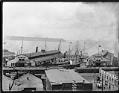
Piers on waterfront, Seattle, circa 1912
Signs in image: Pier No. 4 - Northern Pacific. Arlington Dock Company. Nome, St. Michael, Tanana - S.S.Ohio, 3500 tons; S.S. Indiana, 3500 tons; S.S. Copenhagen, 3000 tons - Empire Transportation Co., 607 First Ave. Steamship Tickets [...] Valdez [...] San Francisco. Steamship Tickets for Alaska, California, Mexico, Central and South America, Hamburg, Antwerp, Havre, London, Southampton, Cork, Dublin, Continental…
ID Number:1983.10.6755.2
Date:Circa 1912
Photograph
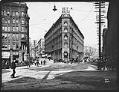
Hotel Seattle, Seattle, ca. 1911
The Hotel Seattle was located near Pioneer Square, which was then the heart of Seattle's business district. The five-story brick and stone building had 200 rooms. It was close to the railroad depots, the docks, and the point where most of the city's streetcar lines started. The hotel was torn down in 1962 to make room for a parking garage.…
ID Number:1983.10.6827
Date:Circa 1911
Photograph
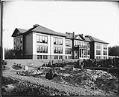
Interlake School, Seattle, 1911
When the Interlake School was constructed in 1904, the Wallingford neighborhood was growing very rapidly. The architect designed an addition in the central rear section that was built four years later. The name of the school refers to its location midway between Lake Union and Green Lake. In the 1920s, Interlake was the largest elementary school in Seattle. It closed…
ID Number:1983.10.6843
Date:1911
Photograph
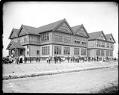
Lowell School, circa 1911
The Lowell School was originally named the Pontius School, renamed the Columbia School in 1891, and was finally renamed the Lowell School in 1910. It was built in 1889 on East Mercer Street on Capitol Hill. At that time, the area was outside the city limits. Within 20 years, the city had grown and the school was surrounded by a…
ID Number:1983.10.6844
Date:Circa 1911
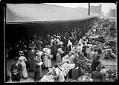
Photograph
The new arcade at the Pike Place Public Market, circa 1911
Seattle's Pike Place Market began as a jumble of farm carts, produce, and shoppers on Western Avenue. Starting in 1911, farmers could set up stalls in the city's new covered arcade. The "dry row" of stalls was inside the arcade, and the "wet" stalls were outside. All stalls rented for 20 cents a day.This photo, taken around 1911, shows shoppers…
ID Number:1983.10.6868.2
Date:Circa 1911
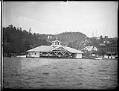
Photograph
Thornley's Boat House in Leschi Park, Seattle, circa 1905
Leschi Park, on the shore of Lake Washington, was a popular place for Seattle's city-dwellers to go for recreation. Many people caught a cable car at Pioneer Square and rode to the park along Yesler Way. This photo shows the park's boathouse. Handwritten on sleeve: Thornley's Boat House Leschi Park, 1905?Webster & Stevens number: 2789
ID Number:1983.10.6980.1
Date:Circa 1905
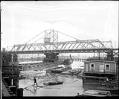
Photograph
New Spokane Street Bridge, circa 1917
In 1917, the city built a new swing bridge to carry Spokane Street traffic to West Seattle. The roadway passed 28 feet above the West Waterway of the Duwamish River. The bridge tender watched water traffic from a little cabin on the side of the bridge. When ship traffic approached that was too tall to fit under the span, the…
ID Number:1983.10.7210.1
Date:Circa 1917
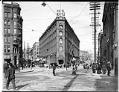
Photograph
Hotel Seattle, circa 1900
The Hotel Seattle was located near Pioneer Square, which was then the heart of Seattle's business district. The five-story brick and stone building had 200 rooms. It was close to the railroad depots, the docks, and the point where most of the city's streetcar lines started. The hotel was torn down in 1962 to make room for a parking garage.This…
ID Number:1983.10.7324
Date:Circa 1900
Photograph
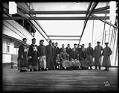
Chinese trade commission, 1906
American trade with China and other Asian nations was increasing in the early 1900s. Seattle businessmen were particularly interested in having Chinese products enter the United States through Seattle.A group from China visited the city in 1905 to discuss trade and other matters. In this photo, they pose for their picture on the deck of their ship. Some of the…
ID Number:1983.10.7340.2
Date:1906
Photograph
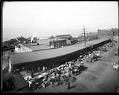
Pike Place Market, Seattle, circa 1911
The City of Seattle spent $10,000 to install a double row of stalls to provide shelter for Pike Place Market farmers and their customers. The canopy-covered west side was known as "the dry row." The arcade, extending from Pike Street to Stewart Street, was ready for occupancy in early 1911. Handwritten on sleeve: Pike Place Mkt. newsheds, 1905 [sic].Webster &…
ID Number:1983.10.7355.2
Date:Circa 1911