518 results for: Protests and Demonstrations
Photograph
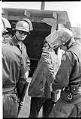
State Representative Mike Ross being arrested at UCWA protest, June 7, 1972
A 1970 federal court order established minority hiring percentages for construction unions. Two years later, the United Construction Workers Association (UCWA), a minority group, protested Seattle’s ongoing non-compliance with the order. In early June, they closed down a number of construction sites around Seattle. Despite a temporary restraining order from the King County Superior Court, UCWA members gathered June 7…
ID Number:2000.107.19720608.2.05
Date:1972
Photograph
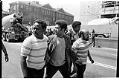
UCWA leaders at head of march at Seattle Central Community College, June 7, 1972
A 1970 federal court order established minority hiring percentages for construction unions. Two years later, the United Construction Workers Association (UCWA), a minority group, protested Seattle’s ongoing non-compliance with the order. In early June, they closed down a number of construction sites around Seattle. Despite a temporary restraining order from the King County Superior Court, UCWA members gathered June 7…
ID Number:2000.107.19720608.2.31
Date:1972
Photograph
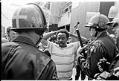
Tyree Scott being arrested at UCWA protest at Seattle Central Community College, June 7, 1972
A 1970 federal court order established minority hiring percentages for construction unions. Two years later, the United Construction Workers Association (UCWA), a minority group, protested Seattle’s ongoing non-compliance with the order. In early June, they closed down a number of construction sites around Seattle. Despite a temporary restraining order from the King County Superior Court, UCWA members gathered on June…
ID Number:2000.107.19720608.2.36
Date:1972
Photograph
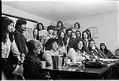
Jim Robideau and others at BIA protest, Seattle, November 6, 1972
On November 2nd, 1972, several hundred Indigenous people occupied the headquarters of the Bureau of Indian Affairs (BIA) in Washington, DC. They presented 20 demands for better conditions for Indigenous peoples in the United States, including reform of the BIA, enforcement of existing treaties, protection of Indigenous lands, and improved treaty procedures. Over the following days, BIA offices in other…
ID Number:2000.107.19721106.1.24
Date:1972
Photograph
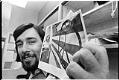
Harold Spence with a photo of his controversial peace symbol flag, June 28, 1974
In May 1970, 23-year-old Harold Spence taped a peace sign to an American flag and hung it outside his University District apartment to protest the US invasion of Cambodia and the Kent State killings. Spence was arrested and convicted at trial for improperly displaying the flag. Spence eventually petitioned the Supreme Court, which heard the case in January 1974. The…
ID Number:2000.107.19740628.2.08
Date:1974
Photograph
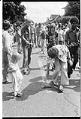
Central Area residents painting a red line down the middle of Roy Street to protest red-lining bank policies, August 17, 1975
In the mid-20th century, protesters began challenging long-established inequitable practices in housing. Racially restrictive housing covenants and discriminatory lending (“redlining”) excluded people of color from buying or renting housing in most of Seattle’s neighborhoods. Seattle passed an open housing law in 1968, making redlining illegal, but it often continued in secret and its effects have continued for decades. This photo,…
ID Number:2000.107.19750817.2.21A
Date:1975
Photograph
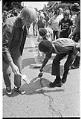
Central Area residents painting a red line down the middle of Roy Street to protest red-lining bank policies, August 17, 1975
In the mid-20th century, protesters began challenging long-established inequitable practices in housing. Racially restrictive housing covenants and discriminatory lending (“redlining”) excluded people of color from buying or renting housing in most of Seattle’s neighborhoods. Seattle passed an open housing law in 1968, making redlining illegal, but it often continued in secret and its effects have continued for decades. This photo,…
ID Number:2000.107.19750817.2.22A
Date:1975
Photograph
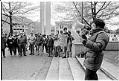
Student anti-apartheid protest in Red Square, Seattle, April 25, 1986
When South Africa’s National Party came to power in 1948, the white leadership put extreme laws in place forcing the country’s racial groups to live and develop separately. These “apartheid” laws caused much hardship and resentment. The growth of the Civil Rights Movement in the United States in the 1950s brought attention to apartheid, and in the 1970s and 80s,…
ID Number:2000.107.19860425.1.03
Date:1986
Photograph
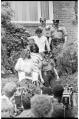
Police escorting three protesters from the South African consulate, Seattle, June 14, 1986
When South Africa’s National Party came to power in 1948, the white leadership put extreme laws in place forcing the country’s racial groups to live and develop separately. These “apartheid” laws caused much hardship and resentment. The growth of the Civil Rights Movement in the United States in the 1950s brought attention to apartheid, and in the 1970s and 80s,…
ID Number:2000.107.19860614.1.33
Date:1986
Photograph
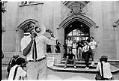
Students protesting outside Board of Regents meeting, August 22, 1986
When South Africa’s National Party came to power in 1948, the white leadership put extreme laws in place forcing the country’s racial groups to live and develop separately. These “apartheid” laws caused much hardship and resentment. The growth of the Civil Rights Movement in the United States in the 1950s brought attention to apartheid, and in the 1970s and 80s,…
ID Number:2000.107.19860822.1.09
Date:1986