136 results for: World War I, 1917-1918 (WWI)
Photograph
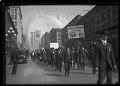
U.S. Army draftees parading through downtown, Seattle, May 10, 1918
On May 10, 1918, 62 men, conscripted from Seattle and King County through the new Selective Service system, paraded through downtown Seattle streets before entraining for Vancouver Barracks, where they would join the U.S. Army. The men assembled at the Soldiers' and Sailors' Club, where they received packages of food, tobacco, and other useful items, then marched to King Street…
ID Number:1983.10.1091.1
Date:1918
Photograph
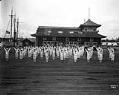
Sailors drilling at naval training camp, Seattle, circa 1918
During World War I, the University of Washington had a U.S. Navy training station on the shores of Lake Union. Before the camp closed in 1919, over 5,000 men had been trained there for both naval and naval aviation units. Handwritten on sleeve: Naval Training Camp DrillWebster & Stevens number: 65659
ID Number:1983.10.1217
Date:Circa 1918
Photograph
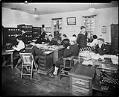
Office interior at the Naval Training Station, circa 1918
When the United States entered World War I in 1918, the University of Washington provided land on the shore of Lake Union for a Naval Training Station. In this photo, navy trainees work and talk on the telephone in the station's busy office while women type and file. Webster & Stevens number: 66247
ID Number:1983.10.1241
Date:Circa 1918
Photograph
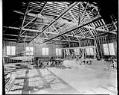
Hangar interior at naval training camp, Seattle, circa 1918
During World War I, the U.S. Navy had a training station on the University of Washington campus. The Navy buildings were on the shore of Lake Union, near where the university's health sciences center is now located. This photo shows the interior of a hangar with two planes. Handwritten on sleeve: U.S.N.T. Caralion Int Hangar.Webster & Stevens number: 66293
ID Number:1983.10.1246
Date:Circa 1918
Photograph
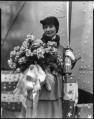
Woman preparing to christen S.S. West Eldara, Seattle, October 14, 1918
In 1916, the Skinner & Eddy Corporation opened a shipyard at the foot of Massachusetts Street on the site of the old Moran Brothers yard. Skinner & Eddy built 75 vessels during World War I, becoming Seattle's largest shipyard. The end of the war, in 1918, brought a depression in shipbuilding, and the yard was sold in 1923. Here, a…
ID Number:1983.10.1279.3
Date:1918
Photograph
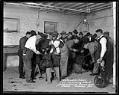
Military veterans learning automobile mechanics, January 1920
After the veterans of World War I returned home in 1918, many had trouble finding work. The Knights of Columbus, a Roman Catholic benefit organization, sponsored a free evening school to help them learn job skills. In this photo, World War I veterans are learning auto mechanics. At least one member of the group is an African-American. Webster & Stevens…
ID Number:1983.10.1791.8
Date:1920
Photograph
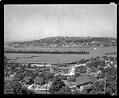
Surplus warships in Lake Union, circa 1921
Seattle's shipyards boomed during 1918, when the United States entered World War I. After the war, some of the U.S. Navy's surplus wooden warships were stored in Lake Union and other sheltered parts of Puget Sound. This "mothballed" fleet was nicknamed "Wilson's Wood Row," after President Woodrow Wilson, the wartime president.This photo, taken about 1921, shows the surplus wooden warships…
ID Number:1983.10.2261.1
Date:Circa 1921
Photograph
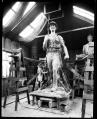
Clay figure for the World War I memorial statue, circa 1922
Alonzo Victor Lewis' "Doughboy" was controversial from the beginning. It was to be a memorial to Seattle soldiers who had served in World War I. Navy veterans felt left out. Some people thought the statue was too arty, others thought it wasn't arty enough. Still others objected to the German helmet slung over the soldier's shoulder. Eventually, without the helmet,…
ID Number:1983.10.2718.1
Date:Circa 1922
Photograph
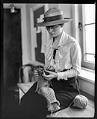
University of Washington student Geraldine Gilbert knitting, Seattle, 1918
Not one to waste time, Miss Geraldine Gilbert, sophomore in the college of pharmacy at the University of Washington, knits two socks at one time. Knitting with the standard four needles she knits one sock inside the other. The outside sock is knit 'inside out,' the American way, while the inside sock is knit 'right side out,' the Continental way.…
ID Number:1983.10.7137.1
Date:1918
Photograph
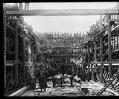
Thomas Barker talking to shipyard workers inside the hull of a wooden ship, 1918
When the United States entered World War I in 1918, Seattle's shipyard workeers were called on to help win the war.In this photo, Thomas Barker, representing the U.S. Department of Labor, speaks to several hundred shipyard workers about the importance of their work to the nation's war effort. The men are sitting on the beams and scaffolding of a large…
ID Number:1983.10.7236.3
Date:1918