106 results for: Williams
Photograph
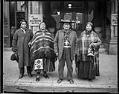
Two Yakama couples outside a Seattle hotel, January 29, 1921
The Yakama (formerly spelled Yakima) people have lived in the Columbia River basin since time immemorial. Historically, they lived in permanent winter villages built on the valley floor where the climate was most temperate. Starting in spring, they traveled along the rivers and into the hills to gather food. Some gathered roots and berries, and others fished in rivers, especially…
ID Number:1983.10.2082.2
Date:1921
Photograph
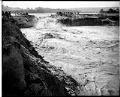
Releasing water from Lake Union into the Montlake Cut, Seattle, August 26, 1916
The Montlake Cut is part of the Lake Washington Ship Canal that connects Puget Sound, Lake Union, and Lake Washington. While digging the Montlake Cut, engineers built a temporary dam to hold back the waters of Lake Union's Portage Bay. The waters were released in August 1916, and the Lake Washington Ship Canal opened for business on July 4, 1917,…
ID Number:1983.10.10326
Date:1916
Photograph
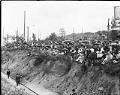
Spectators at opening of Lake Washington Ship Canal, Seattle, July 4, 1917
The Lake Washington Ship Canal opened for business on July 4, 1917, after six years of construction. The opening was the high point of Seattle's Fourth of July celebration. In this photo, spectators crowd the banks of Lake Union to watch the parade of several hundred boats passing through the new canals. It is likely that the photographer was standing…
ID Number:1983.10.10570
Date:1917
Photograph
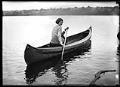
Woman paddling canoe on Green Lake, Seattle, 1923
In this image, an unidentified woman paddles a canoe on Green Lake, a freshwater lake in north central Seattle. The lake has long been a recreation area for residents of the city; an electric trolley reached the south end of the lake about 1891, and in 1903 the lake was included in the Olmsted Brothers' comprehensive parks plan. The lake…
ID Number:1983.10.11287.2
Date:1923
Ephemera
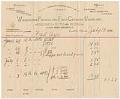
Washington Produce and Fruit Growers Union sales account for Fred Cyr, July 13, 1896
The Washington Produce and Fruit Growers Union, Inc., was established in 1895 as a cooperative of farmers who banded together to sell their produce to public markets and retailers rather than using established commission merchants who only paid farmers after the produce was sold.This sales account dated July 13, 1896, lists amounts and prices for strawberries received by Fred Cyr…
ID Number:1984.66.17.1
Date:1896
Photograph
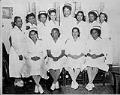
Mary Mahoney Professional Nurses Organization founders posing, Seattle, circa 1949
In 1949 the Mary Mahoney Professional Nurses Organization was begun by 13 African-American nurses in Seattle to support each other and to help young women who wanted to become nurses. Inspired by Mary Eliza Mahoney (1845-1926), the first African-American woman to earn a nursing degree in the U. S., the organization has helped African American women and men in their…
ID Number:1985.62.1
Date:Circa 1949
Videorecording
Oral history interview with Kenneth Fisher, April 23, 1985
Kenneth Robinson Fisher (1906-1999) was the grandson of O.W. (Oliver Williams) Fisher, founder and owner of Seattle’s Fisher Flour Mill. Fisher built his mill, the largest in the west, on the newly constructed Harbor Island in Elliott Bay at the mouth of the Duwamish waterway, one of the first industrial businesses to open on the island. Fisher ran the business…
ID Number:1985.135.10
Date:1985
Videorecording
Oral history interview with Holt W. Webster, 1985
Holt Webster (1919-1992) was a pioneer in the freight industry, and one of the founders of Airborne Express, where he also served as chairman and chief executive officer. During World War II, Webster was a captain in the military Air Transport Command from 1942 through 1946. After the war, he worked for Northwest Airlines in Seattle from 1946 to 1951…
ID Number:1985.135.28
Date:1985
Photograph
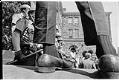
Police watching Black Student Union (BSU) and Students for a Democratic Society (SDS) protest on Seattle Community College's Edison campus, Seattle, 1969
In 1969, Seattle Community College (SCC) faced boycotts, demonstrations, and rioting in protest of disparities in funding and academic focus between the College's central campus, located near the city's Black residential area, and the north and south campuses, located in predominantly white neighborhoods. Out of $33 million in capital funds for the three campuses, the central campus, located on Capitol…
ID Number:1986.5.50743.1
Date:1969
Photograph
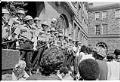
A. Frank Williams addressing protesters outside SCC, Seattle, May 22, 1969
In 1969, Seattle Community College (SCC) faced boycotts, demonstrations, and rioting in protest of disparities in funding and academic focus between the College's central campus, located near the city's Black residential area, and the north and south campuses, located in predominantly white neighborhoods. Out of $33 million in capital funds for the three campuses, the central campus, located on Capitol…
ID Number:1986.5.50743.5
Date:1969