31 results for: DeLong, Dan
Photograph
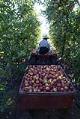
Francisco Hernandez hauling apples at Brandt Orchards, Orondo, Washington, October 16, 2002
Apple growers in Washington State contribute significantly to the state's economy, especially in the eastern regions of the state, such as the Wenatchee apple district.In this image, Francisco Hernandez transports a bin of Cameo apples at Brandt Orchards in Orondo, Douglas County. In 2002 growers harvested a particularly good crop, bringing apple prices up by about $2 box that year.…
ID Number:2000.107.20021016.CD02.001
Date:2002
Photograph
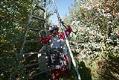
Employees working at Brandt Orchards, Orondo, Washington, October 16, 2002
Apple growers in Washington State contribute significantly to the state's economy, especially in the eastern regions of the state, such as the Wenatchee apple district.In this image, two workers pick apples at Brandt Orchards in Orondo, Douglas County. In 2002 growers harvested a particularly good crop, bringing apple prices up by about $2 box that year. Caption information written by:…
ID Number:2000.107.20021016.CD02.002
Date:2002
Photograph
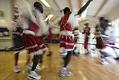
Sudanese dancers rehearsing for performance at Highline YMCA, Burien, October 20, 2002
Many young people from southern Sudan fled their home country during its second civil war in the 1980s and 1990s, becoming known as the "Lost Boys" and "Lost Girls" of Sudan. About 3800 boys and 90 girls who fled the war were resettled in the United States, with about 100 settling in Western Washington. There, a group of about 12…
ID Number:2000.107.20021020.CD03.01.001
Date:2002
Photograph
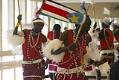
Mayen Akoon leading Sudanese dancers, October 20, 2002
Many young people from southern Sudan fled their home country during its second civil war in the 1980s and 1990s, becoming known as the "Lost Boys" and "Lost Girls" of Sudan. About 3800 boys and 90 girls who fled the war were resettled in the United States, with about 100 settling in Western Washington. There, a group of about 12…
ID Number:2000.107.20021020.CD03.01.002
Date:2002
Photograph
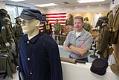
Hunter Floyd, co-founder of Seattle Veterans Museum, December 6, 2002
The Seattle Veterans Museum was founded in 2001 by two veterans, reserve Army Captain Hunter Floyd and Navy Lieutenant Todd Crooks. It began with Crooks collecting his father's uniform and gear from WWII, then grew as he collected mementos and items from other conflicts in US history. When Floyd and Crooks realized that Seattle did not have a local museum…
ID Number:2000.107.20021206.CD01.03.001
Date:2002
Photograph
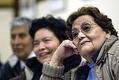
People participating in a citizenship class at El Centro de la Raza, Seattle, January 21, 2003
Seattle had a growing Latino population in the late 1960s, and activists had been pressing the city for a building in which to establish a Chicano community center. Tired of having their requests ignored, in October 1972 they took over the abandoned Beacon Hill School on 16th Avenue South and renamed it El Centro de la Raza. After a 3-month…
ID Number:2000.107.20030123.CD06.001
Date:2003
Photograph
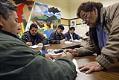
People participating in a citizenship class at El Centro de la Raza, Seattle, January 21, 2003
Seattle had a growing Latino population in the late 1960s, and activists had been pressing the city for a building in which to establish a Chicano community center. Tired of having their requests ignored, in October 1972 they took over the abandoned Beacon Hill School on 16th Avenue South and renamed it El Centro de la Raza. After a 3-month…
ID Number:2000.107.20030123.CD06.002
Date:2003
Photograph
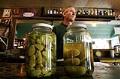
Howard Brown behind bar at Eastlake Zoo Tavern, Seattle, September 23, 2007
The Eastlake Zoo Tavern opened in 1974 at the corner of Eastlake Avenue East and East Lynn Street, in a 1902 building that had housed various bars and taverns since the mid-1930s. In 1974, a group of individuals, many from the nearby “hippie” houseboat community in Eastlake, acquired the building and opened the Eastlake Zoo as an employee co-op. Ownership…
ID Number:2000.107.20070923.CD01.001
Date:2007
Photograph
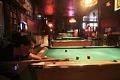
Man playing pool at Eastlake Zoo Tavern, Seattle, September 23, 2007
The Eastlake Zoo Tavern opened in 1974 at the corner of Eastlake Avenue East and East Lynn Street, in a 1902 building that had housed various bars and taverns since the mid-1930s. In 1974, a group of individuals, many from the nearby “hippie” houseboat community in Eastlake, acquired the building and opened the Eastlake Zoo as an employee co-op. Ownership…
ID Number:2000.107.20070923.CD01.01.001
Date:2007
Photograph
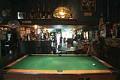
Interior of Eastlake Zoo Tavern, Seattle, September 23, 2007
The Eastlake Zoo Tavern opened in 1974 at the corner of Eastlake Avenue East and East Lynn Street, in a 1902 building that had housed various bars and taverns since the mid-1930s. In 1974, a group of individuals, many from the nearby “hippie” houseboat community in Eastlake, acquired the building and opened the Eastlake Zoo as an employee co-op. Ownership…
ID Number:2000.107.20070923.CD01.01.002
Date:2007