3246 results for: Seattle Post-Intelligencer
Photograph
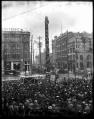
Unveiling the totem pole at Pioneer Square, Seattle, 1899
This Tlingit totem was carved around 1790 to honor a tribal woman named Chief-of-All-Women and it was placed in the village of Tongass on the Alaska coast. In 1899, a group of leading Seattle businessmen on a goodwill tour of southeastern Alaska stole the totem and brought it back to Pioneer Square. The businessmen were indicted for the theft, but…
ID Number:Lib1988.33.146
Date:1899
Photograph
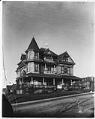
James Nugent residence, Seattle, circa 1898
Captain James Nugent began construction of this home at the corner of Cherry and Twelfth streets in 1892. According to an article published June 6 in the Seattle Post-Intelligencer, the corner tower afforded a fine view of the bay and the Sound and surrounding mountains. There were 14 rooms in all, and the home was supplied with hot water and…
ID Number:Lib1988.33.431
Date:Circa 1898
Photograph
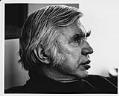
Journalist Emmett Watson, Seattle, 1970
Emmett Watson (1918-2001) was a Seattle journalist who covered sports for the Seattle Star and then wrote as a columnist for the Seattle Post-Intelligencer and the Seattle Times. This portrait was taken by photographer Josef Scaylea (1913-2004), worked for 35 years as chief photographer for the Seattle Times, winning over 1000 awards for his photographs highlighting the scenery and people…
ID Number:Lib1993.20.232
Date:1970
Photograph
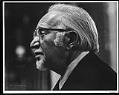
Rabbi Raphael Levine, 1977
Rabbi Raphael Levine (1901-1984) was rabbi of Temple de Hirsch from 1942 to 1969, and continued on as rabbis ermeritus until his death. Levine was was involved in interfaith efforts across the city, including founding an interfaith summer camp called Camp Brotherhood and a KOMO-TV panel of clergymen called "Challenge." Levine authored articles in the Seattle Post-Intelligencer and supported civil…
ID Number:Lib1993.20.235
Date:1977
Photograph
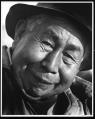
Sherman Dominick, 1970
In the 1960s, Native Americans and their supporters began protesting Washington State laws restricting Native American fishing rights that had been granted in a series of treaties with the United States between 1854 and 1855. The Survival of the American Indian Society (SAIA), the NAACP, and the National Indian Youth Council (NIYC), coordinated a series of protests and peaceful demonstrations…
ID Number:Lib1993.20.240
Date:1970
Photograph
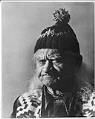
William Frank, Sr., 1980
William Frank, Sr. (1879-1983) was a Nisqually elder, early tribal government official, and leader in the struggle for Indigenous fishing rights. His name at birth was Qu Lash Qud, and he was renamed Frank while at boarding school, after a white homesteader for whom his father worked. In 1917, the US Army took most of the Nisqually Reservation to expand…
ID Number:Lib1993.20.249
Date:1980
Photograph
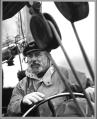
Henry Kotkins, Seattle, June 1975
Founded in 1910 as the Seattle Suitcase, Trunk and Bag Manufacturing Co., Skyway Luggage Co. has been an innovated suitcase company, including introducting the first commercially successfull wheeled luggage to the United States. Still operating out of Kent, Washington, as of 2024, Skyway was run by Henry Louis Kotkins (1912-2002), son of the company founder, for decades. Kotkins was an…
ID Number:Lib1993.20.283
Date:1975
Program
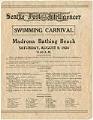
Swimming carnival program, 1924
On August 9, 1924, the Seattle Post-Intelligencer hosted a swimming carnival at Madrona Bathing Beach, a popular recreation area on the Lake Washington waterfront. Various competitions were held among the 382 children who had participated in summertime swimming lessons at eight local beaches.This program has two names, Mary and Roseanne, handwritten next to the events in which they competed and…
ID Number:MS.COLL.244
Date:1924
Ephemera
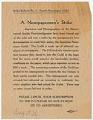
Seattle Newspaper Guild Strike Bulletin No. 1, August 1936
Spurred by "arbitrary" dismissals and assignment changes and other 'efficiency' moves" by the Seattle Post-Intelligencer, 35 newspaper writers went on strike from August 19 to November 29, 1936. This small group of strikers was able to force P-I owner William Randolph Hearst to recognize the union. Through the strike, the union was able to negotiate a 40-hour work week, originally…
ID Number:MS.COLL.1432
Date:1936
Photograph
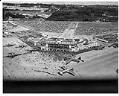
Aerial view of Sea-Tac Airport on opening day, July 9, 1949
In 1942, construction started on a new international airport between Seattle and Tacoma. The new airport, dubbed Sea-Tac, was formally dedicated on July 9, 1949. The airport cost $11 milliion and opened free of debt. United Airlines, Northwest Airlines, Pan American World Airways and Western Airlines started their regular passenger service at Sea-Tac on the day of the dedication.This July…
ID Number:PI20340
Date:1949