608 results for: Seattle Daily Times
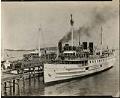
Photograph
Service men lined up on training ships, Seattle, 1918
In 1918 the U. S. government chartered the steamships Chippewa and Iroquois for service in World War I as school ships to be based at the Seattle Yacht Club buildings (recently purchased by the U. S. government) in West Seattle. William Jacob Grambs (1862-1943), previously an engineer at the Puget Sound Traction, Light & Power Company, was appointed supervisor of…
ID Number:2000.107.233.10.07
Date:1918
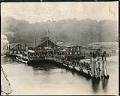
Photograph
Servicemen posing at naval training station, West Seattle, circa 1919
In 1918, the U. S. government chartered the steamships Chippewa and Iroquois for service in World War I as school ships to be based at the Seattle Yacht Club buildings in West Seattle. The yacht club had recently been purchased by the U. S. government for $3,000. William Jacob Grambs (1862-1943), previously an engineer at the Puget Sound Traction, Light…
ID Number:2000.107.233.10.09
Date:Circa 1919
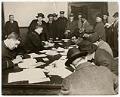
Photograph
Men registering as "Alien Enemies" at police station, Seattle, February 1918
Following the United States' entry into World War I, non-naturalized citizens, or "enemy aliens" by definition, were required to register with U. S. authorities in the interest of national security. This included all non-citizen males over the age of 14 and their wives, even those women born in the United States but married to non-citizens. The registration focused primarily on…
ID Number:2000.107.233.10.10
Date:1918
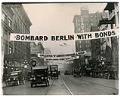
Photograph
Bonds banners across Second Ave., Seattle, October 1, 1918
During World War I, the United States began selling war bonds called Liberty bonds or Liberty loans to support the allied cause. Subscribing to the bonds became a symbol of patriotic duty in the U. S. and introduced the idea of financial securities to many citizens for the first time. The Act of Congress which authorized the Liberty Bonds is…
ID Number:2000.107.233.10.11
Date:1918
Photograph
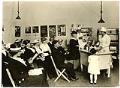
Cooking demonstration at war kitchen, Seattle, July 1918
In this image, demonstrations and advice are given to housewives and cooks on preparing food with the limited wartime rations. The "War Kitchen," as it was referred to, was located at the Central Building in downtown Seattle and supervised by Dorothy Shank, home economics instructor at the University of Washington, Mildred Thronburg, demonstrator, and Mrs. F. G. Stoner, special investigator.…
ID Number:2000.107.233.10.14
Date:1918
Photograph
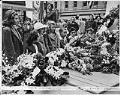
Children placing wreaths on Memorial Day, Seattle, May 30, 1945
In this image, children place wreaths at the foot of a pylon carrying the names of more than 1,000 King County residents killed in World War II. The ceremony took place during Memorial Day exercises held in Seattle's Victory Square, on University Street between Fourth and Fifth Avenues. The children are identified from left as: Gay Attebery, Barbee Scott, Ruth…
ID Number:2000.107.264.02.02
Date:1945
Photograph
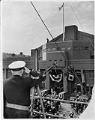
Dedication ceremony at Naval Reserve Armory on Lake Union, Seattle, July 4, 1942
In 1942 the Works Progress Administration built the Naval Reserve Armory on Lake Union as an Advanced Naval Training School during World War II. Designed by Seattle architects William R. Grant and B. Marcus Priteca, the building was decommissioned after the war, and disestablished in 1994. The building was renovated in 2012 to become the new home for the Museum…
ID Number:2000.107.270.09.01
Date:1942
Photograph
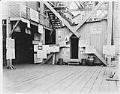
Campaign posters at Duthie shipyard, Seattle, June 26, 1918
John Frederick Duthie (1876-1945) was born in England and immigrated to the U. S. about 1887 with his parents and siblings. Around 1899 he moved to Seattle with his wife and the following year he opened a small shipyard, J. F. Duthie & Company, on land leased from the Port of Seattle, located on the Duwamish River's East Waterway, just…
ID Number:2001.67.3
Date:1918
Photograph
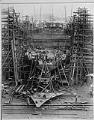
Employees working at Duthie shipyard, Seattle, October 18, 1918
John Frederick Duthie (1876-1945) was born in England and immigrated to the U. S. about 1887 with his parents and siblings. Around 1899 he moved to Seattle with his wife, and the following year he opened a small shipyard, J. F. Duthie & Company, on land leased from the Port of Seattle, located on the Duwamish River's East Waterway, just…
ID Number:2001.67.6
Date:1918
Ephemera
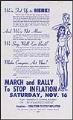
Flier for march and rally to stop inflation, Seattle, November 16, 1974
The United States went through a recession in the 1970s, with job loss and double-digit inflation. The Coalition to Stop Inflation called for a march on November 16th from the U.S. Courthouse at Fifth Avenue and Madison Street to a rally at Westlake Mall. This was to be but one of many such demonstrations held across the United States on…
ID Number:2002.23.1.25.3
Date:1974