608 results for: Seattle Daily Times
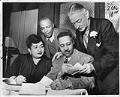
Photograph
Commercial Club officers discussing projects, Seattle, March 5, 1951
The East Madison Commercial Club organized in 1935 in order to improve Seattle's Madison Park neighborhood. In 1959 the club, by then known as the East Union - East Madison Commercial Club, merged with the Central Community Club.In this image the officers of the East Madison Commercial Club talk about upcoming club projects. The individuals are identified from left as…
ID Number:2000.107.170.25.06
Date:1951
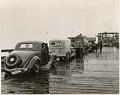
Photograph
Cars and passengers waiting at Fauntleroy ferry dock, Seattle, June 17, 1937
On May 28, 1937 passenger and automobile ferry service ceased on Puget Sound due to a union strike over labor disputes with the Washington Shipowners' Association. Twenty-five ferries were tied up during the 28-day strike, which ended after Washington State Governor Clarence D. Martin interceded.In this image cars lining the dock at the Fauntleroy Terminal in West Seattle wait for…
ID Number:2000.107.171.30.01
Date:1937
Photograph
Colman clock tower in water, Seattle, December 21, 1936
The Colman Dock has held a prominent place on Seattle's waterfront since it was built by Scottish engineer James Colman in 1882. It was rebuilt in 1889 after the Great Seattle Fire, then expanded in 1908 to include a domed waiting room and a 72-foot clock tower. Struck by the steamship Alameda in 1912, the clock tower fell into Puget…
ID Number:2000.107.171.30.02
Date:1936
Photograph
Fisherman's Terminal, Seattle, February 21, 1952
On May 17, 1952 the Port of Seattle's Fishermen's Terminal at Salmon Bay between the Interbay and Ballard neighborhoods was rededicated as the home of the Pacific Northwest fishing fleet after an expansion and modernization that allowed for moorage, drydock, repair, maintenance, and supply facilities for 1,000 vessels. This image of fishing boats docked at Fishermen's Terminal was taken facing…
ID Number:2000.107.171.31.01
Date:1952
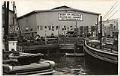
Photograph
Band playing at Fisherman's Festival, Seattle, September 19, 1937
This image was taken during a performance by the Seattle Symphonic Band at the Fisherman's Festival, held September 17-18, 1937, at the Port of Seattle's Fishermen's Terminal (then Fishermen's Dock) at Salmon Bay between the Interbay and Ballard neighborhoods. The large storage shed, visible behind the revelers, had recently been competed for fishermen to hang their nets and other gear…
ID Number:2000.107.171.31.02
Date:1937
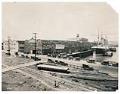
Photograph
Spokane Street terminal, Seattle, March 22, 1927
The creation of the Port of Seattle in 1911 transformed a messy jumble of privately-owned and competing waterfront companies into a publicly owned and organized entity capable of propelling Seattle into a major center for trade. In 1915 the Port constructed the Spokane Street Terminal at Pier 24 (now Terminal 30), on the Duwamish East Waterway, in what is now…
ID Number:2000.107.171.38.01
Date:1927
Photograph
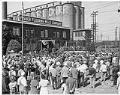
Employees watching awards ceremony at Fisher Flouring Mills, Seattle, September 8, 1944
The Fisher Flouring Mills was one of the first industrial businesses to open on Harbor Island, located in Seattle's Elliott Bay at the mouth of the Duwamish waterway, after construction of the artificial island was completed in 1909. In 1926, founding brothers Orin Wallace Fisher (1891–1979) and Oliver David Fisher (1875-1967) began a radio station (now KOMO and part of…
ID Number:2000.107.172.34.05
Date:1944
Photograph
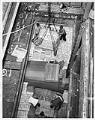
Employees loading bags of bulgur at Fisher Flouring Mills, Seattle, July 24, 1961
In different administrative and organizational forms, the Food for Peace program of the United States has provided food assistance around the world since President Dwight D. Eisenhower signed the Agricultural Trade Development and Assistance Act, or Public Law (P.L.) 480, in 1954. Initially a means to donate surplus U.S. commodities, the U.S. government now purchases food from American farmers through…
ID Number:2000.107.172.34.06
Date:1961
Photograph
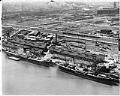
Aerial view of Foreign Trade Zone, Seattle, September 21, 1949
Foreign-Trade Zones (FTZs) are duty-free, quota-free, secured areas in a designated customs “port of entry,” considered outside U. S. Customs territory and exempt from customs tariffs. The FTZ program was established in 1934 to stimulate economic growth and development in the United States by lowering the cost of international trade.This image shows two ships docked at Seattle's FTZ: the French…
ID Number:2000.107.173.01.03
Date:1949
Photograph
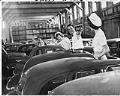
Employees with imported cars at Foreign Trade Zone, Seattle, April 20, 1950
Foreign-Trade Zones (FTZs) are duty-free, quota-free, secured areas in a designated customs “port of entry,” considered outside U. S. Customs territory and exempt from customs tariffs. The FTZ program was established in 1934 to stimulate economic growth and development in the United States by lowering the cost of international trade.In this image, from left, Robert Edwards, Rose Schnoberger, Bruce Williams,…
ID Number:2000.107.173.01.04
Date:1950