365 results for: Discrimination
Ephemera
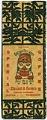
Golden Potlatch themed coffee bag, 1912
The Tilikums of Elttaes were a fraternal, civic organization composed primarily of influential white Seattle area businessmen, who used Native American imagery to promote tourism and the economic development of the city. In July 1911 the Tilikums ("Friends" in Chinook Jargon; Elttaes is Seattle spelled backward) organized the first Golden Potlatch celebration. The Golden Potlatch was a city-wide festival held…
ID Number:2018.3.3.39
Date:1912
Ephemera
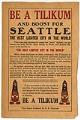
Golden Potlatch advertisement, 1913
The Tilikums of Elttaes were a fraternal, civic organization composed primarily of influential white Seattle area businessmen, who used Native American imagery to promote tourism and the economic development of the city. In July 1911 the Tilikums ("Friends" in Chinook Jargon; Elttaes is Seattle spelled backward) organized the first Golden Potlatch celebration. The Golden Potlatch was a city-wide festival held…
ID Number:2018.3.3.42
Date:1913
Ephemera
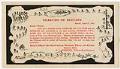
Tilikums of Elttaes invitation, 1912
The Tilikums of Elttaes were a fraternal, civic organization composed primarily of influential white Seattle area businessmen, who used Native American imagery to promote tourism and the economic development of the city. In July 1911 the Tilikums ("Friends" in Chinook Jargon; Elttaes is Seattle spelled backward) organized the first Golden Potlatch celebration. The Golden Potlatch was a city-wide festival held…
ID Number:2018.3.3.43
Date:1912
Program
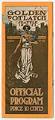
Golden Potlatch program, 1911
The Tilikums of Elttaes were a fraternal, civic organization composed primarily of influential white Seattle area businessmen, who used Native American imagery to promote tourism and the economic development of the city. In July 1911 the Tilikums ("Friends" in Chinook Jargon; Elttaes is Seattle spelled backward) organized the first Golden Potlatch celebration. The Golden Potlatch was a city-wide festival held…
ID Number:2018.3.3.44
Date:1911
Postcard
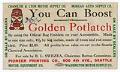
Golden Potlatch booster advertisement, 1912
The Tilikums of Elttaes were a fraternal, civic organization composed primarily of influential white Seattle area businessmen, who used Native American imagery to promote tourism and the economic development of the city. In July 1911 the Tilikums ("Friends" in Chinook Jargon; Elttaes is Seattle spelled backward) organized the first Golden Potlatch celebration. The Golden Potlatch was a city-wide festival held…
ID Number:2018.3.3.45
Date:1912
Ephemera
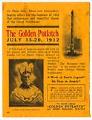
Golden Potlatch advertisement, 1912
The Tilikums of Elttaes were a fraternal, civic organization composed primarily of influential white Seattle area businessmen, who used Native American imagery to promote tourism and the economic development of the city. In July 1911 the Tilikums ("Friends" in Chinook Jargon; Elttaes is Seattle spelled backward) organized the first Golden Potlatch celebration. The Golden Potlatch was a city-wide festival held…
ID Number:2018.3.3.46
Date:1912
Document
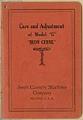
Care and Adjustment of Model "G" "Iron Chink," circa 1906
In 1903, Seattle inventor Edmund A. Smith (1870-1909) developed a machine that gutted and cleaned salmon for canning 55 times faster than human workers. Most Northwest cannery workers were Chinese immigrants, and Smith, with "unselfconscious racism" (in the words of historian Carlos Schwantes), called his invention the "Iron Chink." The innovation increased cannery profits, but forced thousands of people to…
ID Number:2018.3.3.128
Date:Circa 1906
Photograph
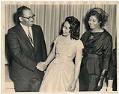
Rev. Samuel McKinney, Coretta Scott King, and Louise McKinney, Seattle, November 1961
Rev. Samuel B. McKinney, pastor of Mount Zion Baptist Church, invited his friend and former classmate Dr. Martin Luther King, Jr. to speak in Seattle in 1961. Dr. King arrived in Seattle on November 8, spoke at UW's Meany Hall and the Temple de Hirsch on November 9, and Garfield High School and the Eagles Auditorium on November 10. Afterward,…
ID Number:2018.10.7
Date:1961
Ephemera
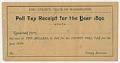
Poll tax receipt, King County, 1890
The poll tax, an annual levy on voting, was a major source of revenue for states and municipalities in the late 19th and early 20th centuries. The tax was a flat fee on voter registration, regardless of income. In practice, poll taxes suppressed the vote of low-income people who could not afford the fee.In 1854, Washington Territory levied its first…
ID Number:2019.3.81
Date:1890
Ephemera
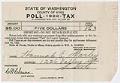
Hannah E. Marley poll tax receipt, King County, 1922
The poll tax, an annual levy on voting, was a major source of revenue for states and municipalities in the late 19th and early 20th centuries. The tax was a flat fee on voter registration, regardless of income. In practice, poll taxes suppressed the vote of low-income people who could not afford the fee.In 1854, Washington Territory levied its first…
ID Number:2019.3.82
Date:1922