3506 results for: Seattle Photographic Co.
Photograph
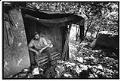
Man sitting in temporary shelter, Seattle, May 1, 1991
In this image Tony, a resident of "The Ranch," a tent city temporarily located on Beacon Hill in Seattle, sits in the doorway of his makeshift home. The Ranch was made up of seven huts constructed of scavenged wood and plastic built in a wooded area near South Dearborn Street and 12th Avenue South. Caption information written by Post-Intelligencer staff…
ID Number:2000.107.257.11.07
Date:1991
Photograph
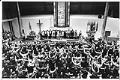
Participants sing at service honoring Martin Luther King, Jr., Seattle, January 15, 1985
In this image, hundreds of people attending a service in honor of Martin Luther King, Jr. join hands as they sing "We Shall Overcome" at Mount Zion Baptist Church in Seattle, on what would have been Dr. King's 56th birthday. Caption information written by Post-Intelligencer staff and attached to the back of the photograph.
ID Number:2000.107.260.01.01
Date:1985
Photograph
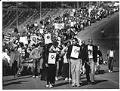
Marchers walking in tribute on Martin Luther King. Jr. Day , Seattle, January 21, 1991
In this image marchers in Seattle walk down Martin Luther King Jr. Way from Garfield High School to Rainier Valley on Martin Luther King Jr. Day. Caption information written by Post-Intelligencer staff and attached to the back of the photograph.
ID Number:2000.107.260.01.02
Date:1991
Photograph
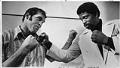
Boxers Boone Kirkman and Ron Lyle, Seattle, August 26, 1974
Heavyweight boxer Daniel Victor "Boone" Kirkman (1945-) earned his nickname from his father during his childhood in Washington State, where he liked to hike, fish, hunt, and observe plants and animals. Kirkman grew up in Renton, and at age 14 began commuting to Seattle's Cherry Street gym to train in boxing. Kirkman slowly built a reputation at local events, and…
ID Number:2000.107.260.01.03
Date:1974
Photograph
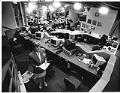
Susan Hutchison preparing for news broadcast, Seattle, January 21, 1993
In this image Seattle's KIRO-TV news anchor Susan (Sylvester) Hutchison (1954-) stands in the news room, ready for an afternoon broadcast. The show had just announced a new format that would allow anchors to move around while delivering the news instead of remaining seated at a desk. Ms. Hutchinson worked for KIRO from 1981-2002, and was Chair of the Washington…
ID Number:2000.107.260.01.04
Date:1993
Photograph
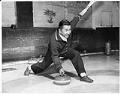
Kearney Kozai with curling stone at the Granite Curling Club, Seattle, January 1960
Born in Oahu, Hawaii, to Japanese-immigrant parents, Kearney Kozai (1925-1990), moved to Seattle with his wife, Betty, in the 1950s, after having served in the Army during World War II. An engineer at the Boeing Co., Mr. Kozai became fascinated by the sport of curling shortly after his arrival in the city. In 1961, Mr. Kozai helped build the Granite…
ID Number:2000.107.260.08.01
Date:1960
Photograph
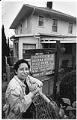
Beatrice LaFramboise outside Providence Regina House food bank, Seattle, November 4, 1986
In this image, Sister Beatrice LaFramboise, director of the Providence Regina House food bank, leans on the fence outside the Seattle facility. The Sisters of Providence have been operating a weekly food and clothing bank out of the South Park Neighborhood Center since 1963. Caption information source: The Seattle Times, November 13, 1989, p. B3.Caption information also derived from captions…
ID Number:2000.107.260.09.01
Date:1986
Photograph
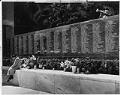
Woman sitting at Seattle War Memorial, Seattle, May 30, 1951
This image of a woman sitting at the Seattle War Memorial Plaza on Fourth Avenue was taken as a VWF (Veterans of Foreign Wars of the US) bugler calls "Taps" on Memorial Day. The woman is identified as a Gold Star mother, a woman entitled to display a gold star on a service flag, due to being the mother of…
ID Number:2000.107.264.02.01
Date:1951
Photograph
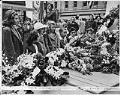
Children placing wreaths on Memorial Day, Seattle, May 30, 1945
In this image, children place wreaths at the foot of a pylon carrying the names of more than 1,000 King County residents killed in World War II. The ceremony took place during Memorial Day exercises held in Seattle's Victory Square, on University Street between Fourth and Fifth Avenues. The children are identified from left as: Gay Attebery, Barbee Scott, Ruth…
ID Number:2000.107.264.02.02
Date:1945
Photograph
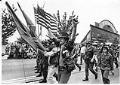
Vietnam veterans marching in Memorial Day parade, Seattle, May 27, 1985
In this image, a Vietnam veteran raises his fists in salute as he and about 100 other Vietnam veterans march down Alaskan Way in a Memorial Day parade. Beginning at Myrtle Edwards Park, various dignitaries, politicians, men in Civil War uniforms, square dancers, Navy bands, Army drill teams, and veterans' groups marched along Seattle's waterfront, ending at the Seattle War…
ID Number:2000.107.264.02.03
Date:1985