3246 results for: Seattle Post-Intelligencer, The
Photograph
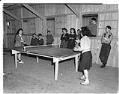
Incarcerees playing table tennis at the Puyallup Assembly Center, Puyallup, 1942
In the spring of 1942, persons of Japanese descent living on the West Coast were forcibly removed by the US Army into temporary "assembly centers" while permanent incarceration camps were built. The Puyallup Assembly Center, euphemistically named “Camp Harmony," was hastily constructed at the Washington State fairgrounds, and temporarily housed over 7,000 residents of Seattle, Tacoma, and Alaska.During their confinement,…
ID Number:1986.5.6681.13
Date:1942
Photograph
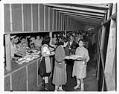
Food line at the Puyallup Assembly Center, Puyallup, 1942
In the spring of 1942, persons of Japanese descent living on the West Coast were forcibly removed by the US Army into assembly centers while permanent incarceration camps were built. The Puyallup Assembly Center, euphemistically named "Camp Harmony," was hastily constructed at the Washington state fairgrounds in Puyallup and temporarily housed over 7,000 residents from Seattle, Tacoma and Alaska.In order…
ID Number:1986.5.6681.16
Date:1942
Photograph
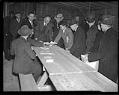
Incarcerees registering at the Puyallup Assembly Center, Puyallup, 1942
In the spring of 1942, persons of Japanese descent living on the West Coast were forcibly removed by the US Army into temporary "assembly centers" while permanent incarceration camps were built. The Puyallup Assembly Center, euphemistically named “Camp Harmony," was hastily constructed at the Washington State fairgrounds, and temporarily housed over 7,000 residents of Seattle, Tacoma, and Alaska.This photo depicts…
ID Number:1986.5.6682.1
Date:1942
Photograph
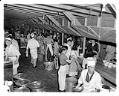
Incarcerees working in kitchen at the Puyallup Assembly Center, Puyallup, 1942
In the spring of 1942, persons of Japanese descent living on the West Coast were forcibly removed by the US Army into temporary "assembly centers" while permanent incarceration camps were built. The Puyallup Assembly Center, euphemistically named “Camp Harmony," was hastily constructed at the Washington State fairgrounds, and temporarily housed over 7,000 residents of Seattle, Tacoma, and Alaska.In order to…
ID Number:1986.5.6682.3
Date:1942
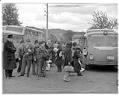
Photograph
Incarcerees arriving on buses at the Puyallup Assembly Center, Puyallup, 1942
In the spring of 1942, persons of Japanese descent living on the West Coast were forcibly removed by the US Army into temporary "assembly centers" while permanent incarceration camps were built. The Puyallup Assembly Center, euphemistically named “Camp Harmony," was hastily constructed at the Washington State fairgrounds, and temporarily housed over 7,000 residents of Seattle, Tacoma, and Alaska.Buses transported incarcerees…
ID Number:1986.5.6682.4
Date:1942
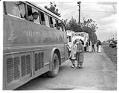
Photograph
Busload of incarcerees arriving at the Puyallup Assembly Center, Puyallup, 1942
In the spring of 1942, persons of Japanese descent living on the West Coast were forcibly removed by the US Army to assembly centers while permanent incarceration camps were built. The Puyallup Assembly Center, euphemistically named "Camp Harmony," was hastily constructed at the Washington State fairgrounds in Puyallup and temporarily housed over 7,000 residents of Seattle, Tacoma and Alaska. Buses…
ID Number:1986.5.6682.5
Date:1942
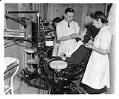
Photograph
Woman receiving dental care at the Puyallup Assembly Center, Puyallup, 1942
In the spring of 1942, persons of Japanese descent living on the West Coast were forcibly removed by the US Army into "assembly centers" while permanent incarceration camps were built. The Puyallup Assembly Center, euphemistically named "Camp Harmony," was hastily constructed at the Washington State fairgrounds in Puyallup and temporarily housed over 7,000 residents of Seattle, Tacoma and Alaska. This…
ID Number:1986.5.6682.6
Date:1942
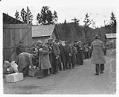
Photograph
Men outside barracks, Civilian Conservation Corps, Longmire, circa 1937
Part of President Franklin D. Roosevelt's New Deal legislation, the Civilian Conservation Corps (CCC) was a government work relief program that employed about 3 million men age 18 to 25 from 1933 until 1942. CCC jobs were generally manual labor, and focused on the conservation and development of parks and other natural resources throughout the United States. Camp Sunshine Point,…
ID Number:1986.5.6728.1
Date:Circa 1937
Photograph
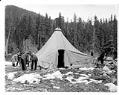
Men setting up tent at campsite, Civilian Conservation Corps, Longmire, circa 1937
Part of President Franklin D. Roosevelt's New Deal legislation, the Civilian Conservation Corps (CCC) was a government work relief program that employed about 3 million men age 18 to 25 from 1933 until 1942. CCC jobs were generally manual labor, and focused primarily on the conservation and development of parks and other natural resources throughout the United States. The men…
ID Number:1986.5.6728.2
Date:Circa 1937
Photograph
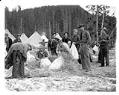
Men stuffing mattresses for camp, Civilian Conservation Corps, Longmire, circa 1937
Part of President Franklin D. Roosevelt's New Deal legislation, the Civilian Conservation Corps (CCC) was a government work relief program that employed about 3 million men age 18 to 25 from 1933 until 1942. Camp Sunshine Point, located near Longmire in Mount Rainier National Park, housed participants for six months to a year. The primary focus was on reforestation in…
ID Number:1986.5.6728.3
Date:Circa 1937